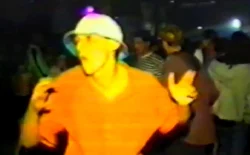
New music is all well and good, but there’s room in our hearts for the old stuff too.
Never more so than in 2008, a year in which even self-styled futurists seemed to get teary eyed with nostalgia. In addition to the ‘92 hardcore homages, the ever-growing series of Don’t Look Back gigs and a worrying trend for has-beens to reform for festival headline spots, a number of musically-passionate independent labels have re-packaged and re-released classic albums and previously unheard tracks by artists truly deserving of a second chance to have their music heard, and enjoyed, by a larger audience.
The best of these sounded as vital – and prescient – now as when they were first made. From the mesmerizing ambient soundcapes of Wolfgang Voigt’s GAS and Aphex Twin’s Selected Ambient Works to the exuberant ‘anything goes’ funk compiled by labels like Soundway and Analog Africa, via the wired experimentalism of Delia Derbyshire’s Radiophonic Workshop and the pop genius of ‘outsider’ disco auteur Arthur Russell and troubled Beach Boy Dennis Wilson, these are our 20 best re-issues of 2008.

20: SHINING
IN THE KINGDOM OF KITSCH… / GRINDSTONE
(RUNE GRAMMOFON)
There’s also a black metal Shining, but this one is the child of Jorgen Munkeby, who rolls with the Horntevth brothers in Jaga (formally Jaga Jazzist). Jaga’s What We Must (2005) saw that collective pushing darker, Slint-ier pursuits, but Shining took that ball and ran with it in about a hundred different directions with these two albums on Rune Grammofon, previously unavailable on vinyl. Freak-jazz madness that sounds more like Disco Volante than Bitches Brew, and comes hugely recommended.

19: ORCHESTRE POLY-RHYTHMO DE COTONOU
THE VODOUN EFFECT
(ANALOG AFRICA)
Our ‘08 highlight from the excellent Analog Africa, we first heard this lot on the label’s African Scream Contest compilation, and The Vodoun Effect proved a no less joyous exploration of Benin funk. The production is almost shockingly good, considering that the originals were just done on a Nagra (Swiss-made reel-to-reel recorder) in someone’s house with a couple of microphones and an engineer sent from the national radio station, and the deluxe inlay – full of obscure record sleeves from the period – appealed to our inner (well, outer) record geeks like no other.

18: GORE
HART GORE / MEAN MAN’S DREAM
(SOUTHERN LORD / FSS)
Originally released by Fundamental/Esksakt, we’d like to say we were already up on Gore and welcomed these re-issues. We weren’t. But we were promptly blown away by the Netherlands trio’s brand of hard, pounding noise that precursors post-eighties heaviness touchstones like Slint, Pan Sonic and SunnO))) and provides the perfect accompaniment to the previously untouchable power electronics of eighties Swans.

17: PHILIP GLASS
GLASS BOX: A NONESUCH RETROSPECTIVE
(NONESUCH)
You’ve got to love Philip Glass. Though his career is not without its blips and commercial cop-outs (remember his score for The Truman Show?), it’s also a career characterized by a vivid grasp of colour and style, a thirst for border-crashing collaboration, and an understanding of the shared creative terrain between pop, experimental and modern classical music. Like his contemporaries Steve Reich and Terry Riley, Glass imbues his minimalism with a range and romanticism that’s awfully addictive.
The Glass Box is a whopping 10-CD set, and it zones in on the most important works in Glass’s oeuvre – from the early masterpiece Music in Contrary Motion, to his ravishing and (believe it or not) not at all patience-testing opera, Einstein on The Beach; his score for Francis Ford Coppola’s Dracula movie is an unexpected highlight also. Really, though, it’s all about the Kronos Quartet’s performances of Glass’s aching string quartets, and the terrific studio album Glassworks – which includes ‘Floe’, sampled to wonderful effect by Ricardo Villalbos on the For Disco 12″ track ‘485U’.

16: TUBEWAY ARMY
REPLICAS REDUX
(BEGGARS BANQUET)
Gary Numan famously remarked that he had added electronics to the first Tubeway Army record as an afterthought when he had found a synthesizer lying around in the recording studio. On some of Replicas‘ tracks, synthesizers still seem to be supplements adding a sleazy veneer to a distortion pedal-dominated new wave sound. But the best, and most unique, tracks are those on which the electronics dominate.
On his melancholic masterpiece, ‘Down In The Park’, sweeping dry-ice synthesizers magisterially paint a neon lit near future stalked by pitiless human-machine hybrids. The line, “you can watch the humans trying to run” is perhaps the most succinct expression of Numan’s android identification, a casually provocative indication of his remoteness from human fellow feeling. But, despite this pose as a cold observer of atrocity, Numan’s android is not emotionless so much as disaffected, and even in its number one hit, ‘Are ‘Friends’ Electric?’, Replicas is saturated by a mood of terrible sadness.

15: DERRICK MAY
INNOVATOR
(R&S)
One of the best ways to get to what is distinctive about Derrick May’s music is to contrast it with the work of his friend and collaborator in the first wave of Detroit Techno, Juan Atkins, whose Model 500 were also compiled this year on R&S’s Classics.
Whereas Model 500 are a kind of technological upgrade of English-originating synth-pop, May’s tunes – serene, stately – seem to come from another lineage altogether: instead of Numan or John Foxx, they recall minimalist experimentalists like Steve Reich or ultra smooth Herbie Hancock-style electronic jazz. May himself described his sound as “23rd century ballroom music”, and even though Innovator’s tracks are highly effective at moving a crowd, listened to at home they take on a strangely solitary quality: as if this were a computer simulation of those future ballrooms, magnificent, opulent, magisterial, but as yet uninhabited.

14: MOUNT VERNON ARTS LAB
THE SÉANCE AT HOBS LANE
(GHOST BOX)
Ghost Box wasn’t the first musical collective to draw inspiration from creaky British sci-fi, the BBC Radiophonic Orchestra, and the curious relationships that exist between people and place, past and present, reality and mythology: Mount Vernon Arts Lab, a musical project conceived by Drew Mulholland, plucks its imagery and psychic energy from similar oddballs and curveballs of our post-war cultural heritage, and feeds them into a sound-world where fact and fiction, old and new, coincide. MVA’s second album, Séance At Hobs Lane, first released in 2001 on the Via Satellite label, was given a welcome reissue by Ghost Box earlier this year. Seeing Séance at Hobs Lane adorned in a House-designed Ghost Box sleeve feels so natural it’s almost – ha – uncanny. Indeed, this isn’t so much a reissue as a homecoming.

13: BASIC CHANNEL
BCD-2
(BASIC CHANNEL)
With modern-day labels like Modern Love, Mojuba, Meanwhile, Punch Drunk and Hessle Audio building on the classic dub-techno sound, not to mention elder statesmen GAS and Pole receiving the deluxe reissue treatment, it was fitting that Basic Channel re-issued their BCD-2 to remind us of their originating role. Collecting some of their best and best-loved works – including ‘Phylyps Track’ and ‘Octagon’, BCD-2 captures a moment when techno turned in on itself and modern music was changed forever.

12: POLE
1 / 2 / 3
(SCAPE)
On this groundbreaking trilogy of albums from turn-of-the-millennium Berlin, Stefan Betke, a.k.a Pole, dispensed with drums in favour of the rhythmic pulses and crackles of a broken Waldorf 4-pole analogue filter, influencing a host of minimal techno, glitch, electronica and dubstep producers along the way. With their primary-colour sleeves and reduced sonic palette, it’s definitely a case of less-is-more. Less ‘clubby’ than dubstep, but no less vital: a welcome reissue.

11: V/A / SOUL JAZZ
AN ENGLAND STORY
(SOUL JAZZ)
Props also go to their excellent Rise of Jamaican Dancehall compilation, but our Soul Jazz pick of the year had to be this, a condensed, properly-released version of The Heatwave’s Blogariddims mix that traced the lineage of UK MCing from the early-mid 80s bliss of Papa Levi and Tippa Irie, through early 90s hip-hop from groups like London Posse, including Blak Twang’s stunning ‘Red Letters’, into modern yard-grime classics like Riko’s vocal of Wiley’s ‘Ice Rink’ and Doctor and Daviche’s ‘Gotta Man’.

10: ROBERT WYATT
DRURY LANE THROUGH CUCKOOLAND
(DOMINO)
Having made several albums of forward-thinking prog-cum-psychedelia with Soft Machine, Wyatt left the band in 1971 having already released his first solo album, End of an Ear. In 1973, inebriated at a party, he fell from a third floor window; paralysed from the waist down, he has been confined to a wheechair ever since.
His first landmark solo record was Rock Bottom (1974), and it’s with this that the Domino re-issue programme begins. A disarmingly beautiful song-cycle recorded at a time of great personal upheaval and hardship, Rock Bottom is a very English kind of soul record on which Wyatt was assisted by Mike Oldfied, Henry Cow’s Fred Frith and the poet Ivor Cutler – for our money it’s one of the best albums ever made, no joke. Ruth Is Stranger Than Richard (1975) is an exquisite work of mature pastoral psychedelia, remarkable for its odd time signatures and beautiful ensemble playing; Brian Eno contributes guitar, synthesizer and “direct-inject anti-jazz raygun”.
Then came Nothing Can Stop Us (1981), a collection of politically resonant cover versions – including a heart-stopping rendition of Chic’s ‘I’m Free’, and ‘Auraco’, derived from Chilean protests at the arrival of Pinochet. Wyatt’s first “proper” LP in a decade was Old Rottenhat (1985); the follow-up, Dondestan (1991), is considered his best work since Rock Bottom, and was “remixed and reappraised” in 1998 for Dondestan Revisited. Shleep (1997) is Wyatt’s sunniest, most musically vivid record to date, and features a star-studded cast of collaborators, including Eno, Evan Parker, Phil Manzanera and Paul Weller. It was followed by another career highlight, Cuckooland (2003), which introduced him to a whole new generation of admirers and sowed the seeds for his most recent artist album, Comicopera (2008).
In making all these albums – not to mention the rare as hen’s teeth EPs – readily available again, Domino are giving all of us the opportunity to better acquaint ourselves with one of Britain’s greatest ever recording artists. Do yourself a favour and take that opportunity.

09: BBC RADIOPHONIC WORKSHOP
A RETROSPECTIVE
(THE GREY AREA)
Although many of the pieces that make up the Radiophonic Retrospective work perfectly well as music – Delia Derbyshire’s contributions in particular establish her as a masterly composer of eerie and sombre electronica – it’s important to remember that these weren’t supposed to be listened to in their own right, but as embedded, functional sound.
The members of the Workshop were public servants as much as they were artists and musicians (to the extent that Derbyshire was never credited for the brilliant original Dr Who theme), and at a time when the BBC has lost its way, the example of the Radiophonic Workshop gives the lie to the notion that public funding necessarily leads to drabness.

08: PAVEMENT
BRIGHTEN THE CORNERS: NICENE CREEDENCE EDITION
(MATADOR)
An unfairly neglected younger brother to Slanted and Enchanted and Crooked Rain, Crooked Rain, Pavement’s penultimate album Brighten the Corners may have featured the band in the midst of their demise, but if it wasn’t their best full-length then it was certainly their last great one. Look, you’re reading about music on the internet. Me telling you Pavement are good is about as redundant as telling you to check out some album called Loveless or to think about starting a blog.

07: THE PRODIGY
EXPERIENCE EXPANDED: B-SIDES AND REMIXES
(XL)
Originally conceived as some kind of ill-advised concept album, The Prodigy’s Experience instead motion captures rave in the midst of its exhilarating, anti-climatic plateau. Experience has the feel of an expert DJ set, with moments of rest and respite amidst the inhumanly hectic forward motion. What we hear rushing past at hyperspeed is the gene (or genre) pool of so much of the hardcore continuum to come – a mobile library of embryonic forms, still seething with mutagenic potential.
The title of their second LP – Music For The Jilted Generation – and its closing three track ‘narcotic suite’ flag a rockist turn to the portentous. It sells incredibly well, its massive success a foretaste of the no future to come – soon after, it would be lads’ mags, Britpop, and ‘dance music’ broken down to one more style in the colourless, dissolute spectacle of the corporate rock festival. And rave? It was already yesterday’s dream.

06: LIQUID LIQUID
SLIP IN AND OUT OF PHENOMENON
(DOMINO)
In the last five years, thanks mainly due to dance floor taste-makers like DFA and Optimo, Liquid Liquid have gone from post-punk obscurities to cultural touchstones, and given the current climate where anything and everything gets re-issued (usually in a popcorn box with a signed toe-nail clipping to boot), it’s frankly pretty shocking that it took this long for Liquid Liquid’s first three EPs to become widely re-available.
But thanks to Domino, here they are; all glorious rhythm section and punk-funk chords that expertly bind 70s punk to 90s electronica, while a thousand kids with Rapidshare accounts pretend that they knew about Young’s merry band all along.

05: A GUY CALLED GERALD
BLACK SECRET TECHNOLOGY
(A GUY CALLED GERALD MUSIC)
In a year that saw contemporary artists commemorating and reimagining the hardcore sound of the early 90 with starlting efficacy and affection – step forward Zomby and HATE – the reissue of Black Secret Technology was nothing if not timely.
A Guy Called Gerald is of course Gerald Simpson, best known for his place in the early line-up of 808 State (he left shortly before they went shit) and his acid house anthem ‘Voodoo Ray’. A slightly lesser-known but no less important contribution to British dance music was Black Secret Technology, a maudlin masterpiece of scuzzy breakbeats and grainy atmospherics which anticipates not only jungle but also the mood and sound design of Burial’s rain-swept garage. On Black Secret Technology Simpson proved that that dance music could be a site of spiritual restlessness, yearning and dislocation as well as wide-eyed bliss and self-annihilating hedonism.

04. DENNIS WILSON
PACIFIC OCEAN BLUE: LEGACY EDITION
(CARIBOU)
People always talk about Pacific Ocean Blue being a “lost” album, “impossible to find”, etc . But I managed to download if off Soulseek three years back, and I saw them selling a bootleg down my local market when I was a teenager, so it’s obviously not that much of a curate’s egg.
As such, what was great about this re-issue wasn’t so much any great sense of discovery – though first-timers will doubtless feel that thrill – as the lavishness of the 3xLP package. Wilson is invariably painted as a lost soul, the least talented Beach Boy (well, they were a talented bunch) and famously the only one of ’em that could actually surf.
Whatever. What I love about Pacific Ocean Blue to this day is its sheer bombast – this is big-bollocked, coke-addled 1970s music, conceived and executed on a grand, no, ludicrous, scale. Need a couple of backing vocalists? Yeah. OK, let’s get twenty in. That’s not enough? OK, let’s get those twenty, plus The Double Rock Baptist Choir. Enough? OK. Accordion, horn section, reed section, guitars, harp, percussion, wait – you want a harp as well? Sure thing. Wilson and his co-conspirators literally chuck in everything and the kitchen sink.
There’s so much musical input, so to speak, that Pacific Ocean Blue is more than anything a triumph or arrangement and organization: so take a bow, Carli Munoz, Gregg Jakobson, John Hanlon, Jimmy Haskell and Sid Sharp. Anyway, if you’ve not heard ‘River Song’, surely the most over-the-top, life-affirming song ever committed to tape, you really ought to – listening to it really loud is basically like taking an E, but better. Much is made of Wilson’s dalliance with the dark side: getting mixed up with the Manson gang, bad vibes and bad drugs, and drowning tragically in 1983. But while there’s a decidedly rueful undercurrent to Pacific Ocean Blue, it’s no portent of doom; rather, it’s a near-nuclear explosion of vivacity and rapture.

03. APHEX TWIN
SELECTED AMBIENT WORKS 85–92 / CLASSICS
(R&S)
The re-launch of Belgium’s R&S label prompted the re-release of these two classic Richard D James collections. Unlike those of, say, GAS, the world hardly needed reminding that these records exist, but who cares? Selected Ambient Works in particular is an album so inexhaustibly wonderful that it should be reissued every year.
Assembling early Aphex tracks produced on modified and home-made equipment in his native Cornwall, James is deliberately provocative in the title he gives the collection: for if any of these tracks really do originate from 1985, he basically invented acid house three years early. For my money, ‘Tha’ is just about the greatest piece of music ever recorded, but there’s no limit to the thrills and spills on offer: from the vampy rave (not so ambient after all) of ‘Ptolemy’ and ‘Willy Wonka’-sampling ‘We Are The Music Makers’, these tunes are truly the shit.
Classics, meanwhile, provides exactly what it says on the tin – find me any pair of tracks that summon the ecstatic, cosmos-compressing power of rave quite so magnificently as ‘Didgeridoo’ and ‘Polynomial-C’ and I will literally cut my dick off and eat it.

02: ARTHUR RUSSELL
LOVE IS OVERTAKING ME
(AUDIKA)
Russell’s reverb-laden studio work always had a disarming rawness to it, so you’d think his demos would be even scratchier – but thanks to fresh mixing and restoration work by Grizzly Bear’s Chris Taylor, these recordings, made between 1970 and 1991, are full-bodied and vivid.
They’re also surprisingly accessible and, by Russell’s standards, conventional. Most often they summon the AM-rock of Tom Petty or On The Beach-era Neil Young. ‘Time Away’, though, is pure VU-meets-Pavement. The contents of Love Is Overtaking Me might not be as important as the avant-dub and disco experiments which Russell remains best known for, but they’re similarly odd, engrossing and essential.

01: GAS
NAH UND FERN / WOLFGANG VOIGT: GAS
(KOMPAKT / RASTER-NOTON)
Kompakt’s Nah Und Fern was a significant reissue for us because it was genuinely illuminating: though we were aware of Wolfgang Voigt’s work under the guise of GAS, in truth we were only faintly acquainted with it, in part because original copies of his 12″s and LPs were, and remain, pretty hard to come by.
Kompakt’s Nah Und Fern consisted of GAS’s four proper studio albums remastered on CD. These records – GAS (1996), Zauberberg (1997), Konigsforst (1998) and Pop (2000) – represent not just a highly accomplished body of work from one of electronic music’s most enduring characters, but also a singular aesthetic, a unique mythology; in short, they contain a world within them.
More from Features



![Ryoji Ikeda installation data-cosm [n°1] extended at 180 Studios until 1 February, 2026](https://factmag-images.s3.amazonaws.com/wp-content/uploads/2025/12/data-cosm-ALubbock_180-14Oct-3554-250x155.webp)
![180 Studios presents new Ryoji Ikeda installation, data-cosm [n°1]](https://factmag-images.s3.amazonaws.com/wp-content/uploads/2025/10/ryoji-ikeda-data-cosm-1-250x155.webp)