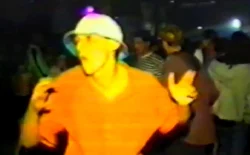
Montreal, especially if you haven’t been before, and even more especially if you’re jetlagged to hell, has a way of messing with your preconceptions.
Everywhere you look there’s a strange melding of the North American (the way the streets look, the fondness for shouting, the dominance of processed cheese) and the continental European (the love of bicycles and cigarettes, the speaking French), with the addition of a borderline Scottish approach to drinking just to confuse matters further.
There are strip bars everywhere (tatty old-school ones, not glossy Spearmint Rhino chains), most particularly in the part of town where all the MUTEK events took place, and heavy metal and punk are by far the most visible subcultures, although there’s clearly a thriving hip hop culture as well – if the quite staggering quantity of high-quality graffiti in even the most inaccessible spots is anything to go by. It’s pretty cheerfully cosmopolitan, too: you’ll see groups of old Greek or Portuguese men sat outside their social clubs chatting away in French, the most famous food outlets are Jewish delis, and it took me a little while to get used to all the elderly Chinese people dressed in the North American OAP’s uniform of golfing slacks and pastel leisurewear.
I’m not trying to be exoticist here. None of this is “weird” or even worthy of comment in and of itself, it just is what it is. But for anyone more used to conventionally European or American cities, these unfamiliar juxtapositions have a way of making you ready to do a double-take at any point. And that’s probably quite a healthy way of being when you’re about to glut on electronic music for five days. It’s so easy to get blasé at these internationalist art-rave beanfeasts that having the locality confound your expectations and put you in a mood to not take even small things for granted is definitely a good thing.
No matter how academic their approaches or how broad their appeal might be, there is something so fantastically “other” about Matmos.
What was most wonderful about MUTEK was that some of the most abstract sets of the week actually created the best crowd buzz – even better than many of the more supposedly immediate dancefloor acts, in fact. Matmos, playing in the Monument National theatre on the first night, were a case in point. Playing to a rapt audience in the smart theatre venue, fifteen years into their career, the duo could have felt like they were settling into a position as electronic art establishment figures. But thankfully, no matter how academic their approaches or how broad their appeal might be, there is something so fantastically “other” about them – such a sense of the kind of intensely psychedelic peculiarity that just can’t be assimilated by any artworld discourse – that they can still create a dazzling collective experience completely on their own terms.
Drew Daniel and M.C. Schmidt – dressed as rocker and office drone respectively – were deadpan charm personified on stage, and the audience laughed frequently both at their terse between-song banter and at unexpected tweaks in their music. It wasn’t the dry laughter of hipsters showing they were in on the joke, either, but warm and real, a sharing of the pair’s enjoyment in tinkering with their tabletops full of jerry-rigged analogue synths and other devices, and a thrill at the often deeply weird but always instantly pleasurable melodies and textures that emerged. The rich, Terry Riley-inspired textures of their 2008 Supreme Balloon album dominated, but their signature crunchy, crackly beats constructed of samples from unusual objects were there throughout too.
The Caretaker subverted the usual tedium of laptop performances by downing the best part of a bottle of whisky as he manipulated his layers of samples from old sentimental records…
When Daniel left Schmidt alone at the end to doodle out a delicate raga on his keyboard to twinkling drone backing the effect was absolutely gripping; a perfect encapsulation of the doctrine of “radical joy” which Matmos have spoken of in interviews, it was quirky without ever being self-undermining and ended to an uproarious reception which seemed to surprise and thrill the duo in turn as Daniel returned and they took their bows. This is how “art” music should be. The performance by [The User] that followed, a forcing of melodies from the buzz of a row of obsolete dot matrix printers plugged into equally archaic PCs as images flickered across their monitors, couldn’t possibly follow such a set in any successful way. It was clever, certainly, and there were poignant moments where the arthritic technology felt almost alive, gamely taking its one last shot at usefulness, but really it was a concept dragged out further than it warranted.
The following night’s events in the Monument National proved the ready engagement of the crowd with really weird sounds was not a fluke. A tidy combination of trippy electronic gurgles and kaleidoscopic animations of dancers’ bodies, skulls and flowers with a distinct whiff of the occult from Freida Abtan started off well. But the performance piece that followed by The Caretaker AKA James Leyland Kirby was something else. Looking every inch the 70s rockstar in gold lamé shirt and shades, he subverted the usual tedium of laptop performances by downing the best part of a bottle of whisky as he manipulated his layers of samples from old sentimental records, all the while looking distractedly back at the huge projections of his own chaotic films behind him.

These films piled up footage from a drunken road trip across Europe, pretty girls’ faces, bar tables and moving views through windows recurring again and again and superimposed on themselves in a way that seemed random at first but which rapidly proved to be an amazing representation of the way memory itself works. It was hugely affecting, the music and images feeling like they were providing a glimpse into one person’s psyche every bit as revealing as a singer-songwriter’s lyrics could provide. Even when Kirby left his laptop and came out to sing an angrily vocodered version of Barbra Streisand’s ‘The Way We Were’, it felt personal and real and the audience again responded with huge warmth – seemingly to the surprise of this generally confrontational performer. Nurse With Wound‘s ambient performance and gripping surrealist films which followed were great and intense, particularly when they became increasingly discordant and Stephen Stapleton’s guitar began to emulate first Hendrix then Tony Iommi, but Kirby really dominated the evening.
The week’s club events began well over the road and past the grouchy hookers from the Monument National at the warehouse-like Societé des Arts Technologiques venue, where Kompakt’s Matias Aguayo and his Coméme crew got loose with some house music which managed to be both intensely old-school in its construction and brilliantly fresh in its sound. Completely obliterating boundaries between DJing and a live set, they gave retro disco and Chicago house grooves a blast of Latin percussion and raw dub effects without ever going for the lowest common denominator. There was a bit of hipster stiffness in the crowd at first, but when Aguayo took the mic and started piling on the instantly recognisable vocal layers of his own tracks, they loosened up pretty quickly.

Matias Aguayo and his Coméme crew gave retro disco and Chicago house grooves a blast of Latin percussion and raw dub effects without ever going for the lowest common denominator.
If there was a problem with the MUTEK atmosphere, though, it was this – that the crowds, while completely open to radically abstract sounds in the “art” music, seemed a little awkwardly resistant to getting stuck in to unfamiliar dance music. Conversations with Montreal’s own Anglophile DJ/producer Bowly, and Vancouver’s dubstep/ambient guru Kuma (“over for my one holiday of the year!”) threw some light on this: both talked of fighting against a conservatism in dance music, Bowly with his attempts to bring UK funky and garage to crowds only interested in the kind of buzz-saw dubstep that metal fans can understand, and Kuma complaining that there was a tendency for electronica fans to be ex-indie kids who only want things they can understand in indie rock terms. Both, though, saw MUTEK as an unreservedly positive force within this, happy in particular with this year’s UK bookings like Ikonika and King Midas Sound.
Bowly‘s own debut live set, in the second room of the huge Club Soda on Thursday night, worked in a similar way to Aguayo’s: freshening up old-school house music, and focusing on groove above all. Leaving aside the production finesse of his recorded work, he concentrated on jacking rhythms, joining dots between UK funky and the most percussive of Carl Craig’s work as 69. And while he got a good few people working a sweat up, the majority were in the main room, where first Jon Hopkins, then Mouse On Mars, then Nathan Fake – all artists capable of great subtlety – resorted to high-gloss pounding techno to fill the space. And it was very easy to see the rock/indie bias of the crowd, with many wigging out “down the front” but the majority taking it in as if they were “watching a show”.
All too often Ikonika lost her usual garage and booty-bass swing in favour of stuff that wouldn’t have been out of place in a fairly mainstream house club just about anywhere in the world…
This “watching” was much less of a problem going into the weekend, as more of Montreal’s party people came out, international techno/house became the main body of the festival, and a party mood kicked in. The first of the weekend’s two outdoor Piknik events was sadly washed out by torrential rain, so the second took place through Sunday afternoon in the dryer environs of the Metropolis club. This was a shame as the Piknik is by all accounts where Montreal’s more general music fans usually come out to join the clubbers, with thousands often in attendance – however the Sunday daytime punters were clearly having a great time and a good crowd of ordinary folk did turn out for an only mildly drizzly free outdoor show by Señor Coconut on Saturday evening.
It does, however become more difficult to pick out knockout musical moments, as all variety began to be subsumed under the relentless four-to-the-floor pulse. Live acts like Hamilton’s Orphx pressed all the usual “mnml” buttons, and even reliably great DJs like Henrik Schwarz, Dixon, Move D and Pepé Bradock began to blur together after a while – the latter in particular technically brilliant but full of so many familiar filter tricks and vamps that might or might not have been from some obscure Daft Punk or Green Velvet record that I began to feel I’d fallen back to 1997 and found myself longing for some kind of glitch or distortion just to break up the relentless professionalism of it all.
Even Ikonika, who I have seen do several of my absolute favourite DJ sets of the past year or so back in London, seemed to feel compelled towards the steady house beat. While her mixing was creative, and it was a great pleasure to hear UK funky tracks like Ill Blu’s Shystie remix on a huge rig, all too often she lost her usual garage / booty-bass swing in favour of stuff that wouldn’t have been out of place in a fairly mainstream house club just about anywhere in the world. As it happened, when she broke the regularity for one of her own brilliantly off-centre tracks, the crowd reacted well, but she seemed unsure and went back into the rock-solid beats before they could settle into this more interesting groove.
In amongst this, though, there was brilliance, sometimes with a straight house beat. In his live set, Actress aka Darren J Cunningham showed no interest in doing the obvious whatsoever. In fact, at first he seemed to be wilfully directionless, looping odd squiggly noises over and over, and the Friday night crowd full of burly hocky dudes and glam clubbers among the hipsters seemed nonplussed – but he was working at his own pace, drawing us all in, and as his unorthodox house rhythms picked up momentum so the most unlikely people started jigging along. Sadly technical foul-ups scuppered the end of his set, but not before he’d got the dancefloor under his control with impressive skill and confidence.
It was at moments like this – when the club crowds proved that they could be just as open as those in the theatre to the avant garde – that MUTEK really showed its strength. Both the Moritz Von Oswald Trio and Demdike Stare lulled their crowds into a hypnagogic state with loping dub-techno grooves, then hit them with strangeness, whether it was the off-kilter clatter of Vladislav Delay’s metallic percussion for the Trio, or Demdike Stare’s collapsing of their sound into thickly-mixed horror movie drones. Although their recorded work is almost gentle in its approach, King Midas Sound underlayed Roger Robinson’s delicate vocals with so much weapons-grade sub-bass and dense distortion that the effect came bizarrely close to My Bloody Valentine’s blend of narcotic melody and sonic ordeal; the wild eyes and sweat-drenched faces of certain crowd members after this set spoke volumes.
King Midas Sound came bizarrely close to My Bloody Valentine’s blend of narcotic melody and sonic ordeal.
Local hero Tim Hecker took a more gentle approach to shoegaze-style layers of sound, seducing his listeners with low-volume harmonies before building to frankly saucy crescendos; a later collaboration with a shirtless Ben Frost was far less successful, although this turned out to be due to technological meltdown. A particularly beautiful moment came when a club crowd was gradually drawn together by Carl Michael von Hauswolff‘s slow transformation of painful feedback tones into a lush, enveloping thrum; watching people’s faces turn from puzzlement or annoyance to enjoyment and then to complete absorption was as pleasurable as the music itself. All of these, however, were again taken as “shows”; like the Hopkins/MoM/Fake night, the audience was very much “taking it in” for the most part rather than getting as involved as they did with the club DJs.
If all this sounds like I’m polarising the lineup into exciting noise and dub acts vs more conservative house and techno – well, it was a little bit like that…but not entirely. Theo Parrish ended the festival with an excellent set: although it took he took his sweet time to get going and had problems with a faulty deck, Theo eventually sent the crowd completely wild with his trademark filter sweeps and astounding mixes which combined gloriously raw, obscure, early house tracks with Afrobeat and new wave electro-disco. This, like the brilliant sets earlier in the festival from the Coméme crew and Bowly, showed exactly how viable and exciting house music still is, particularly when taken back to its first principles and given a bit of rhythmic variation.
And there was nothing wrong with any of the bookings in the house-led parts of the festival per se; every act taken alone was great. But with so many exciting post-dubstep, post-garage, post-hiphop syncopations going on out there in club music around the world, a little more variation would have been nice – and more out-there dance acts like Actress showed that even if the crowds were a little resistant to unfamiliar structures at first, they could be won over. MUTEK is a truly great thing, and it’s not for nothing that it’s grown steadily over eleven years and woven itself into the fabric of Montreal’s cultural life. But if they could apply to their dance bookings some of the same adventurousness and variety that lead to acts like Matmos, King Midas Sound and even the gloriously odd spectacle of The Caretaker being treated like pop stars – a Brackles here, a Rustie there, a Joker or Ras G dotted about the place maybe – it could be absolutely world-beating. But that quibble aside, for me, the sight of James Leyland Kirby, puzzled and drunk but clearly delighted as he bathed in rapturous applause for what was essentially a deeply odd and emotionally involved piece of performance art will stay with me for a long time to come. I rather think his expectations were as confounded as mine were by this brilliantly open-minded city and festival.
Joe Muggs
mutek.org
More from Residency




![Ryoji Ikeda installation data-cosm [n°1] extended at 180 Studios until 1 February, 2026](https://factmag-images.s3.amazonaws.com/wp-content/uploads/2025/12/data-cosm-ALubbock_180-14Oct-3554-250x155.webp)
![180 Studios presents new Ryoji Ikeda installation, data-cosm [n°1]](https://factmag-images.s3.amazonaws.com/wp-content/uploads/2025/10/ryoji-ikeda-data-cosm-1-250x155.webp)