Download: Oval – Ah [taken from o]
For anyone who took a serious interest in electronic music in the ’90s, the name Oval evokes memories of playful, groundbreaking, at times beautiful music underpinned by a theoretical discourse and a determination to expose the means of production unseen since the salad days of Scritti Politti.
After nine years away from the scene, it is heartening to know that Oval (otherwise known as Markus Popp) maintains his capacity to challenge and surprise, both in his recordings (is that a guitar and drums I hear?) and in his interaction with the mass media. In this illuminating interview, he discusses the genesis of both his new EP oh and the forthcoming double CD o (which he collectively refers to as o(h)).
Why the nine-year hiatus between oh and your last release?
“I see the oh EP and the subsequent double album simply as the beginning of the next chapter in my ongoing critical dialogue with music. And while Oval tracks from the Systemisch days were engaging with music on a pretty basic and unsophisticated (yet effective) level, the o(h) releases can now confidently challenge music on its own turf – a much better position to be in.
“Of course engaging with music in such a constructive yet critical manner is easy to claim – being able to actually pull it off was what took me all this time. But after I had all the tech aspect down, things went pretty quickly from there. From here on out, a lot of exciting stuff is possible. And yet my work is all about introducing new distinctions into music – just as it always was. Only this time, everything happens inside the music container.”
“The o(h) releases are not my love letter to music.”
The press release for the EP goes into considerable detail about the new recording set-up and working methods you’ve employed for these latest tracks. What led you to this new approach and when did you start work on the recordings?
“My goal was to bring out or bring back the ‘music’ in ‘electronic music’. Therefore the production of o(h) was often all about ending up with the best possible take. You know, that one recording that is worth practicing an entire day for, the one that can convey a certain elegance and sophistication beyond all that tech involved. But of course I had to keep it contemporary – no musical revisionism or falling back behind what Oval had already accomplished – so don’t expect an album with cover versions any time soon.
“Mind you, the o(h) releases are not my love letter to music. To me, joining the music game is more a pragmatic decision: it means to establish myself as a producer, widen the frame of reference and to ask for a fair chance to show what my music can really do in the real world.
“Now, I would not want to go as far as saying that the Oval from the Systemisch era ended up the way it did – that refusal to engage with music and instead discussing workflow and productivity – all out of sheer respect for music…but then again, I am definitely not an ‘anti-musician’, and never have been.”

The press release also says that “scales, harmonics and melody are the foundation of this music instead of theory and meta-discourse”. Can one assume then that you are no longer interested in – to quote the title of an old Oval track – ‘the politics of digital audio’?
“Well, engaging in a critical dialogue with music simply means to start dealing with scales, harmonics and melody – no more, no less. The real challenge is to end up with music that can build an alternative semantic on top of those formal aspects and deliver a striking, “just listen!” type of music that can really move people.
“I guess o(h) would not be an Oval record without some sort of twist, be it in the form of something you can never can quite put your finger on or in the form of some performative self-contradiction. Here’s an example: today, it’s widely agreed that the Systemisch-era Oval delivered involving, touching music despite all that extra meta-discourse and my constant claims that all this ‘was not about music’. This was one of the elements that kept people guessing: on the one hand, early Oval was a deliberately limited, direct artifact of the generative methods used and yet it was full of finely crafted, organic textures and haunting tunes.
“I am definitely not an ‘anti-musician’, and never have been.”
“Fast forward to 2010. This time around, that inexplicable self-contradicting part of the ‘new’ Oval sound might be its’ ‘trompe l’oeil’-aspect, who knows? Just give your guitar- (or piano-) playing friend some drum-free MP3s off the oh EP’s B-side (or better, the interludes off o‘s CD1) and ask him or her to play a cover version…I think the o(h) releases are capable of surprising anyone on almost any level. These two new releases may not have ‘WATERSHED MOMENT’ written all over them, but this new material has the power to lock you in an intense staring contest for a long time.
The ‘politics of digital audio’ were a typical Oval stance from the mid-90s, when the handling of digital musical productivity tools was more like a vast collective beta test, an adaptation process to those then genuinely new workflows. To hint at the mere eventuality that – what most producers at the time mainly celebrated as sheer ‘creative possibilities’ – could have in fact have any political implications whatsoever, was one of the foundations (and, if may I say so, achievements) of the early Oval programmatic.
“And even though the entire game has of course substantially changed since 1992, I still consider myself first observer, then artist/musician. But then again, you can always read ‘political’ implications into pretty much anything…”

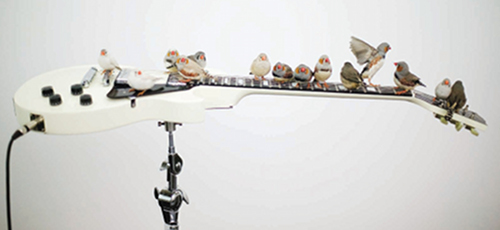
If not Capitalism & Schizophrenia, what writings – or other art forms – have been a source of inspiration for these new recordings? I note, for instance, that the cover image for the EP was designed by Céleste Boursier-Mougenot. What is its significance?
“That irresistibly cute photo of those birds on that Les Paul was in fact very significant, but I am almost ashamed to say that quite possibly for all the wrong reasons, namely first and foremost for its spot-on atmosphere. And of course there’s this certain vague (and wacky) metaphorical subtext that seems to hint at – or mock? – the new Oval sound. I definitely would love to see and hear that sound installation in real life one day. Until then, this installation definitely seems to inspire many interview questions, but those always put me in a slightly awkward position. But it was nice to hear that almost everyone thought these birds were 3D renderings, whereas I liked the authentic ‘snapshot’ appeal of that photo.
“The only other artform with a huge influence on o(h) was music itself – precisely, listening to tons of music of all kinds. Not to emulate music by the book, but to understand ‘how music works’ and to figure out what my own contribution to music could be. The rest was practice, practice, practice.”
“Disruption of music from a perpetual ‘outsider’s perspective’ only gets you so far.”
In a radical departure there are what sound like guitars and drums on a number of the tracks. How were these sounds produced and how conscious were you during recording of not wanting to sound like your previous output?
“Yes, radical departure was absolutely the mission, on all levels: technically, musically, aesthetically. To go beyond my previous output (instrumentation etc) was also essential – in order to put things newly in perspective and to see how it felt after changing sides. And why not bring along some of the most unlikely candidates for instrumentation along for this journey, namely guitars and drums? But seriously, I actually wanted to use guitar-y textures/dynamics in my music for a long time – and the drums were also a long overdue addition.
“What strikes me as a bit odd, though, is that some of the initial reactions to my new sound seem to stop at the mere fact that there apparently are now ‘instruments’, when it in fact should be clear that the mere presence of an instrument says nothing about the quality of the result. I mean, everyone who can tell his favorite music(ian) from the also-rans will immediately remember that it always made a world of a difference how parts and instruments are performed and that we always look for ‘that certain something’ which makes all the difference.”
“Anyway, this ‘certain something’ is what I spent all that time on: to be able to generate these phrases, make them happen exactly in this way with my own hands, whereas disruption of music/tech from a perpetual ‘outsider’s perspective’ only gets you so far.
“Why not just hire a live band? Because I wanted to experience the entire process myself in order to be able to tell the full story afterwards. Also, it was more fun to engage in this exercise of emulating and performing live music dynamics than to front a ‘real’ band – at least for now.”
“Systemisch was never distributed for free, rather it was just another standard retail CD on store shelves. So much for anti-capitalism.”
When was the last time you listened to Systemisch and what did you think? How do you feel about the fact that a disruptive way of using music playback technology with strong anti-capitalist intentions has become just another genre: glitch?
“Systemisch was a clear-cut and basic, yet very focused (if a bit demonstrative) endeavor, very aware of its strengths and limitations. In one word: effective. It was exactly what I wanted it to be at the time. But revisiting it today, totally out of context, works too. In a way, Systemisch was a prototype which brought along its own context…
“‘Anti-capitalist’ is a strong and loaded term to describe my standpoints at the time. Of course there was a lot of enthusiasm and determination to prove something – for example, to point to problematic factors in those ‘creative possibilities’. But it was also clear at any moment that any disruption of the status quo would inevitably only optimize the status quo. This was exactly the ‘systemic’ character of this whole endeavor: there was no outside of the system. Plus, after all, Systemisch was never distributed for free, rather it was just another standard retail CD/LP on store shelves. So much for anti-capitalism.”
A lot of the tracks on oh are very short, and only the opening track, ‘Hey’, exceeds three minutes. Is the EP in some sense a preparatory sketch for the forthcoming double album, and can we expect to hear longer works on that? Will there be anything on there as long as ‘Do While’?
“With this new material, I was aiming at giving each track its most convincing musical form, regardless of a lot of factors, including total track length. That’s why some tracks ended up as ‘miniatures’ (side B), while others are formatted as ‘songs’ (side A). My main concern was to give each track a chance to truly shine. Pardon the comparison, but who would complain that some of Ligeti’s etudes for piano were ‘alright, but maybe a bit on the short side’?
“In addition to that, some tracks using certain phrases or motifs would in fact waste or even completely lose all of their momentum when adding variations – or adding any other sounds for that matter. That’s exactly why all tracks on side B of the oh EP (same goes for CD2 of the upcoming album) are these pure, simple miniatures – what you hear is the essence of each track to get across the maximum emotion. On a technical level, extending the length of a track – either by looping the track around all the way at the end or by copying and pasting parts – is neither a technical achievement nor a very convincing strategy, and it probably never was.
“That epic version of ‘Do While’ [on the 94Diskont album] was more a document than a deliberate ‘extended version’ of the regular cut. The shorter edit (also on that album and used for the music video) was the original version, while the 24-minute-version was the 1-1 edit for an early oval multichannel/128-speaker sound installation. The original FOSTEX R8 8-track reel-to-reel tapes that this installation ran on had a maximum playtime of 24 minutes each.”
“Pardon the comparison, but who would complain that some of Ligeti’s etudes for piano were ‘alright, but maybe a bit on the short side’?”
What else can you tell us about the album?
“o will expand and supersede the EP considerably, hopefully on all levels. In fact, the decision to issue a limited edition EP was made after the overall trajectory of the album had already been decided…therefore, many tracks from the ‘misc’ folder ended up on that EP.
“The album will be a double CD with a total playing time of more than two hours. CD1 will feature ten songs + ten shorter interludes (plus six vinyl-exclusive bonus tracks for the LP version – three long and three short ones), while CD2 will be a ‘sketchbook’ with 50 miniatures, which follow the same minimal ‘hi emo impact’ idea, but are much catchier than what you hear on side B of the EP.
“As for those songs on CD1: of course there are many different approaches to write a song, but I gave it my best shot, even though I ended up more like scratching the surface of what I initially wanted to do. Regarding the ten interludes off CD1, I would go as far as saying it will be very hard to not be moved. The miniatures on CD2 are a ‘best of’ selection of what once started as the ‘ringtone project’ (I use the term ringtone with regard to formatting, not qualitatively). Again, I was trying to pick the most gripping and most ‘visual’ tracks for the album. At some point, working titles for that CD2 were ‘Project Evergreen’ and ‘Hey, visual creator!”.
What plans do you have to perform live as Oval?
“No concrete plans as yet. It will happen, though.”
Justin Toland
More from News