In Electric Eden, his landmark 2010 study of Britain’s “visionary music”, author Rob Young dedicates a paragraph to the work of Martyn Bates. A chapter might have been more appropriate.
Bates and fellow Coventry narive Peter Becker (pictured above, l-r) are the founders and sole constant members of Eyeless In Gaza, a project which debuted in 1980 with the striking three-track 7″ Kodak Ghosts Run Amok. The band’s early 80s vintage, and the sparse, electronic sound they pursued on their early releases, has led to them being cursed, to this day, with the misleading epithet “post-punk” – despite their essaying of a sound, and a vision, far too personal, intractable and ever-evolving to be satisfactorily categorised as such. Indeed, Bates and Becker consider Eyeless In Gaza to be less a band, and more “a life-project.”
2012 marks 32 years of Eyeless In Gaza, 32 years that have seen little in the way of mainstream success – though their records frequently troubled the upper regions of the independent charts in the 1980s – and even less in the way of compromise. Unlike so many of their contemporaries, Eyeless have continued to improve, continued to experiment, continued to grow as artists.
At the heart of their music is a dynamic relationship between songcraft and sonics. A keen student of the folk tradition, but one entirely unafraid of breaking from it, Bates puts everything he has into his impassioned, imposing vocal performances, sometimes rejecting words altogether, at others delivering lyrics that bend effortlessly, and often within the same phrase, from the intimate confessional mode to a grandstanding high romanticism. Here is a man who sounds alive. It’s all further elevated and enriched by the duo’s highly developed sense of atmosphere – Eyeless In Gaza care deeply about production and recording, about the sonic space in which their voices and instruments are suspended. Whether they happen to be using electronics or archaic acoustic instruments, their carefully wrought, uncluttered arrangements are always such that the whole sounds utterly eerie and immersive, and it’s no surprise that their work is often mentioned in the same breath as that of David Sylvian and the 4AD roster.
Though most of their recent releases, including last year’s Everyone Feels Like A Stranger, have been issued via their own Ambivalent Scale imprint, Eyeless In Gaza’s new EP, Butterfly Attitude, comes courtesy of Downwards, the label founded and operated by Karl O’Connor [aka Regis] with Peter Sutton. Downwards has explored many different avenues over its nearly two-decade existence, from the pistoning industrial techno of its early days to the US-centric shoegaze and gothic pop showcased on its DO 10″ series, but it’s fair to say it’s never released anything quite like Eyeless’s Butterfly Attitude.
FACT’s Kiran Sande traded emails with Martyn Bates to find out more about the Downwards connection, and to try to pinpoint what exactly is is that has given Eyeless In Gaza such longevity.
“We wanted to create work that people could become involved with, themselves; active rather than passive.”
 How did the two of you come to work together, and why?
Martyn Bates: “Having met Peter Becker I discovered a wonderful synchronicity within the principle of two; we had all the colours we needed for our explorations – more to the point we had the vital factor of control contained within a compact symbiosis. Another major factor about this decision (and it’s something that has continued to be an interest and an area that we’ve explored in lots of atypical ways) is a shared interest in minimalist music and writing.
“When I say ‘minimalist music’, I’m not thinking of the so-called ‘modern classical music’ such as Reich and Glass – that doesn’t particularly interest me. In a personal sense, minimalism simply means a quality that delves right into the tone of the music and into the grist of the words, into the heart of the music and the text…to explore it and yet not ‘do something’ with it…. It’s a way of leaving a skeletal picture which allows other spaces to come into the work…and also it allows the listener to become more active in their involvement as a listener, within the experience of listening to what is being created; it somehow invites greater participation.”
 What were your aims and ambitions when you started Eyeless In Gaza, and have they remained the same?
MB: “We wanted to create work that people could become involved with, themselves; active rather than passive. We wanted to make a music that inspired, that promoted investigation of one’s own spirit and creativity; a kind of emancipation via music and words – via the impetus of example, as opposed to patronising and proselytizing. We always thought of what we are doing as ‘art’ (with a small ‘a’ – a kind of ‘folk-art’) as opposed to pop music, which sounds quite a precious statement to make. However, we always have a consciousness about the song, the words, the melodies, and the value of that discipline. What we always want to do is to combine all of our interests – and, above all, we always want to communicate.”
“Records are the creatures that you send out into the world, things that will always live.”
How would you describe the evolution of Eyeless in Gaza’s songs and sonics over the course of your career? How did you get from Kodak Ghosts Run Amok to Everyone Feels Like A Stranger?
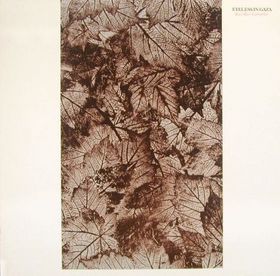 “I like the way that the songs and sonics have run, obviously. However, as a general rule, personally, I come to feel more and more that recordings are ‘where it happens’. Records or recordings are more ‘alive’ in many senses than live concerts are. Of course I feel that the two things are intrinsically different, and I also feel that the art of playing ‘live’ concerts is a peculiar, and a most special and ‘rare’ occurrence – each concert being a unique ‘happening’, for want of a better expression. But for me – records are the creatures that you send out into the world, things that will always live – creatures that live and breathe and take on lives of their own, beyond the moment.
“This includes of course the life where the listener completes the picture – creating, making new life by simply listening and completing the circle. Apart from all this though, I feel that Eyeless in Gaza have always striven for a timeless, transcendent feel. Obviously, everything under the sun is more, much more than that – things are death and life, in one seed – and that is a good thing.

How did you first encounter Karl O’Connor [aka Regis, on whose Downwards label EIG’s new EP is to be released]?
MB: “Karl and I share the same TG [Throbbing Gristle] roots – all those interests from way, way back. I met up with him again when I was working with Mick Harris on the Murder Ballads trilogy, although I knew Karl from way before that, I used to write and send cassettes to him unless I’m mistaken. He knew my stuff, and acknowledges that aspects of Eyeless In Gaza’s work lock into some of the stuff he does. For instance, he name checked ‘John of Patmos’ from Photographs As Memories as being one of the first hard, electro/techno mash-ups – that ‘‘you two were there at the start’’. Eyeless in Gaza have always been eclectic, having many many diverse interests. It’s been our downfall, and it’s always been our main strength.”
“Eyeless in Gaza have always been eclectic…it’s been our downfall, and it’s always been our main strength.”
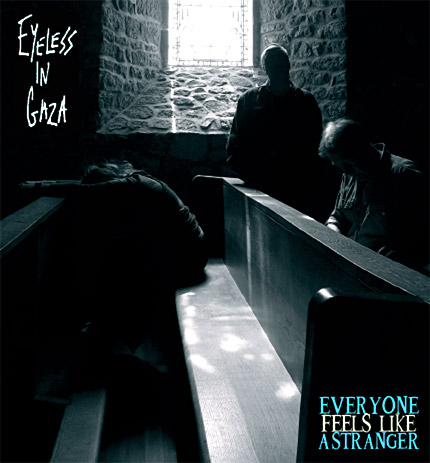 Why did you decide to release Butterfly Attitude through Downwards, and what’s the connection between this record and [recent album] Everyone Feels Like A Stranger?
MB: “These days we mostly function as a small independent label, Ambivalent Scale Recordings. Karl approached us to do this release with Downwards, and the idea grew out of that. So, that’s great – why not? If it makes more people aware of the music then OK, provided that we are happy and don’t feel compromised. People with fresh ears are always welcome.
“As regards the relationship between the two records, we’d already found that on completing Everyone Feels Like A Stranger, we’d discovered we had a further body of work within several pieces from those sessions – pieces that shared qualities of the main or ‘brother’ album, yet were slightly outside or tangential to the central moods and thematics of the main album, and equally valid. The question was whether we should we release a double, or two separate-ish projects. We opted for the latter and the idea of the kindred spirit. Its something that we’ve done successfully before – with Saw You In Reminding Pictures and its sister/companion volume Streets I Ran, back in the World Serpent days.
“Butterfly Attitude is the sparsest thing we’ve ever released.”
“In a way, Butterfly Attitude is the sparsest thing we’ve ever released – with strange song-pieces that feature just voice and melodica, or acoustic guitar and bass, or ukulele, electric guitar and voice. It’s something quite different for Eyeless in Gaza, in some key ways.”
 Do you think of Eyeless In Gaza as having a particularly English or British sound, aesthetic, mood or preoccupation? How would you describe Eyeless’s relationship to folk or the folk tradition?
MB: “To answer this question, I’d have to first state that personally, my main interest lies in unmediated music and art. This surely feeds into the ‘folk tradition’, and I’d say yes, it’s been an influence – right from the start, even when I was fighting it. For me, it has to feed into it – as from my point of view Nature plays a big part in the general melee of English culture and in the gestalt of what might be called the ‘British imagination’. As far as I’m concerned, ‘Nature’ is a rich metaphor for the internal landscape…it’s a manifestation of the psyche. As a writer I am totally trying to clue into the intensity behind the ordinary, behind the everyday, and it’s not a passive process at all.”
“As a writer, I’m trying to clue into the intensity behind the ordinary, behind the everyday.”
Why was Eyeless in Gaza dissolved in the 1980s, and what prompted you to begin working together seriously again after that?
“Chronologically, so much has happened that it’s difficult to relate, beyond biographical stuff such as discographies…in some senses, nothing has happened to me personally, as an individual…I still feel as fucked-up and ecstatic as I ever did. I’m blessed, I’m cursed…I see it all, I see nothing…and I’ve only just begun to live – and I feel that every day, every day. And now, at my age, I’m wondering, ‘Where is my wisdom?’ It should be here by now! And I’m still waiting. Pete Becker and I, we like working together – simple as that. Sometimes you just need to come up for air, that’s all.”
 How would you say your lyrical themes and interests have developed over the years?
MB: “To my mind, the aim of writing is to draw attention to a range of different phenomena: it is never just about cause and effect. You might say this is a protest of sorts – against those who would have you reduce the richness of experience into boxes and labels…’angst’, ‘ennui’, ‘happy’, ‘sad’, etc, etc. These places are real enough, they are the places where people live and have their being – but such containment can’t be anything but reductive and unhelpful.
“Next, all of this is crafted – of course! – and refined into songs, more so in some particular songs than in others. Songs are a mix of music and thought – they are a register of feelings that exist beyond definition – a wholly different place from the areas where ‘beliefs’ and attitudes rule the roost, those received wisdoms that run us all like automatons. It’s music that enables this register, much more so words ever could – there are whole schools of thought that posit the idea that the very first vocal utterances were more akin to song and speech, and that makes perfect sense to me, from my particular viewpoint.
“I still feel as fucked-up and ecstatic as I ever did.”
 “In my writing, my feeling is that the songs, words and music here are not discreet entities – they are elements in the same discourse – where each casts certainty or doubt, illumination or shade, upon the other. And, probably, the overarching aim of all this writing is to communicate one thing: that sometimes you make decisions for yourself on an obscure level, that something in you is wise, old and wise – wise enough to take care of you. And that, always, the thing is to paint with words – effect is important and pivotal to the meaning, but meaning is essential. It is the most important factor in the writing – but also, importantly meaning is not fixed in place – and I do not see that as being the aim of art. The beauty of all this lies in its ambiguity.”
Have you settled on a specific approach to writing, recording and improvising these days, or is the process always changing?
MB: “It’s always changing. Our songcraft is the thing that concerns me most of all right now – we are recognised for many things, but the high quality of our songwriting is generally not discussed. It’s usually the many other elements that people speak of. I love to improvise, but especially together with quality songwriting – to create something extra. Baudelaire once pinpointed a particular site, a focussed objective of creative positioning: ‘Doesn’t matter where, as long as it’s out of this world’. This is how I feel today about it all, and it is how I have always felt – and you can bet that Pete Becker feels the same.”
Kiran Sande





![Ryoji Ikeda installation data-cosm [n°1] extended at 180 Studios until 1 February, 2026](https://factmag-images.s3.amazonaws.com/wp-content/uploads/2025/12/data-cosm-ALubbock_180-14Oct-3554-250x155.webp)
![180 Studios presents new Ryoji Ikeda installation, data-cosm [n°1]](https://factmag-images.s3.amazonaws.com/wp-content/uploads/2025/10/ryoji-ikeda-data-cosm-1-250x155.webp)