Words: Ryan A. Diduck
In the winter 1965-66 issue of Film Quarterly, critic Ernest Callenbach wrote: “I cannot escape the feeling that La Jetée is a great film, and will last … It is a film of heartbreaking nostalgia – nostalgia for the ordinary life, the ordinary loves, of our present.” In today’s present, 50 years after its initial release, Chris Marker’s seminal film about time travel indeed endures, continuing to captivate global audiences and inspire myriad artists.
Nostalgia for the present is an intriguing condition to consider in 2012, a time that is so seemingly preoccupied, culturally, with both the past and the future, in its ongoing quest for a definition of ‘now’. Intersecting with these themes of nostalgia – as well as of mediated memory and temporal diaspora – is Her Ghost, an audiovisual performance work conceived by Kode9 (Steve Goodman), Ms. Haptic (Jessica Edwards), and the MFO collective (Lucy Benson and Marcel Weber), which was premiered at last year’s Unsound festival and presented again at the 2012 MUTEK festival in Montréal.
Something between a tribute, a remake, and a singular, standalone piece, Her Ghost radically reworks Marker’s original film into a far darker, steadfastly unsentimental yet sublime assault on the senses. I was fortunate to have experienced the performance at MUTEK on June 1st, which nestled comfortably between stellar sets from local artists Le Révélateur (Roger Tellier-Craig and Sabrina Ratté), and Bristolian Roly Porter (also accompanied by images from MFO), as part of MUTEK’s Friday night A/Visions programme, entitled Trompe L’œil. The event was held at the suitably stunning neo-Renaissance-style Monument-National, Québec’s oldest operating theatre, constructed between 1891 and 1893 on an otherwise dubious stretch of St. Laurent Boulevard. The setting was thoroughly appropriate to Her Ghost’s dirty and frayed aesthetic, and the palimpsestic spatiotemporalities that Goodman, Edwards, Benson, and Weber simultaneously summon. Yet, while moving chronologically forward and backward, Her Ghost is very much a work of art that exists solely in its own present place and time – the here and now, then and there.
Something between a tribute, a remake, and a singular, standalone piece, Her Ghost radically reworks Chris Marker’s original film into a steadfastly unsentimental assault on the senses.
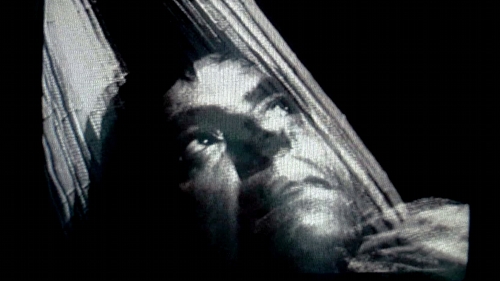
Where Marker’s original film consists of placid still images and a saccharine score that seems to linger on the surface, Her Ghost feels more like a sinuous, writhing sandworm, ploughing and piercing through claustrophobic subterranean depths. The narrative of Her Ghost centres on the female rather than the male protagonist; the static photographs and smooth transitions of La Jetée are replaced by jagged cuts between their vacillating spectres; the original soundtrack is terraformed into a heaving, bass-laden sonic terrain. During the presentation, Ms. Haptic’s laconic narration weaved seamlessly between Kode9’s foreboding score and MFO’s staccato visuals. Having been presented only thrice previously, the performance felt remarkably polished for a piece that is so obviously contingent upon countless variables. At one point, however, the video unexpectedly dropped out, displaying the dreaded “NO SIGNAL” warning onscreen, unintentionally echoing an earlier image of a burning filmstrip that separated the work’s two main movements. For an apparent blunder, the timing couldn’t have been more opportune.
The following afternoon, I caught up with the foursome behind Her Ghost at their downtown hotel. We talked about the redundancy of music festivals using tickets, passes, wristbands, and hand-stamps; the inevitability of subcutaneous RFID tags; the ongoing student protests (known as the ‘manifencours’) which are now taking place in Montréal; methods of civil disobedience; America’s Army: peripheral topics that were both interesting and apposite in relation to their project. The conversation was relaxed and affable. But with Weber and Benson due to fly home forthwith, we soon got down to brass tacks.
I’m interested to know how this collaboration came about.
Steve Goodman (Kode9): “Mat [Schulz] from the Unsound festival in Krakow asked us kind of independently at first, I think. He was aware that [Marcel] and I both were big fans of La Jetée, and at least from my side, he asked me to do a new soundtrack for it at one point, which I was very enthusiastic about. Until he tried to go through the legitimate channels of Chris Marker, who was quite rightly saying ‘it doesn’t need a new soundtrack’ – and he was totally right. So we kind of went off the idea for a bit, and Mat came back to us with the idea of doing a more thorough remix of the whole project – the sound and the image. And I think once we both agreed to get involved in that, then we came up with the idea that maybe we should remix the script as well, and have live narration, and that’s where Jess became involved, a little bit further down. And we changed the perspective of the script from the male to the female.”
Marcel Weber: “The beginning was just an endless thought process, thinking about many ideas of what we could do. I think at least from my side, I agreed about the project because I was a huge fan of La Jetée, and just later on thought: ‘What am I going to do?'”
SG: “It was just a reflex reaction, actually. We thought: ‘Amazing!'”
“People are talking about retromania, people are talking about nostalgia, and it’s easier to think of a dystopia than a utopia.” – Kode9
MW: “Yeah, amazing! And then we started an endless thought process about what we could do, and exchanging ideas of what would be interesting, how to change the story, how to extend the story; do we want change, do we want to extend the story? All of that. I also thought about 12 Monkeys, which was inspired by La Jetée…
SG: “Probably Back to the Future as well… I saw it lurking under your cardigan. [laughs]”
[I had, admittedly, donned my Back to the Future t-shirt on purpose.]
MW: ” … and we quite quickly decided that we didn’t want to do something like that, which was this Hollywood entertainment kind of approach. What we wanted to do was stay true to the original piece.”
Jessica Edwards: “But not too true.”
SG: “No, but I suppose it was also to do something to differentiate it from what I think a lot of musicians and visual artists do at electronic music festivals, which is usually wordless, non-verbal performances. So just to do something that was neither that, but also neither a film. Because it’s a performance piece. There’s no solid version. It’s slightly different every time we do it also.”
Was there something specific about this time, or this piece?
SG: “I don’t know if it was something that was in Mat’s mind, specifically about asking us at that moment, but it was more like a coincidence that it’s 50 years, really. Because we were quite heavily immersed in the project, and then we realized: ‘Oh!'”
MW: “There was a feeling that we all had that this movie needs a bit more attention, and it would be really interesting to update it in a new way. And yeah, it was just a coincidence that it was 50 years later.”
“There was a feeling that we all had that this movie needs a bit more attention.” – Marcel Weber
JE: “But I think also, in a wider context, that there has been this more speculative return, culturally, anyway, at least in Britain and Europe, so that all those uncertainties that we had…and even around the time of Marker making the film…uncertainties of, or at least the possibility of, a nuclear war. But in our age, being even more uncertain. So this sense in which you could endlessly speculate about the future. I think that kind of, in a way, seems to underpin this move to rethink him – about what Marker’s piece might mean in our time.”
SG: “Yeah, definitely the zeitgeist is stuck in the inability to think about the future anymore. Like, people are talking about retromania, people are talking about nostalgia, and it’s easier to think of a dystopia than a utopia.”
MW: “There are, in fact, no utopian models around. Not a single model that comes to mind that has a lot of believers.”
SG: “Yeah, mostly utopia has been discredited one way or another. We were already immersed in the project when we realized that, ok, it’s 50 years since the original, and actually all these themes in the original are very resonant with what’s going on today.”
Did you write the dialogue together?
SG: “I suppose it started with us two [Marcel] and…
MW: “Bouncing ideas…”
SG: “Yeah, the first thing we did was, in terms of gender, just invert the script. That was just a quick and easy move: change the he’s to she’s, and just experiment with that. And then, after I was working on it for a bit, then Jess became more involved…”
MW: “… and also extending it was one of the first steps. It was quite early that we had these ideas, and were trying to write them out into a piece. The idea of the time fugitives was one that came quite early, when thinking about Marker and his piece, 50 years back. He was thinking about people of the future that someone travels to, to ask for help, and that could actually be us. What would we do if some time fugitive were to arrive here and ask for help? And then there was the beginning point to think about this idea of having time refugees – a movement of time refugees – people that try to flee their time because they had time fragments ending, and come to the future. All of these ideas, we scribbled them down, and I think that was the first version of the script. It was very, very rough.
“A key aspect was the making the idea of a refugee into a temporal one, as opposed to a spatial one.” – Kode9
JE: “And pretty much the one we did at Krakow [for Unsound]. And then I think a lot of the revisions came post-Krakow.”
SG: “Yes, that key aspect of making the idea of a refugee into a temporal one, as opposed to a spatial one. But also, just trying to bring out some of the things that are kind of implicit in the original, but make it contemporary – to do with financial crashes. We haven’t really brought out the radiation theme as much as we could do.”
MW: “Yeah, we talked about that, this theme of atomic warfare, that was very strong for Marker in his time; it was a political, very heavy topic for him. But it’s not that strong anymore for us today.”
JE: “Fukushima?”
SG: “Well, it’s not so much a war thing as an ecological thing now.”
MW: “So that was one of the thoughts that was underlying the idea of time fugitives: this political topic of our time – at least in Europe, the topic of refugee streams, and how it’s dealt with.”
“This theme of atomic warfare, that was very strong for Marker in his time; it was a political, very heavy topic for him. But it’s not that strong anymore for us today.” – Marcel Weber
SG: “If people came to our time to look for help, instead of helping them as in the original, we would just hole them up in refugee camps.”
MW: “I think it’s quite realistic.”
JE: “I think you also have, with our own model of refugees in terms of spatial dynamics and spatial transitions – even within that spatial dynamic of refugee status – you still have that temporal dislocation. So, refugees come to Britain and are dealing with different temporalities. And you have a double or triple consciousness: you have your home time, the dislocated transitional space, and the time and the space you arrive in.”
SG: “Yeah, third world, second world, first world, all with their own chronological moments.”
JE: “And they’re all competing.”

So the script evolved a lot between performances, then?
SG: “Yes. It’s still … it’s stopped squirming, and it’s now just, like, twitching. [laughs]”
SG: “… almost stable.”
MW: “Whenever we decide, OK, this is the finished version, some days later, someone comes up with some changes.”
“After the first performance, I felt that I still didn’t know enough about the woman I’m narrating.” – Ms. Haptic
SG: “It’s nice to fold in the feedback that you get from every show into the process.”
JE: “From my perspective, I think after the Krakow performance, which was the first one, I felt that I still didn’t know enough about the woman I’m narrating. So we talked about the decision then to really start to unpack and unfold her. To give her a bit more dynamism, I suppose. And then going back to Marker’s original, and recognizing just how much of the film – although she’s seemingly a passive figure in Marker’s original – so much of the coming together of all the particles of time revolve around her. But in a way, Marker is rather understating her, because we get the action largely through the man, who is coming and going. But I think it’s quite nice to invert that, and see how he revolves around her, as opposed to the original.”

Why was that gender inversion important?
SG: “It does seem such a crucial point about the original, that man – whether it be ‘the man’, or ‘mankind’, or ‘mankind under the dominion of men’ – makes the fatal error of choosing the past over the future. That’s this kind of immanent critique that the film suggests. So, it seemed important to bring that out.”
JE: “But he also points to a quiet…f you think about the period in which [Marker] wrote La Jetée, ’62, y’know, the women’s movement. He quietly has a kind of proto-feminist movement, because it’s the woman who’s allowed the futurity.”
SG: “That’s what I mean: [Marker’s] critique of mankind is very subtle, but it’s very strong.”
JE: “Yeah.”
MW: “Also, it’s a bit more interesting [laughs]. We already know what happens to the man. Of course we could also do a bit more on his side of things, but it’s just more appealing, I would say.”
SG: “I would say one of [Marker’s] innovations is the use of female narration, not in La Jetée, but it’s also in Level Five, and Sans Soleil. So it’s like, how to fold back those innovations into one of his earlier pieces.”
JE: “And for us, I think we were quite interested in exploring a kind of Rashomon aesthetic, so having it from multiple perspectives.”
“The question of memory, desire, loss, trauma, skews how we see these things, how we remember and re-experience these moments.” – Ms. Haptic
MW: “It’s quite an interesting approach, I think, because his story is, like, twisting around her.”
JE: “Like a double helix.”
SG: “You can kinda see it happening already in the original, because he’s telling his story from multiple points in time. So we just take that further, and tell it from different points in time, from different characters.”
The original has a theme of recurrence, so this is like variations on a theme of recurrence.
JE: “Yes. And also in terms of how we remember. We may experience the same phenomena, but it’s those minute and individualistic aspects of remembering that change the parameters of what we’ve experienced, and what we’ve seen. Obviously, the question of memory, desire, loss, trauma, skews how we see these things, how we remember and re-experience these moments. I think those are the things we’ve tried to push through.”
Did Chris Marker end up having anything to do with the project?
SG: “No, I think he was resistant to the idea of someone – anyone – doing a new soundtrack to essentially what is like a perfect, pristine bit of film history. Kind of understandable. But after that reaction, we just kept it away from him. [laughs]”
Has he seen it?
SG: “No. We may do it in London later in the year, so he may have to become aware of it at some point. I suppose with these kinds of projects, it’s nice to think that the original creator would like it, or would approve of it. Ultimately, paying too much attention to that is like a block. So you really have to bracket that. If people paid so much attention to that, there’d be no sampling in the history of music, and so on. So you really have to ignore that for a bit, and let the project grow. And if it’s interesting, then is the better time.”
MW: “In the end, it’s still our reinterpretation. You don’t need permission to understand something in your way.”
SG: “Yeah: ‘Please, will you sanction our love for your work?’ [laughs]”
MW: “Nevertheless, of course we would love him loving it.”
“Chris Marker’s in his 90s. I’d be worried Her Ghost would give him a heart attack.” – Kode9
I feel like he would.
SG: “I don’t know, he’s in his 90s. I’d be worried it would give him a heart attack. [laughs]”
JE: “130 decibels!”
SG: “Yeah, if we were unsettling Roly [Porter’s] nervous system, I’d be worried about Chris Marker’s.”
JE: “I think even in the feedback we have from the performance – not just here, but in other performances – we’ve seen it slightly change, whether it’s because it’s done live as opposed to watching it in the film dynamic, the viscerality of it, the affective tension of it, particularly played out through sound, and the strafing of the images, and the work that [MFO] do – that it’s much more…sometimes claustrophobic; it sometimes feels quite expansive, and other times, you get that sense of dread and fear coming through.”
SG: “There is definitely a contrast between the kind of gentle, quiet spoken-word parts, and the audiovisual assaults – once you’ve been attacked once, you get the feeling you’re going to be attacked again.”

The sound and the image, and the narration, to a certain extent, are very tangible and tactile. Were you after a haptic quality of being able to touch these elements?
JE: “Yes.”
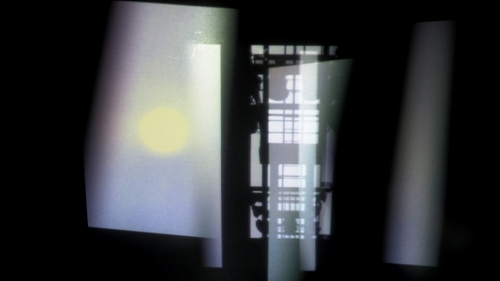
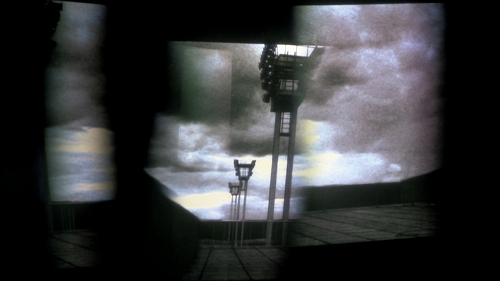
Lucy Benson: “Yes. At the beginning of the first act, and most of the animation that you see throughout the whole piece, is actually done with analogue or hand-held movements, and then filmed. So, the blurs and coming in and out of focus and stuff is actually done with an actual slide projector and film and various techniques. So all of that stuff is quite important, in the first act, particularly, dealing with this memory and nostalgia, and looking back through images. I think it was quite personal: someone sitting there with a bunch of images and going through them by hand.”
MW: “The first act was made like: A) Marker did this piece with just still images, breaking the medium of film down to its bare minimum of still images. So, we used still images and redeveloped it on slide projector film. And the other idea was the slide projector as a symbol for memory. Much more was done with blurring the images out to also reflect the process of memory, which is often blurry. You just remember the good parts.”
“My music is a bit less romantic, less whimsical, and a bit more smoldering and tense and chaotic, I suppose. Curdled is the word I keep returning to.” – Kode9
What about from the sound side?
SG: “Well, the original sound and music is very romantic, stock classical music. It wasn’t composed specifically for the film; it’s kind of classical library music. But really amazing sound design in the original: the whispers, the heartbeat, the drones, were quite advanced for the time, in a way. 95% of the sounds in our version are just like what [MFO] were doing with the image, really, just through looping and pitching and reversing and manipulating, and trying to squeeze some new potential out of the original sounds. And then there are a couple of newer sounds in the middle.
“When it gets quite dark in the middle, it’s kind of the sound of breaking glass, chinking, crystally: I just added that in not because it’s in the scene or in the image – though it does work with some of the micromovements in the image – but more to just get this idea of a broken crystal of time. That is certainly what the original, and what our version, is about. That crystal is what refracts the same story from lots of different points of view. It’s shattered. So that’s coming in there, and there are some other synth sounds that are from a documentary – the Future Shock documentary, the one that Orson Welles narrated. [‘Future Shock’] was the theme of the Unsound festival where we played at…the first iteration of it. Those sounds work really well with the final section of the piece. So, 95% is squeezed out of the original, and there are just a couple of new sounds. Then, just to lead to Jess, the one thing we really wanted to retain from Marker was this affective tone in the voice as well, which is always a kind of deadpan, monotone delivery that we wanted to maintain.”
JE: “Yeah, I’m attempting a delivery that oscillates somewhere, or rather, recombines somewhere between a dispassionate over-viewing of this future that’s unfolding, but at the same time, there’s a kind of quality of a…I don’t know if it’s a regret? So, I think I’m trying to find my way to a sort of remorse that this is the only eventuality, or the only future that has unfolded, for us or for humanity. But at the same time, as you see in Marker’s other documentaries, there’s this detachment. So, there are moments, because I’m obviously working in consort with the visuals and Steve’s sound design, that it depended on how you manipulate the images in that moment in response to Steve, and depending on where you go in the kind of live sound of the piece, it affects the performance of the delivery, of the voice. So, I’ll sometimes feel more tension, or sometimes when Marcel gets all romantic…[laughs]”
“You’re always trying to find that balance, that equilibrium, between being overly emotional and then looking at the waste that humanity is.” – Ms. Haptic
JE: “Particularly in those moments when they come together. But you’re always trying to find that balance, that equilibrium, between being overly emotional and then looking at the waste that humanity is.”
SG: “Yeah, I’m not a big fan of the music in the original, so I definitely wanted to take that somewhere else. So, it’s a bit less romantic, and a bit less whimsical, and a bit more smoldering and tense and chaotic, I suppose. Curdled is the word I keep returning to. It definitely hits you in the gut as curdled milk would. [laughs]”
JE: “Yeah, we talk about curdled milk.”
SG: “The Curdler! That’s my new moniker. Every track I make will be like a different liquid. [laughs]”
MW: “There’s a technique that applies to all three elements of the piece – the sound, the script, and the videos – that is this dogmatic approach to take all the bases out of the original by sampling, but then it’s extended, transformed, mutated, or just textured, so that we can tell our own story with these methods of changing it. But still, it’s always based on the original.”
SG: “Yeah, it’s a great self-discipline in an age of too much choice…”
JE: “… to work within confines.”
SG: “Yeah.”
How much of the performance is improvised, and how much is set in stone?
SG: “I suppose it’s all come from improvisation and experimentation, but the script is on a quite rigid grid. And then there are pockets within the script where we can kind of improvise more. So, it’s like a rhythm between…”
JE: “Order…”
SG: “And…”
JE: “Chaos.”
MW: “It’s born out of the original idea that these three building blocks can be combined, and build a new rhythm of combinations of sound and image, or sound and spoken word, or images and spoken word. And then at some point, we realized that sounds and images need a bit more room for improvisation, and we made these, like, pockets.”
JE: “Yeah, you’re oscillating between disjunctive and conjunctive synthesis. So there are these moments where the voice on the grid fades out, and then [Steve and Marcel] are always helixing around one another. Yeah, it’s coming apart, and coming back.”
SG: “Yeah, I’ve noticed that when you stop talking, then there’s like a moment where we both go off kind of randomly, and then I see what [Marcel] is doing, and you hear what I’m doing.”
MW: “Yeah, that’s one difference to the earlier performances: that now, I’m much slower at fading in the crazy stuff. In the earlier performances, I was immediately like ‘Let’s go!'”
SG: “Because I’m waiting for you. I’m waiting to see the stuttery thing before I press the stutter button.”
MW: “I realise that, so now I always start slow.”
SG: “Yeah, sometimes I accidentally bring in the stutter thing, and realize you haven’t started stuttering. So then I take it out. So each bit of the improvisation is like a feeling about for a few seconds – just a couple of seconds, sometimes.”
JE: “There isn’t a specific moment of lead-in; you’re each a leader.”
MW: “We are dancing together.”
SG: “I think I genuinely felt like I was just copying. I’m just staring at the screen like this – [stares blankly, pokes imaginary keyboard] – reacting to what I’m seeing, and waiting to add space when the voice drops in.”
MW: “The funny thing is that I’m also waiting for the sound, so we are, all three, like a loop.”
SG: “I suppose that’s what bands do.”
Time is something that you keep coming back to, Steve. Is there something about the idea of wanting to break the temporality mediated by sound or image recording?
SG: “I think, obviously, what this film is about is that all media…memory is distributed through media. So, we’re like immersed in a media environment – a mnemonic media environment – and that media environment has shattered chronology. So all of history has been recorded, and is available as samples and loops and so on. So, younger generations don’t have a notion of the place of everything in the straight line of history, y’know, you have a bit of the ’60s with a bit of the 80s mixed in with a bit of whatever. That is reality. And then just these kind of paradoxes, like a memory of the future, is something that I think fascinates us all, and is very ‘Marker’. I mean, that idea used in my own musical context came from a book about Chris Marker called Memories of the Future. So, it’s just this recurrent theme that somehow I keep coming back to in our project, or other stuff as well.”
William S. Burroughs said that by cutting into the present, the future leaks out. Is this project an attempt to imagine a utopia once again? Or at least the possibility of a utopia?
JE: “There are no new utopias anymore.”
“There are no new utopias anymore.” – Ms. Haptic
Can one be created?
SG: “Well, this is an intervention into this situation where, like I said earlier about the immanent critique of the original and our thing, like: why does man keep choosing the past instead of choosing the future? Whether it involves the creation of new utopias, that’s a bigger question, I think. There’s a whole series of smaller questions about nostalgia, and retro, and…”
JE: “Sameness. Y’know, even towards the end where we talk about the way in which the woman convinces the scientist to go back and bring the man to the future to be with her: it’s a moment in which it’s a refugee status, which is exactly the same, or has a sameness to the underground status. So, it’s not really utopian in the sense of the dream ending. Yeah, it’s replication of the same, but in a different form.”
That makes me think of Brian Massumi’s Parables for the Virtual, where he discusses stasis as a special case of movement – of reiterative movement. Do you think we’re somehow reiterating the past until we’ve got a handle on it?
[crickets]
What I mean is: in terms of how cultural productions are so abundant and available, and in the context of retromania, we keeping coming back to the past. Is this an attempt to process that overabundance?
LB: “Yes, to solidify where we are.”
MW: “The way to the future is not a linear way. It’s always meandering.”
LB: “Probably quite a lot like an individual’s experience of life, as well. You spend most of your life coming to terms with the day before, or the week before.”
JE: “That also reminds me of the Nietzschean concept of the law of eternal return, of trying to find this moment of escape out into a possible future by going back and reworking, or trying to work out the moment at which you took the wrong path. I suppose it’s like Groundhog Day. [laughs]”
Do you have plans to document this project in the form of a release, or a DVD?
MW: “Maybe that would limit our witchcraft.”
LB: “I think a DVD would be a return to the past.”
SG: “Yeah, that would be a serious regression. Some people might say that forcing people to be in a live context would be like a retro thing, but I actually think it’s like a huge breath of fresh air. If you think it’s retro, you’re an idiot, because it’s an issue of sorcery and witchcraft, and how to create an event, and how you remember what resonates with you. OK, it’s always been an event for me sitting with my laptop watching La Jetée on headphones. It always stays with me, it always blurs into one experience delivered over years, but really it’s about how to create an intense event as opposed to how to make something domesticated and convenient. Because it keeps changing, it’s a creature that’s not done, and hasn’t finalised how it wants to use us yet.”
JE: “From the audience’s perspective, not that I’ve ever been in the audience…”
“If you think it’s retro, you’re an idiot, because it’s an issue of sorcery and witchcraft, and how to create an event, and how you remember what resonates with you.” – Kode9
SG: “But we are in the audience!”
JE: “Yeah, but we’re all kind of very focused in at that moment…that to be sat, in the very traditional sense of the immersive experience of cinema, where you have the soundtrack, and you have images, which are at points like retinal burn. They move too quickly, and all you get are these traces that blur into one. So you’re not actually able to…you’re assaulted by the image, but you can’t arrest the image. What is it to be in that audience collectively? Those heartbeats come in, and suddenly, you’re assaulted by the sound that just rumbles and resonates through your body, in a collective environment. So, even with great home cinema systems, you can’t replicate that at home.”
SG: “To be fair, that is the standard Hollywood cinema experience these days: surround sound, huge sub-bass. It’s not difficult to have that intense sonic experience of a mainstream cinema; the difference is to have a performance in the middle of it, and for it to be live.”
MW: “I think that that interferes with the audience. As an audience, you feel that it’s completely live, like when that ‘NO SIGNAL’ thing came up…”
SG: “Yeah, everyone was suddenly on the tightrope. We were feeling it the most, but everyone that I’ve spoken to, everyone’s heart stopped.”

I gasped.
JE: “Yeah, no signal from the future. But in terms of development, we’ve thought about it and talked about whether we can turn it into an installation, and to go back to this Rashomon aesthetic, whether we can tell another narrative than what is there in the original script. More than trying to record a specific moment of the performance, I think those are more the kinds of directions we want to pursue.”
LB: “I think also for a project dealing with time and with experience, it’s quite an interesting thing to bring people together into one room to share an experience in that time.”
SG: “I suppose often with films, people concentrate too much on the text of the film, or the content of the film, and actually what’s as important with all film is that it’s a collective experience of everyone sitting in the dark, with a dream machine. That’s a very powerful thing.”
“I’d hate to think of Her Ghost, which is a very time-based piece, sitting on someone’s shelf, waiting to be activated.” – Ms. Haptic
MW: “That’s very true.”
SG: “I mean, when you watch people watching film, it’s quite weird.”
MW: “But that’s a very good point, because at the time [of the original film], cinema was probably where live performance is today. The standard film, you can now get on DVD, you can bring to your home cinema and access it whenever you want. It’s not as focused, temporally.”
LB: “Dealing with a medium in time, which is very specific to the project, to limit that by recording it into some particular format is maybe not so relevant to today’s technology anyway. It just doesn’t seem to make sense.”
JE: “And I’d hate to think of Her Ghost, which is a very time-based piece, sitting on someone’s shelf, waiting to be activated. [laughs]”
Ryan A. Diduck



![Ryoji Ikeda installation data-cosm [n°1] extended at 180 Studios until 1 February, 2026](https://factmag-images.s3.amazonaws.com/wp-content/uploads/2025/12/data-cosm-ALubbock_180-14Oct-3554-250x155.webp)
![180 Studios presents new Ryoji Ikeda installation, data-cosm [n°1]](https://factmag-images.s3.amazonaws.com/wp-content/uploads/2025/10/ryoji-ikeda-data-cosm-1-250x155.webp)