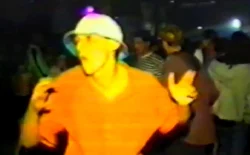
“In Holland we always have been terrorized by horrible prefab music on the radio, pushed by the industry.”
I-f – real name Ferenc van der Sluijs – is among underground dance music’s most iconic figures.
A disco fiend first and foremost, the Dutchman’s seminal mix CD of 1999, Mixed Up In The Hague Vol.1, is cited by many – including fellow freak Morgan Geist – as the catalyst for the italo disco revival which has persisted throughout the 00s, and Cocadisco (2001), the aptly titled album Ferenc recorded with Intergalactic Gary as The Parallax Corporation, is simply one of this decade’s finest.
I-f’s involvement in dance music begins in the early 90s, when he was a member of Unit Moebius, the seminal Hague-based acid-techno act often referred to as “Europe’s answer to Underground Resistance”. Raw, jacking acid quickly became the fledgling producer’s bread and butter, and the various tracks he recorded under the name Beverly Hills 808303 – including ‘Acid Planet 4’ and ‘Greatest Shit’ – are some of the craziest squat party jams you’ll ever hear. In 1997 he turned out the proto-electroclash classic ‘Space Invaders Are Smoking Grass’ – still one of the most influential dance tracks ever made – by which time his cult status was rigorously assured.
That didn’t mean he took his foot off the gas. Though the last couple of years have been quiet on the production front, over the course of this decade Ferenc has made music under a bewildering array of aliases, including Housemaid, Jungian Archetype and Frank Castle, and groups like Los Muchachos Gruesos and Brothers Fuck & Friend. He has founded and helmed a number of acclaimed record labels, primarily Viewlexx and Murder Capital, the aesthetic of the latter inspired by the stylized violence of 70s cop movies and The Hague’s all too real status today as, yes, “murder capital” of Holland.
But for all the production and label work that’s made I-f’s name, it’s arguably his role as radio broadcaster that’s most distinguishing and impressive. Following some short-lived pirate dalliances in the late 80s and early 90s, Ferenc founded the legendary, now defunct CBS (Cybernetic Broadcasting System), which gave a level of attention to out-there disco, italo and electro that would have been unthinkable for a mainstream station.
CBS paved the way for the bigger, bolder and more “future-proof” Intergalactic FM, without doubt the greatest internet radio service and community on the planet (well, if you like electronic music). Across its four continuously streaming channels you’ll hear everything from giallo scores, library music, electro classics, underground hip-hop, synth-pop, spooky jazz, techno – there are no rules, just an unwavering commitment to great music.
What’s great about Intergalactic FM, above and beyond the quality of its music and personality of its presenters – Legowelt’s Astro Unicorn show is a weekly highlight, by the way – is that it actually tells you what the hell it is you’re listening to. Stream IFM in your iTunes and the track title of the currently playing song and the one that played before it will roll before your eyes; the IFM homepage will display the playlist for the last hour. Intergalactic FM rally shares its finds and its expertise, it doesn’t just show off, and that’s what makes it so remarkable.
Be sure to check out I-f’s FACT Mix, originally broadcast on Intergalactic FM and available to download here.
With the Intergalactic FM empire growing steadily – two new channels are planned for 2010 – we spoke to Ferenc about the origins of the station, its aims, its practical difficulties. “Radio just has more possibilities than releasing records,” he says. “I can play a lot more stuff I’d like you to hear on the radio in one hour than I can release on vinyl in a year…”
Your first foray into internet radio was with CBS. What was the original vision behind that, and how did you go about making it happen?
“The reason for starting CBS was a long-standing wish to provide the planet with a 24/7 quality music stream. In Holland we always have been terrorized by horrible prefab music on the radio, pushed by the industry. This was the basis for a reasonably large pirate radio culture in the Netherlands, so at least it was good for something…
“The blueprint for CBS came actually from those days: apart from some typical disco or Chicago acid hours we played basically all kinds of music that we liked through each other.
“But that pirate radio thing was an expensive hobby so by the late 90s it was basically over. Sometimes we’d put up a transmitter for the last week of the year but it was rare that it would last longer than a few days. Then, in late 2001, me and my former radio friends started experimenting with internet radio. They really did not want to go through with it at a certain point and so in December 2002 I started CBS.”
The west coast of Holland has a rich pirate radio history. What were the most important pirates back in the day?
“One that was really big here in The Hague was Radio Stad. Their primary focus was italo disco, which for those days was great.
“Later on there was Nightlife 105 from Rotterdam in which we were heavily involved and maybe a few others. We never made it big time though…There were a lot of Dutch schlager stations active in those days too. Some of those were really big.”
Why did CBS close down? What then led you to founding Intergalactic FM? Is the business side of things a struggle?
“The CBS concept ran into the ceiling and with the community attached to it it almost looked like a sect. This was all nice but it didn’t get us any further and scared new listeners, basically.
“CBS was also never designed to be anything other than it was. In order to go to a next phase I had to take it down, take it apart and rebuild it and that’s when Intergalactic FM came around the corner.
“Running it is not really cheap but depending on your wishes and the help you get from the outside it can be affordable.”
For those who are less familiar, can you explain how IFM differs from CBS?
“CBS was just one stream with tons of different music styles. This was its strength and weakness at the same time. The world is constantly changing and the CBS concept was not really flexible and changing the CBS concept felt like blasphemy.
“Intergalactic FM has been build up from modules running multiple streams, currently four. Two more stations are being developed and those will launch before 2010.
“IFM is very flexible, easy to find and to access and offers a lot more choice and possibilities also because it’s part of an organization and no longer run by an individual.”
Who, apart from yourself, are the people who make IFM happen?
“It keeps me busy 24/7. And we have to be efficient since we depend on donations and some ads. This also means we gotta be creative but this is no problem.
“In our daily struggle there are 10 to 20 people involved depending on what’s going on. Each station has an operator and crew behind it taking care of the music for the database and the programming. We also have tech people taking care of server stuff, programming and security.
“IFM is an operation from the Hotmix Foundation in which three persons are active 24/7. The Organization, so to speak.”
What’s the radio climate like in Holland? Are there many – or indeed any – other stations comparable to IFM?
“Not that I know of, but I’m not the most objective person to ask. There are tons of internet stations coming from the Netherlands but I can’t name one of them. IFM really satisfies my radio needs – and beyond.”
Am I right in thinking that IFM operates out of your apartment? Has CBS/IFM always been based in the same location, or have you moved at all over the years?
“Yes, the office and studio are at my place. I moved to The Hague a few years ago from Delft. We currently can’t afford a place for IFM although we’re busy trying to find something, maybe with the help of the city government. We are ready for that now.”
Largely thanks to you and CBS/IFM, the west coast of Holland has become synonymous with electro and italo…
“This music has always been around but there never was a central place for lovers to hang out and to find likeminded people. Plenty of people knew us already from our records and stuff, and the radio only helped to get all the freaks together and gather all the music that always kept us going. We see it [IFM] as the central Electro portal although the term Electro has been severely polluted.
“As TLR once said, ‘Electro was once something to be proud of but now you’d rather not be identified with it’.”
IFM has four main channels, The West Coast Sound of Holland, Intergalactic Classix, The Dream Machine and CBS/IFM4. Can you tell us what each of these streams offers in terms of music?
“IFM1 is mostly everything in between old-school and modern electro and music that qualifies as ‘wave’. IFM2 is classics. We play from country to Italo, from surf and garage to Chicago house. IFM3 is soundtracks during the day, and space and experimental at night. IFM4 is CBS which will soon turn into a 24/7 request station. You can browse through the database and each track will feature a request button. Pushing it will get your requested track in queue and when it’s your turn it plays on the radio.
“IFM5 will be underground hip-hop and IFM6 will be punk and garage and everything related to that. Hope to have 5 and 6 running before 2010, we are working around the clock to make it happen.”
With your forum, membership cards and so on, IFM seems to encourage a sense of community. Do you feel that’s something lacking in modern culture?
“It seems everything is being built around communities nowadays. People can’t wait to throw all their details, opinions and – often unfinished – creations online. The insecurity of individuals has become major business and we are anxiously awaiting comments while F5ing our individual site hoping it gets approved by other individuals who will maybe even become our friends! Oh and don’t forget to click the Gucci ads while listening. For all you know you could be wearing the wrong shoes. You and your community are nothing more than cash cows for majors.
“The IFM community is the people listening to the radio. The people who do things for the radio. The people who attend our parties. The people who really care. I would not be able to sleep if we had to milk people’s cash under false pretences.”
You’ve been quite quiet on the production front recently. I gather you were building a new studio. Have you been working on new material?
“Studio is still not finished but IFM is keeping me busy although I tweak some sounds every now and than. I do not feel the desire – yet – to lay down a new production and I’m not going to do it for the sake of it, otherwise I would have done a 100 minimal records already. Making music nowadays is really easy if you have zombies as an audience.”
You’re a big fan of violentas, giallos, 70s cop movies of all shapes and stripes – and that informs the aesthetics of many of your label and artist ventures. Did you watch that stuff when you were a kid, or did it come later to you? What drew you to those films?
“Music and sounds have always been an important factor for me. I remember always being sent to bed as a kid when the good stuff came on TV – i.e. violent movies and police series. But I was always lurking from the corner of the hallway into the room where the TV was and watching them anyway. It was so exciting: those TV cops chasing TV bad guys with great music, fat cars and guns blazing. It was a major influence for my music. I love the tension and build-ups you often only find in soundtracks.
“Italian violenta from the 70s are a fetish for me, and Henry Silva is my all-time favorite hitman. He can wack me any day, it’d be an honour.
“There’s no other genre which is so raw and direct but if you ask me for my favourite director, that’s gotta be Jean-Pierre Melville. Le Samourai, Le Cercle Rouge, Un Flic – I think you’ll never see such masterpieces again.”
It’s currently possible to listen to IFM on mobile internet, right? Do you agree that mobile technology will make internet radio stations even more vital and popular?
“It would be like that already if it wasn’t for politics from mobile providers and the lack of normalization of phone application – each brand has its own OS, apps, etc. As long if it’s not a one push of a button thing it remains in the margin.
“But in the future I foresee car stereos with internet streaming possibilities and an expansion of the mobile internet network. I can listen IFM on my phone via the low bit-rate stream driving from The Hague to, let’s say, Eindhoven – but still not via the 128k main stream we offer. Still, it’s better than nothing.”
You DJ digitally these days, right? Do you still buy vinyl? Do you still have any strong feelings for, or attachment to, vinyl?
“I actually play with both CDs and vinyl most of the time. CDs give me the chance to play stuff no one else has, like unreleased material and edits, and on top of that I like to travel light and never want to worry again at an airport waiting for my records. This is bad for my heart.
“Most of the time records do sound better on the floor though. The problem with playing vinyl is that most clubs nowadays hardly accommodate it. There are always turntables but too often with broken needles or a defect channel and whatnot. That really sucks. “The format on which the music is being released or played is totally unimportant in the end. I’ve seen too many collectors not being able to just enjoy music anymore because it’s on the wrong label or the wrong format or not rare enough. This is madness and unreasonable. Those people need treatment.
“Music should be always #1 and then comes format and all the other blah blah…Fair deal if you like a track and refuse to pay for an mp3 or CD and really want it on vinyl. Nothing wrong with that.”
You’ve spoken before about playing a record on the radio being more satisfying than putting out a record on vinyl. Can you elaborate?
“That was maybe a bit ‘short through the corner’ as we say in the Netherlands. It’s just a different sensation.”
“Radio just has more possibilities than releasing records. I can play a lot more stuff I’d like you to hear on the radio in one hour than I can release on vinyl in a year. That’s all there is to it; it’s not that I don’t like to release records.”
Trilby Foxx
More from Residency



![Ryoji Ikeda installation data-cosm [n°1] extended at 180 Studios until 1 February, 2026](https://factmag-images.s3.amazonaws.com/wp-content/uploads/2025/12/data-cosm-ALubbock_180-14Oct-3554-250x155.webp)
![180 Studios presents new Ryoji Ikeda installation, data-cosm [n°1]](https://factmag-images.s3.amazonaws.com/wp-content/uploads/2025/10/ryoji-ikeda-data-cosm-1-250x155.webp)