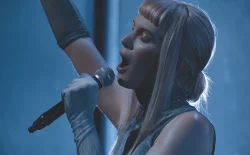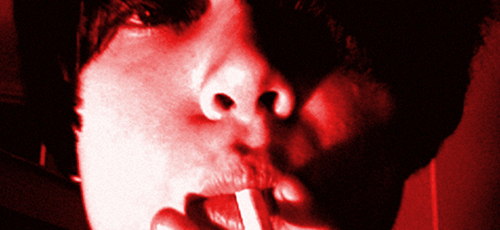
“My music is as apolitical as I am…I think it would be a big undermining of the process of music-making to waste it on politics.”
Natalie Beridze is not your typical electronic music producer. Hailing from war-ravaged Georgia, her work is inventive and exploratory, yes, but always playful and highly personal – music that looks inwards for inspiration. Releasing and performing mainly under variations of the name TBA, Beridze rose to prominence in the mid-noughties through her work with the Goslab collective and then her association with Thomas Brinkmann. She has collaborated with Brinkmann on techno-oriented material as Tba Empty, and has released some of her best work on his Max.Ernst imprint, including her breakthrough record, 2005’s Annule. Combining dancefloor-primed tracks (what Beridze describes as “straight-beat”) in the microhouse mode with more delicate, contemplative compositions, Annule has deservedly earned cult status in the five years since its release, and like all Beridze’s productions, it deserves to find an even wider audience, and no doubt will in time.
Now dividing her time between Tbilisi and Berlin, Beridze looks to be entering a new purple patch in what has already been a highly fruitful career. In 2010 she’s set to follow up her Pending album for Laboratory Instinct (a platform for releases by A Guy Called Gerald, Atom TM and Daedalus, among others) with a new club-focussed 12″, ‘Straight Base Drum’, heralding a new LP for Monika Enterprise, the Berlin-based label operated by Gudrun Gut. It includes a collaboration with Ryuichi Sakamoto, following her contribution to his chain-music project.
As part of our continued collaboration with the Alpha-ville festival to shed light on some of the lesser-known talents in the electronic music sphere, FACT spoke to Natalie about her past, present and projected future work. You can also listen to an exclusive podcast made by TBA for Alpha-ville by clicking the link below.

Listen: Alpha-Podcast presents TBA
You studied political science prior to releasing records. Is your work as a musician political? Do you consider yourself a particularly political or confrontational artist?
“I did my masters in Political Science and later in Media only because I didn’t know what to do after I was finished with my post-graduate. Four years of wasting time…and although I realised how ridiculous it would be for me to study politics, I passed those vicious exams and even got my masters at the end of the year. Frankly I just tried to avoid starting a job, so I filled up every second of my spare time. I didn’t know I was going to make music back then…[laughs]
“My music is as apolitical as I am. I don’t think I even have a clear message or a statement to convey. Or at least I tend not to think about it in the process of making music. I think it would be a big undermining of the process of art and-music-making to waste it on politics. Process of work is probably the only area of absolute intimacy and freedom. Those two things have absolutely no resemblance to politics.”
“Process of work is probably the only area of absolute intimacy and freedom.”
What is Goslab?
“It was a group of friends, who wanted to play creative games and hang out the best they could in given circumstances…It was not long after the civil war in Georgia, which was followed by another war in Abkhazia, leaving the country crumbling. It was a time of fear and confusion – of electric black-outs, felony, isolation. A time of anguish and despair. But nevertheless there was a huge wave of commitment and eagerness to pull through. In a sense the only way to break through was to stick together and surf on a wave different to reality. We named it Goslab for better sense of integrity and togetherness, and we had fun…
“Nowadays there is no more need for collective effort, since there’s no more hindrance as such. So we all work separately. Goslab is now a recollection.”
How has changing technology influenced your artistic practice? Do you have a core set-up that never changes are you always adding to it, looking for ways to improve it?
“I’d be lying if I said I was a high-tech addict or perfectionist. I more or less have a reference of the perfect sound from the perfect speakers, since I had an experience of working with them. Nowadays I’m back to shitty ones, but the reference does it’s job [laughs]. Fruity Loops is my absolute favourite. I’d never trade it for anything. So that’s pretty much my core set-up. Plus the mic…”
“It was a time of fear and confusion – of electric black-outs, felony, isolation.”
Tell us about the podcast you recorded for Alpha-ville – what aspects of your work does it represent?
“The mix I made is of music which I not only admire, but which is also literally part of my life. The idea was to mix music has inspired me lately, so I just skipped through my iPod for honesty of choice [laughs], and I took the playlist which has been there forever. I doubt that this selection would ever become boring for me.”
Were there any particular artists or works that really inspired you to embark on your own career as an artist?
“Me becoming an artist was a result of coincidence and sheer luck. I did know that I would be an artist, but I didn’t have any preference for, or commitment to, one particular discipline. My friends were doing electronic music back then and I found it stunning that you could produce music without even basic knowledge of notation et cetera, so I got myself an ugly desktop computer and installed Fruity Loops. I was lucky, firstly because I had people around me who were motivating and gave me a sense of determination to do music. And I was lucky because I got a record deal in less then a year.
“Additionally, I undoubtedly was, and always will be, inspired by the legacy of truly outstanding composers and artists, the list of which is a bit too long to recall in full. I’ll avoid relaying the names, so as not to leave anyone out.”
“I wanted to be with the man who would become my husband, in Cologne, and instead I was trapped in Tiflis, Georgia.”
The first album I ever heard by you was Annule (Max.Ernst, 2005). Can you tell us about that origins of that record? How do you feel about it now?
“It was the third album I did, and strangely it sold the best. The title track ‘Annule’ was recorded in a desperate need of a Schengen Visa, which I was rejected in most of the consulates of Georgia. I wanted to be with the man who would become my husband, in Cologne, and instead I was trapped in Tiflis, Georgia. That’s the story of the cover artwork and the title track. This album was the first time I tried straight beat and rap [laughs]. I also found out that merging different styles of music is probably the most interesting way for me to put together an album. That’s how I’ve done it ever since…”
What other up-and-coming artists are you into at the moment? Any recommendations of people we should check out?
“Nika Machaidze AKA Nikakoi.”

You make a lot of broken, rhythmically abstract music, but you’ve also made tracks that are more club-oriented, rooted in house/techno. Do you think of any of your music as “dance” music? Does dance music interest you?
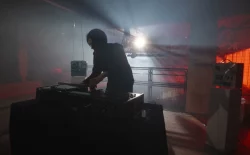
Tba Empty’s Stupid Rotation is the first dance album I made. It’s something I always loved and wanted to do, but never thought I could. Techno was always one of the biggest inspiration sources to me. It has the most qualitative and functional emptiness in it. There’s no other construction that has so much room for thought inside.
“In the beginning I thought that I’d never be able to produce anything groovy enough to make me dance. With Stupid Rotation I was startled to find out that I can make a club full of people dance for hours and that playing live can actually be so much fun. Since that album I put out several EP and LP s with a pure, straight beat. For me, it’s much more difficult to produce a good techno track then a good song or a composition for piano. And it is 100% due to Thomas Brinkmann that I sometimes make straight-beat.”
“Techno was always one of the biggest inspiration sources to me…There’s no other construction that has so much room for thought inside.”
What reaction are you trying to provoke with your music? What message, if any, are you trying to convey?
“I’m truly happy if my music is able to reach the listener. I never think of putting any concrete message into music. It’s as abstract and metaphysical as poetry. Initially you make music or art because you feel the urge to say something, but I don’t care about the content of what I’m saying.
“It doesn’t matter if what you say is accurate and true. I don’t care about facts, because myths are much more alive, bewitching and creative, because they provoke development and process. Most importantly they have ability to live and inspire further on, beyond the feasible verge. So if my music succeeds in reaching someone and changing just a tiny little detail, or making one’s day – then i think I’ve done a good job [laughs].”
Where do you live and work? In the city? How have your surroundings affected the kind of work you make?
“In Tbilisi and in Berlin. I really don’t know if my surroundings have much to do with my work. It’s always hard for me to answer this question, because once again my understanding of music and the process of making music is way too focussed on individual approach. That certainly involves the environment and surroundings in which an artist was raised and formed. But at the end of the day music is more wide-ranging and extensive then cultural bounds, it is an integrated part of our inner world. That’s the place it interacts with, and derives from.”
“I became lazy because I make music, which is a pure luxury – it requires nothing but a moment of peace and contemplation.”
You’ve made several films, right? Are you still working with visual media? Is the visual aspect of your performances important to you?
“I’ve made actually just one video and luckily enough it won a prize at the film festival. I guess that’s why people think that i make video art too…
“Right now I don’t do any visual media at all. It’s too focused for me. Somehow I think that besides the form, it also requires a great deal of ideas. And me – I totally lack ideas. I became lazy because I make music, which is a pure luxury – it requires nothing but a moment of peace and contemplation.”
You released several records on Max Ernst. Did the music and ideas of Brinkmann and the label influence you in any way?
“Absolutely. Thomas taught me probably the most important thing: to be able to confront your limits and go beyond them. His music is just as uncompromising and unconditional as his character. Max.Ernst [Brinkmann’s label] gave me and my music a chance to find it’s way in the world. And the way this label works is probably the most incorruptible and self-aware that I have ever encountered.”
“The way Thomas Brinkmann and Max.Ernst works is probably the most incorruptible and self-aware that I have ever encountered.”
How do you feel the climate, audience and market for electronic music such as your own changed in the years since you began your career as an artist?
“I think it was already too late and too burdensome to become big with the small labels when I began making music. It was already not ‘the right place and the right time’ kind of thing, because by that point electronic music had its front-runners and the canon had been formed. Nowadays the scene is even more hostile for the newcomers, because music doesn’t sell, unless it’s from the ‘big name’ and unless millions of dollars were invested in it beforehand. The MP3 download era is not exactly very friendly with the labels, distributors and artists. We all have to think twice before spending money on a moderate 2,000 copies. But even that is not a good enough hindrance for artists. And even though there’s just too much music and too many labels nowadays, I still encounter outstanding and quality music sometimes, and that’s just about enough.”
Tell us about your work on chain-music…
“One day I got a mail from Ryuichi Sakamoto, who wanted me to participate in the project. I sent him lot of music and we chose one track. Later on we collaborated on one track, which is going to be part of the album I’m releasing on Monika, in september.
What else do you have lined up for 2010?
“An online EP release on Monika (actually happening right now), also a CD release in September, on Monika, and vinyl (‘Straight Base Drum’) on Laboratory Instinct. “I’m also working on a feature animation film soundtrack…very excited about this.”
Kiran Sande
More from News




![Ryoji Ikeda installation data-cosm [n°1] extended at 180 Studios until 1 February, 2026](https://www.factmag.com/wp-content/uploads/2025/12/data-cosm-ALubbock_180-14Oct-3554-250x155.webp)
![180 Studios presents new Ryoji Ikeda installation, data-cosm [n°1]](https://www.factmag.com/wp-content/uploads/2025/10/ryoji-ikeda-data-cosm-1-250x155.webp)