
The secret history of Warp Records

The following is an extract from How Soon Is Now? The Madmen and Mavericks Who Made Independent Music 1975-2005, a new book by Richard King. Reprinted with the kind permission of Faber and Faber Limited. All rights reserved © Richard King, 2012.
By the midpoint of the 1990s the momentum of the independent sector had stalled almost to a halt.
Rough Trade and Factory had both ceased trading. Creation and 4AD were in the hands of a support staff as [Alan] McGee and [Ivo] Watts-Russell, exhausted and broken, had removed themselves from the day-to-day running of their compaines. Daniel Miller was finding himself in the difficult position of firing and rehiring staff as Mute’s finances became increasingly volatile. With the end of Rough Trade Distribution came the end of the most sympathetic route to market for independently released music – a market that was now beginning to harden into a professional era of double-format CD singles, high-end advertising campaigns and overpriced albums. The music often associated with independence or indie – four-piece guitar bands referencing the Sixties – had become mainstream and rebranded Britpop. Almost none of the bands associated with it were signed to independent labels.
The most creatively successful independent label of the era had nothing in common with the perky ordinariness of Britpop.

Beckett and his friend Rob Mitchell were in their early twenties but already veterans of the Sheffield underground, whose focal point was FON studios and record shop. FON had been a bridge between the dystopian futurism of the Sheffield of Cabaret Voltaire and Human League and the city’s next generation of bands like Hula and Chakk. It was with Chakk’s major-label advance that FON had been built as a state-of-the-art studio. The project had been successful; FON’s clients included David Bowie and Yazz. Chakk’s material was recorded by Robert Gordon, a local producer and FON regular who had credits on mixes for Top Forty singles by Erasure, Ten City and Joyce Sims to his name, and a reputation for serious technical dexterity behind the mixing desk.
The debut release on Warp was an evocation of the nocturnal energy of an industrial city in decline, whose empty, industrial spaces were being turned into illegal and autonomous party zones.
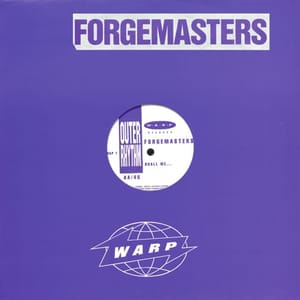
Pressed up as a white label, ‘Track With No Name’ by Forgemasters was the debut release on Warp, an evocation of the nocturnal energy of an industrial city in decline, whose empty, industrial spaces were being turned into illegal and autonomous party zones. “The whole thing was crime from the start,” says Beckett. “It was an illegal place, selling illegal drugs, with the gangs on the door taking their illegal money. But people were having this amazing time and I can’t ever remember fights going on.”
“On a Saturday they were literally queuing down the street to wait for the doors to open. All the Transmat releases, or whatever the two or three big tunes were that week, would be gone in an hour.” – Steve Beckett
Warp was initially a partnership between Beckett, Mitchell and Gordon. The first decision taken by the trio was to refit the FON shop into a new record store, also called Warp. The cash flow for the refurbishment came from an unlikely source and was testament to the trio’s working knowledge of the grey-market economics of hardcore. Warp sold tickets for events at Sheffield University, then one of the indie circuit’s most successful venues. “We sold thousands of pounds of students’ union tickets and then used that as cash flow,” says Beckett. “They’d say, ‘We need the invoice paying.’ We’d just keep fobbing them off until we’d got the money, but obviously, because it was students who had no business sense, they just think everything works like it’s supposed to work. ‘You’re supposed to pay us now.’ … ‘Yeah, but we can’t.’ ‘Oh – what happens now?’ ‘Come back next week’ … ‘Oh, OK.’ … ‘Chill, chill.'”

Warp specialised in imports from Chicago and Detroit, steel cities producing sleek precise techno that was in as much demand from local DJs as from the record-buying cognoscenti. “On a Saturday they were literally queuing down the street to wait for the doors to open,” says Beckett. “All the Transmat releases, or whatever the two or three big tunes were that week, would be gone in an hour. The importer had brought in what he could and there was obviously no digital access to it then, so it was a real supply-and-demand thing.”
Despite bringing the sound of hardcore into the Top Twenty, Warp was encountering some severe teething problems.
The influence of the music released by Transmat, Metroplex, Trax and Underground Resistance could be heard on the next set of Warp releases. A series if 12-inch singles by Tricky Disco, LFO and Sweet Exorcist, the latter an intergenerational collaboration between Cabaret Voltaire’s Richard H. Kirk and DJ Parrot, combined the minimalism of American techno with a northern intensity. In typical fashion, John Peel’s antennae noticed the energy coming from a new, non-metropolitan label and he began playing Warp releases as a matter of course. “We got a call from Peel about Sweet Exorcist at the shop,” says Beckett. “He’s like, ‘I love this record, I’m playing it tonight.’ One of the guys serving in the shop was walking up the stairs going, ‘This is the coolest fucking shop in the world.’ He was like, ‘John Peel!’ His life was made.”
 Warp had quickly found that its releases had an unexpectedly large market. ‘Tricky Disco’ by Tricky Disco reached no.14 in the Top Twenty in November 1990 and ‘LFO’ by LFO had already been in the charts that July. The raw self-titled anonymity of the releases was an overt emphasis on the functionality of the music.
Both LFO and Tricky Disco were bedroom producers with access to recording equipment that could produce the minimal and hard-edged sounds that worked in a club, without the need to visit a studio. Once a track was finished it was mixed down straight on to a metal cassette and tested through the rave PA. “It wasn’t even demo-led at the time,” says Beckett. “People were literally walking into the DJ booth and going, ‘What is this record?’ LFO were playing cassettes in the club. We were going up to them and persuading them we had a label and wanted to put a record out.”
In the absence of either party knowing or caring about the legal or technical details of a record deal, LFO and Warp decided that, rather than bother with a contract, they should place their signatures on the LFO demo inlay card. As well as being the medium on which their music was played in clubs, the cassette was also their binding agreement with Warp. “We didn’t know what you’re supposed to do, but they said, ‘Oh, you’re supposed to sign them.’ So we said, ‘What will we do? Let’s just sign it then, sign the tape.’ So that was our first deal.”
“That was our introduction to the music business. We just thought, oh my God, what have we done?” – Steve Beckett
Despite bringing the sound of hardcore into the Top Twenty, Warp was encountering some severe teething problems; Robert Gordon left the company and the partnership on bad terms. More significantly, Warp had made a decision they were now starting to regret. After its appearance as a white label, ‘Track With No Name’ had been re-pressed and given an official release. The record was housed in the distinct purple sleeve that would become a Warp trademark, but on the vinyl label there were two record company logos, the smallest of which said Warp, the bigger Outer Rhythm.
“We almost straight away started going into the relationship with Rhythm King,” says Beckett. “We got our sleeve back and we were like, ‘What the fuck! What the fuck’s Outer Rhythm? Where’s our thing?’ That was our introduction to the music business. We just thought, oh my God, what have we done?”
“Rhythm King was actually quite short-lived,” says Horrocks. “By the time we got to doing ‘Rock Da House’ and ‘Beat Dis’, we had everything worked out: how to work a record, make it successful, etc., and it kind of went hand-in-hand with the proliferation of Ecstasy and clubbing.” Three months later the label had its first no.2, ‘Theme From S’Express’ by S’Express, a record that had been financed along with the rest of Rhythm King’s catalogue by Daniel Miller at Mute.
Rhythm King’s success was not without its problems for Miller. The culture of dance music relied on a fast turnover of artists. Despite top-of-the-range studios and expensive videos, many of its successes did not last. In contrast, Miller had always run Mute at its own pace, one that was dictated by when his artists had finished recording an album.
Warp signed to Rhythm King’s experimental subsidiary, Outer Rhythm, and looked on in horror as LFO and Tricky Disco climbed the charts.
“I think I took too much on financially,” says Miller. “Even though it was successful in the beginning, it was quite a strain. Also Rhythm King and Blast First didn’t like each other at all. I was trying to control these renegade people, and I think the artists found them quite difficult to deal with as well.” The hedoism of the dance floor had been amplified by Rhythm King’s chart success and the company was determined to enjoy the high life. The partying duly took over. “I often got the artists coming to me saying, ‘What can we do?’,” says Miller, “because they couldn’t really deal with the culture of that company.”
A scout for Rhythm King had picked up on ‘Track With No Name’ as a white label, and Beckett and Mitchell were asked if Warp would be interested in working with the London company. “They made an approach to do a label deal and we thought we’d done the deal of the century,” says Beckett. “We signed away everything for £10,000 and just walked out of Rhythm King going, ‘Yes,we’ve done it.'”
Warp signed to Rhythm King’s experimental subsidiary, Outer Rhythm, and looked on in horror as LFO and Tricky Disco climbed the charts. “It’s the classic story,” says Beckett. “You’re into your little mind-set going, ‘Fucking some idiot’s given us 10,000 quid to release our records,’ and then not realising that after a while you’re selling 100,000 records and you’re not seeing a penny and going, ‘Hold on…my God, what have we done?'”
Beckett and Mitchell asked Daniel Miller to intervene and help them extricate Warp from the Rhythm King deal.
Miller [pictured right, in 1983] was more experienced and at one remove from the still-evolving and frenetic culture of dance music. As he surveyed the fly-by-night deals and fractious relationships between the parties involved, he began to understand that the relationships between Mute, Rhythm King and Warp were no longer practicable. “We did very well for an eighteen-month period. We had no. 1 singles, but it was very pressured,” he says. “One of the parts that got unravelled was Warp, and I regret that massively, of course.”
Beckett and Mitchell asked Miller to intervene and help them extricate Warp from the Rhythm King deal. Miller, displaying his ability to retain perspective amid the chaos and recrimination of fast money and chart success, agreed to facilitate Warp’s departure. “We were having secret conversations with Daniel, trying to get out,” says Beckett. “We’d meet in the cafe nearby and he just said, ‘Oh God, not another one.’ I’ve got so much respect for him. He was the one drilling into our heads to get the international side together, saying, ‘Look, every label’s hot for a while, then they go cool in a year or two. Don’t just rely on the hacks in the UK, get all your international things set up.”
On Miller’s advice they started to develop a catalogue distinct from the hot-for-a-week turnover of hardcore singles.
Rhythm King proved a salutary experience for the partners in Warp. They had registered incredible sales through word of mouth and some night-time plays on John Peel alone, but none of the profits had made it back to Sheffield. Once Beckett and Mitchell recovered control of the label, they resisted any further offers from interested parties and insisted on remaining independent.
On Miller’s advice they started to develop a catalogue distinct from the hot-for-a-week turnover of hardcore singles. In a display of their A&R instinct that would become one of the label’s hallmarks, Warp released the first album by a British techno artist, Frequencies by LFO, in 1991. “Frequencies was the first album we did,” says Beckett. “It pulled us out of the trough, where we were just completely skint with no royalties, and it was the point where we turned ourselves into a record label. We really started clocking that that was the way to have a bit of longevity and build artists.”
All rights reserved © Richard King, 2012
Taken from How Soon Is Now? The Madmen and and Mavericks Who Made Independent Music 1975-2005. Reprinted with the kind permission of Faber and Faber Limited.


