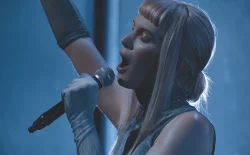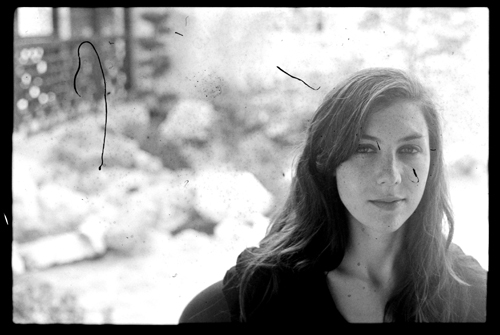
‘Marienbad’
Julia Holter’s Tragedy was one of our favourite albums of 2011, and we were far from alone in our lauding of it.
It’s rare for a debut to earn such a broad and unambiguous sweep of critical praise – particularly one as esoteric as Tragedy, whose labyrinthine song architectures and arcane sonorities were bound together with a narrative lifted from Euripides’ Greek epic Hippolytus.
This year’s Ekstasis is crisper, brighter, poppier – songs like ‘Marienbad’ and ‘In The Same Room’ seem almost chart-friendly compared to some of Tragedy’s more delphic passages – but without losing its structural suppleness, its tendency to veer off into lengthy explorations of virgin territory. Put simply, the LA musician has amply met the stratospherically high expectations placed on her, without making the mistake of fulfilling them to the letter (as evidenced by her recent FACT mix, which seemed to ruffle a few feathers).
Holter’s bid for global renown is coming on apace in 2012 – last week saw the debut performance of her new three-piece band at Le Poisson Rouge in New York (which you can watch here), with a tour of the UK and Europe to follow in the next couple of months.
FACT’s Angus Finlayson met Julia during a recent visit to London, to discuss the various preconceptions and misconceptions surrounding her music, of which there appear to be many…
“Running out of ideas is just not a concern I have.”
 I thought it’d be good to start by talking about the live show. You have a band now?
Julia Holter: “Yeah, two guys I know from the music world. Corey does a lot of solo percussion stuff, and Chris, I worked with for a while, he’s a great cellist. I just started working with them like a month ago, we threw together some versions of my songs.”
The arrangements of your songs on record are very complex. How did you go about re-arranging them for a band?
JH: “Well, it’s sparser. We’re not using anything besides what we’re playing. It’s really cool…I’ve come up with some ideas for the arrangements but for the most part I just play the songs back to them and they come up with ideas. There’s a lot of things that I tried to do on the recordings that they can do better, and that’s been really exciting. Then there’s a lot of other stuff that’s missing from it, but I think that’s just part of it. Mainly, actually, what’s missing is the vocal harmonies, so I’d love to have another singer with me.”
Is it difficult, you having put all this detail in the recorded songs, to then have to strip them back for a live setting?
JH: “I don’t think it’s difficult except that we had so little time, it was completely terrifying. Because this New York show [at Le Poisson Rouge] did get kind of built up…somehow interest accumulated, and I didn’t expect that. It was our first show and I was just like, ‘Oh God, everyone’s going to judge me based on this show’. So we really worked our asses off for like four weeks.
“People sense some sort of formal thought that goes into my work. To me it just sounds like pop music.”
“For the most part, I want to re-arrange my songs specifically for a live setting, because it’s just different. You can’t pretend it’s not – at least in my case. I think there’s some music, dancier music maybe, where you can convincingly bring in backing tracks, try to recreate the song or whatever. But for me you’re basically creating a new experience, you can’t deny that. And it would be fake to try to recreate the album, because it was already made in such a funny way anyway.”
 About that album…Tragedy had a narrative to it, of sorts, but Ekstasis doesn’t. How did your approach differ?
JH: “I was writing both of the records at the same time. So with Tragedy I was having fun with this story I was building it off of – and then Ekstasis was kind of freeing, I didn’t have a particular story, I was just building these individual songs. So it was nice to have two different projects, I could have fun with two different approaches.”
With the two albums out in quick succession, have you totally cleared your backlog of songs now?
JH: “No – I finished Ekstasis like a year ago, and Tragedy a year and a half ago, so I’ve been writing a lot since. I’ve written enough music for one and a half records already, maybe two.”
Do you ever worry about running out of ideas?
JH: “No…no. I mean it could happen, I’m not saying it won’t. It’s just not a concern I have.”
So has what you’re doing now changed a lot from these two records?
JH: “I think what’ll be different is I’m going to work with other people to play it, it won’t just be me recording myself. But my conception of my own music is kind of weird. Even the music off my EP in 2006, that no one’s really heard, I still think of that in the same way as Ekstasis and Tragedy. Regardless of the context, whether it’s part of a concept or an independent song – I’m always kind of writing for the words, writing for the purpose of each song, and not thinking about how it’s different. I don’t think of my work as progressing. I mean I do think I’ve gotten better at certain things, but it’s hard for me to identify what those are.”

‘In The Same Room’
You studied at music college – composition?
JH: “[slightly exasperated] Yeah.”
Right. Do you get really bored of people coming back to that? Do you think it was significant, or is it peripheral to what you do now?
JH: “I understand why – it was kind of announced, and that’s the problem. Basically I really think it’s good to study music theory and stuff like that. Studying composition for me was kind of a mixed experience…it was a really good challenge, it was a good struggle that I had. But I do tend to shy away from the discussion of it I think. Which is stupid, because it was really an important experience and I learned a lot. I think the people that wrote my bio – whoever it was – put it in because some people sense that there’s some sort of formal thought that goes into my work. To me it just sounds like pop music, what I do.”
And is there formal thought?
JH: “I think I structure things carefully. I don’t know if you can tell from the music if there’s anything ‘classical’ about it – I don’t think so. All know is I put a lot of work into it, you know. I do have to come up with a basic idea, some kind of seed of something that’s repeating, and then it kind of becomes this structure that I work with. But after I got out of school I very quickly learned to trust my instincts, and basically follow my heart with everything as opposed to constantly questioning – ‘why am I doing this?’, ‘what am I referencing here?’, whatever. Because of the way I am, I think school was very anxiety-inducing for me – I constantly felt like I was supposed to be questioning and analysing my work every step of the way. It was really awkward. It created very awkward music [laughs].”
“I very quickly learned to trust my instincts, and basically follow my heart with everything as opposed to constantly questioning – ‘why am I doing this?’, ‘what am I referencing here?'”
You mentioned needing a seed of an idea to start with. How important are literary influences – or at least influences from other art forms – to your work?
JH: “It depends, each song is different. Sometimes I don’t have any influences…inspiration is a good word maybe. Influence is a harder word because I don’t know what I’m influenced by. I don’t think it’s references either. I do sometimes use quotes that I reference later in footnotes or something like that, so that people know that wasn’t me, it wasn’t my words. But I use quotes because they work with what I’m doing, kind of like why people sample things. It’s like with Frank O’Hara poems where he describes paintings that exist already: it doesn’t feel like a reference, it feels like just part of his poem, it kind of all blends in. I guess people would say that’s stealing from the idea or whatever, but to me that’s just how you make things. You incorporate the image of something else that evokes something else. Yeah it’s borrowing, but that’s kind of how I work.”

I wanted to ask about field recordings. How important are they to your work, and how do you use them?
JH: “I use them sometimes, Ekstasis barely has any but…”
There’s a couple on Tragedy, and you used them in your FACT mix…
JH: “Yeah. The FACT mix actually was mostly music by other people and then recordings of the radio that I did. It was basically what I listen to, my world. I don’t really listen to a lot of new music. I think I should but I haven’t, because I’m a bad person I guess. I’m just very involved in my world – I haven’t really kept up, so it’s hard for me to make a mix of new music that would be very good or interesting. So I made a mix of stuff I hear everyday, because I thought that would be good and interesting. It’s OK that some people clearly hated it, that’s fine.
“In general with field recording, there’s something really exciting about recording an environment. It’s like creating a world, once you have it on record, it’s like a platform to build a song off – or it’s already a world, it’s already a song. There’s already a story which you couldn’t create on your own.”
“I want to be the songwriter, and I want to produce the music, but I don’t want to engineer it. I don’t listen to things that way, I think I’m very zoomed out or something.”
A lot of your tracks are kind of through-composed, they don’t follow strict song structures. How important is a sense of ‘story’, or linear narrative, in your music? Do you have that in mind when you write?
JH: “Every song’s different, so the form is different for every song. I don’t have a need for there to be a story necessarily…whatever works for that song, you know what I mean? It sounds vague, it is vague. That’s sort of a stupid answer to your question, but that’s how it is. It’s just that certain words call for certain melodies and call for certain forms. I just take words and I try to…they come together with sound. It’s so terrible and vague. It’s hard when people ask me what I do with music, it’s hard for me to describe.”

Often people attach the tag ‘lo-fi’ to you. How do you feel about that word, do you see yourself as a ‘lo-fi’ artist at all?
JH: “No.”
Why do you think people apply that word to you?
JH: “Because I recorded it myself, but the thing is everyone’s doing that. My record doesn’t sound lo-fi to some people – it sounds pretty hi-fi to me, but I don’t have the ears for hi-fidelity.”
You mean you prefer lower fidelity sound?
JH: “No, I just can’t tell the difference. Like I can’t tell the difference between a WAV file and an mp3. I’ve tried and it sounds the same to me. In general, I’m just not perceptive about that stuff, and I kind of don’t care. I want to do it right though, and I want to work with people who do care, and I want to collaborate with them and not have to focus on it. I want to be the songwriter, and I want to produce the music, but I don’t want to engineer it. I don’t listen to things that way, I think I’m very zoomed out or something.”
“I’m hesitant to say I’m so ‘trained’, because I am trained in a certain way but I’m also very insular, and there’s so much I don’t know about musically.”
It’s kind of like Nite Jewel – the word lo-fi was applied to her a lot, and then with this new album she’s got into a studio and it sounds polished and hi-fi. Is that the next step for you, getting into a proper studio?
JH: “Oh yeah absolutely – I already have a bunch of demo stuff that I want to do. But the goal was always to make something really rich sounding. I want it to sound like an orchestra or something, I want it to sound really big. From 2006 when I was making Eating The Stars, I wanted it to be sounding great. To me it sounded hi-fi. I wasn’t even using proper speakers, I was just using my computer speakers, there was no bass – but I just worked with what I had, so at that point I was like, ‘Oh well, it’s blending really well’.”
In terms of your influences, people like Laurie Anderson and Meredith Monk are often mentioned. Do you feel that, as a female musician, you only ever get compared to other female musicians?
JH: “Yeah I do, but sometimes there’s an exception and someone thinks of a male artist. I accept that there’s gender differences between people and I have a feminine voice, so that’s fine. I’ve never heard Meredith Monk really, though I’ve listened to her a little bit and I have a sense of what her music’s like. And with Laurie Anderson, I’ve heard ‘O Superman’ a few times, but I don’t ever listen to her. I actually just recently bought that track because I’d heard so many people say that I sounded like her. I think they were probably pioneers though, and a lot of people that I’d heard growing up had been influenced by them, so you know. I’m not denying that, but I just don’t know their music. There’s a lot of music I don’t know, and that’s why I’m hesitant to say I’m so ‘trained’, because I am trained in a certain way but I’m also very insular, and there’s so much I don’t know about musically.”
Final question – what have you got coming up?
JH: “We’re going to be touring a lot. I have a tour coming up in Europe, for a month – May 25 to June 25, then hopefully some US dates after that. And I already have a ton of songs that I want to put out, so that’ll happen soon I hope.”
Angus Finlayson
juliashammasholter.com
Julia Holter’s Ekstasis is out now on RVNG Intl.










![Ryoji Ikeda installation data-cosm [n°1] extended at 180 Studios until 1 February, 2026](https://www.factmag.com/wp-content/uploads/2025/12/data-cosm-ALubbock_180-14Oct-3554-250x155.webp)
![180 Studios presents new Ryoji Ikeda installation, data-cosm [n°1]](https://www.factmag.com/wp-content/uploads/2025/10/ryoji-ikeda-data-cosm-1-250x155.webp)