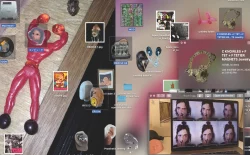
Available on: Smalltown Supersound LP
It goes without saying that dance music is about much more than dancing. Dance music is music for work, rest and play. One of house’s natural homes is cooking. Something about the slow, holistic build-ups, the clean easiness of the beats, and the general beauty of it make it fit gastronomic creation perfectly. And so Bjorn Torske releases Kokning, named after the Norwegian process of putting potatoes on the boil then going out to catch a fish and prepare your meal. In Norway you can seemingly be certain to catch a fish in the time it takes to play a house record; in fact, I like to imagine that’s some family’s motto.
The opening track is a simple and easy starting block, the onions and oil of your musical dish. Then we move on to more intricate songs like ‘Gullfjellet’. It could be used as a soundtrack to speeded-up films of flowers coming into bloom; every song grows. And they all sound very organic, too. There are plenty of simple sounds and instruments; acoustic guitars, clean electric guitars, the synths muffled and simplistic. Then ‘Langt Fra Afrika’ starts up, a two-minute djembe loop bringing you back down to reality after Gullfjellet’s dreamy guitars brought you too high up.
And things begin to heat up. ‘Bergensere’ is one of a handful of club tracks on the album. Disco resonances abound, from the cheap drip-drop synth punches in the intro to the repetitive, flustered bass. But then this high synth line comes in, sounding almost 8-bit. It’s so heavenly that when the guitar comes in to match it, it feels a little unwelcome. Two tracks later, the album’s highlight arrives in the form of ‘Nitten Nitti’. It sounds like a Speaking in Tongues-era Talking Heads instrumental. Witty, widdling synths are joined by a scratchy high-end guitar riff, repeating over and over. A simple snap-crack beat keeps things on track with a properly beautiful hi-hat coming in as the tone gets a bit wobbly.
At times Kokning does drift a bit too far into the Royskopp end of the spectrum, with music that’s a little anonymous. ‘Slitte Sko’ is a good example of this. It features a thumb piano. I think it’s fair to align the thumb piano with the kazoo or the harmonica as a musical instrument; if you want to play it, fine, but you have to play it really inventively to make it good and worthwhile. And Bjorn doesn’t really do that, and it starts to meander into chill-out.
But even ‘Slitte Sko’ features a heavenly warm two-note bassline coming in half-way through, and just going on and on over and above the song which redeems it. The whole album is perhaps not to be listened to overwhelmingly closely. I like the idea of dance music being made with an activity in mind and so it’s best listened to when it’s not the only thing on your mind. The only part of it where the cooking theme completely ceases to make sense is ‘Versjon Wolfenstein’, a monstrous German prog number with ghoulish bass notes trembling right down at the bottom like human groans and, at one point, a chainsaw sample. But we all have our methods.
James Hampson
More from Residency









![Ryoji Ikeda installation data-cosm [n°1] extended at 180 Studios until 1 February, 2026](https://www.factmag.com/wp-content/uploads/2025/12/data-cosm-ALubbock_180-14Oct-3554-250x155.webp)
![180 Studios presents new Ryoji Ikeda installation, data-cosm [n°1]](https://www.factmag.com/wp-content/uploads/2025/10/ryoji-ikeda-data-cosm-1-250x155.webp)