
Mark Fell: vortex studies

Mark Fell – ‘Vortex Studies – 2’
“Since then my interest was in the texture of synthetic sound – there was something much more beautiful (and perhaps more emotionally charged) about a sustained square wave than any guitar solo. Soon I began to search out and replay sections of music which dropped to a single sound – these for some reason were the best.” – Mark Fell, UL8 liner notes
Best known as one half of the production duo snd, Mark Fell has focused on the singularity of sound as a composer, and technological art as a multimedia artist and curator for over twenty years. By applying academic techniques to his background in Sheffield’s historic ’80s and ’90s rave culture, Fell has consistently extrapolated dance music’s combination of minimalism and extended pop song structures into challenging and original territory. His two latest solo albums, Multistability and UL8, released within weeks of each other, show two distinctly different, yet inherently linked explorations of his intense interests. We caught up with him to find out more about their conception and his individual approach.
Multistability has been released on raster noton, as was snd’s last album Atavism. Was this a commission?
“It was kind of made with them in mind, but not a commission. I had been working on some ideas, thinking about making some music of this sort and wondered which label it would best suit. I spoke to Olaf at raster noton and he was keen on the idea, so I sent them some sketches and it just went from there. Although it’s not raster noton ‘central’ (ha) it seems to fit with their vibe somehow.”
A bit like Atavism.
“Yes, though that was also a bit outside their central aesthetic too, to an extent.”
It is described as being two different outcomes of the same starting material, so the album is actually featured twice, once in one way, once in another. Was it specifically designed to only have the two paths, or many?
“Well as the project developed I ended up thinking it would be a nice way to structure the album, two versions of itself. But beyond that there’s scope for several more releases as a result of the project, because I recorded loads.”
Since the tracks are essentially results from a starting point, I guess you arranged them in numerical order, but did you mean for them to be played in that order too?
“I’m not too keen on track follows track, etc. It’s nice to have a different overall structure; thats what i liked about some early Brinkmann or Ikeda releases, the structure of the album. I think it’s down to the way I play music; I rarely play something from start to end, so for me it’s just something to skip around in. People who come to my house are always annoyed at me because I just play 30 seconds of stuff here and there. Actually, I never listened the whole album through until recently. With UL8 I didn’t even listen to individual tracks the whole way through until I got into the master studio in Berlin, haha! At one point I had to stop Lupo and change something because it was a part I hadn’t really heard properly. I guess it’s a bit silly really, but I have such a short attention span.”
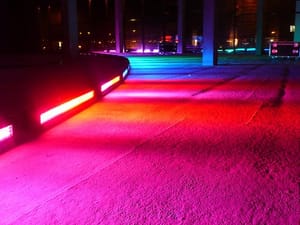
Mark Fell – ‘Multistability 10-A, 11’
But if it produces output then arguably it’s a good method of working for you.
“Yeah. I mean, I overcame problems with it a long time ago. Like, for example, I couldn’t work with timeline-based sequencing of music. So that’s how snd and the early Shirt Trax stuff came about; snd where nothing changed and we just tweaked sounds, and Shirt Trax (the album on OR) which was just chaos!”
As a ‘beginning-to-end’ listen I found Multistability difficult in stages, mainly durations of certain tracks. There is amazing content throughout, but what felt a little like some missed opportunities within it too, things that were only touched upon.
“Yeah, I like long durations. The listener can always skip forward. And missed opportunities, I guess you mean things I could have done, but then again I didnt want to introduce extra elements into tracks. I find some tracks have different energy levels, some pull you along, some are in your face, some create a kind of space or distance. It’s a kind of foreground and background.”
True. I think those levels of foreground and background distinguish it largely from an snd release.
“Yeah, to me it’s nothing like an snd record, but lots of people think it is since it uses some of the same kinds of sounds. But they’re used in completely different ways. People will hear the chords and the percussion, but even those are quite different. Then again, I guess I listen to these things differently having made them – I hear massive differences where perhaps the difference is only small.”
Well you do seem to have an intense focus on the listening experience in a way many others don’t.
“It’s probably hard to be objective about that. I guess people listen differently to things. But I think making patterns like that for several years has changed my sense of what is nice and what is crap.”
“I used to be totally anti-academia, but really it makes more sense to see what academic and non-academic practices can offer one another.”
Yours and snd’s music manages to bring something inherently of the immersive, physical club music scene, yet retains a more arguably academic approach and mastery of technique. It’s a rare balance of mixed aesthetics. Hecker seems to have captured this too, having a similar audience while using such totally academic approaches.
“I’m definitely interested in bringing together academic and non-academic musics, though not because one is better than the other. I used to be totally anti-academia, but really it makes more sense to see what academic and non-academic practices can offer one another. I think Hecker’s background is also in techno circles to some extent, and although his music is in a way academic sounding, his approach is very much intuitive. It has an energy you don’t find in many academic contexts.”
I think there is a tendency in academic music circles for the audience to be expected to sit and listen intently, to analyse the piece as it unfolds. Since there is a quote attributed to you about ‘music being a technology for an experience of time’, I was interested to know your take on that.
“I just put that quote in just to spark off questions! [laughs] I used to think there was a problem with seated spaces for music, but clubs were also a problem. There wasn’t an ideal space. I think I have changed my mind now though; in the past couple of years I’ve got more into seated spaces. But I’m not really into the idea that analysing music is somehow superior to just listening, so I react against that, I think. I mean, I am heavily into philosophy, but I don’t make music that you need a philosophy degree to enjoy. Like, people always say my stuff is ‘conceptual’ or whatever, but its actually just meant to sound nice.”
How much improvisation/intuition versus more rigid elements/processes went into Multistability compared to an snd record? And what kind of techniques are you using to accomplish these?
“I’m not really strict about process. Well, in some ways I am, some ways I’m not. Most of the tracks on both UL8 and Multistability are procedures implemented on a computer to generate patterns and timbral data that I will typically mess about with as they go along. It’s all dead simple, I have no real interest in technical complexity. I find the best systems are the very simple ones, where it’s just a very few linked procedures. They sound complex, but could be summed up in a couple of lines of text. So there might be a few parameters I change and that’s enough to create the level or change I want; I tweak the parameters until it sounds right. Lots of the time it sounds totally wrong, but then I find a set of values that work and explore those. On Multistablity there are only two places where I actually ‘composed’ notes, at the ends of part one and part two. I wanted to end with just those two bits after all this ‘non-composed’ stuff. The rest is all real time interaction with very, very basic pattern generating systems.”
“We tend to strip things away to bare essentials once things are on a grid – like, ‘what can we remove?’ A bit like that game, Kerplunk.”
How does this compare with how you and Matt Steel work as snd? Is there a typical process there? Do you supply material in a data form, and he arranges it?
“Er…it’s hard to say, really! Well, Matt’s a non-programmer, so bits of the algorhythmic stuff from me go in there…but then again much of it is just written into a sequencer. I guess sometimes I make a system, then we both mess about with it, or we both work on patterns. Which is good because one person can do something while the other relaxes on the sofa and listens. But, yeah, it’s actually quite a loose method we have. Lots of tea and chatting.”
That tends to solve most things. It sounds really tight and focused, considering the relaxed environment you describe.
“We tend to strip things away to bare essentials once things are on a grid – like, ‘what can we remove?’ A bit like that game, Kerplunk. Matt is also deaf in one ear, so I think for him the fewer elements there are, the more he can hear them. Also, we tend to know what each other will like. In a sense it was always there; I was interested in chords and percussion, and it was liberating to realise a track could just be that, and not have to have snare rolls and basslines, and so on. We would swap tapes of stuff we made (like, circa ’94) of just percussion patterns and lush chord samples, but then at the start of the snd project we agreed on what we would use, which was basically percussion, chords, and sometimes a twinkly sound like a vibraphone or some metallic tuned percussion playing a nice melody.”
Are yours and snd’s chords and melodies FM synthesis for the most part? It all sounds very metallic, glassy and glossy.
“Older snd stuff is mainly FM synthesis, but other stuff too, as we would take a chord sample from whatever equipment we liked. Atavism and Multistability are entirely FM though. I’m a big fan of it, as I have always been looking for other ways to tweak sound rather than filter cutoff. I got a Yamaha TX81Z in the very early ’90s, so that’s where I learned most of it. It had a great function in multitimbral mode where each sucessive note played the next voice, so if you had 8 voices you could play a sequence and it would cycle through them. That’s pretty crude these days, but at the time it was an amazing characteristic. I did loads of very basic tracks like that; I used to do a show on a pirate radio station in Sheffield around ’95-ish, and I would play these long tracks all night, from midnight until 6am, made entirely of complex sequences, haha! It taught me that if you find an interesting quirk, you can use if to create lots of interesting music, so I was always on the look out for gear with quirks. At that time I knew the spec of every synth ever made just in my head!”
How do you do these kind of operations live with snd?
“We use [graphical coding software] Max to implement pattern generating procedures, but recently we have decided to go for a kind of linear pattern approach. We got a bit sick of playing live with generative systems and decided we wanted to go the other way.”
How recently did you decide that? I first saw snd perform in 2008 and it didn’t seem very generative then.
“Yeah, by that time the live stuff was just patterns written as text files, and they would trigger external gear. We could DJ with them almost. We wanted something very, very basic, because our previous live set was entirely generative, like 1 million button presses a minute, and it got boring. Actually, i’m just developing the environment for the live version of Multistablity, which is interesting. It’s kind of like half way between the two; it’s all generative, but more like decks where I can load systems.”

snd – ’06:24:41′
“Although the patterns are machine generated, I hope it has a human feel, a kind of trajectory.”
How will it be presented? Performance piece, installation, toured live set?
“I’m going to do some live versions; a version for seated auditorium, for instance. And a version for brutal concrete car parks, ha! I hope to get a few dates out soon, but my priority is really studio work. Live is good fun – traveling, meeting people, OK pay – but studio work is more important to me, what I want to focus on.”
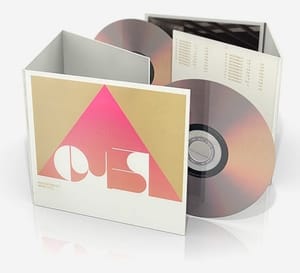
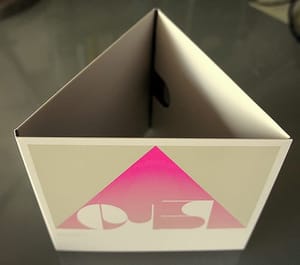
UL8′s first two parts feature a work of yours for DVD and a work for installation. For this release these were altered through the addition of synthetic percussion. I was wondering if you saw this as a qualifier of sorts? That by adding something more reminscent of ‘music’ as opposed to ‘sonic art’ it became a CD piece, and may therefore also appeal to a different audience?
“Well, again it was just an aesthetic choice; I wanted to make those tracks with kicks on because it would sound good. But they wouldn’t work in an installation context, I think. In a club they would sound much better with kicks and, although it’s not really dance music, it’s all ultimately music for clubs. Not all of Multistability, but some bits. All of UL8, though; for me, UL8 is meant to be a techno album, I imagined it being played in a club really loud as I was making it. None of UL8 has a normal time signature, but it is similar in some ways to patterns found in non-Western musics. I have a friend who is a musicologist working in that field, who pointed out some interesting things about it, the use of subtle duration and timing changes. So although the patterns are machine generated, I hope it has a human feel, a kind of trajectory.
Since these are larger scale compositions, unlike the smaller ‘fragments’ on Multistability, do you ever find yourself getting sick of the initial premise as you work on it? Start out excited but tire of it as you develop it?
“It depends. Multistability took ages to make. I ended up with literally days and days of material, and I spent ages making each sound. I guess it took 18 months on and off, and think that shows in the project. For me I’m totally happy with it. There’s room for me to develop it, but as a piece of music I am quite proud of it. UL8 was the opposite story; I had booked a mastering session and ended up making lots of the tracks in the days leading up to the session. Even while on holiday in Whitby, I took my computer and made some tracks because I was late completing it. So lots of the tracks on UL8 were done in three afternoons. It was a bit of a panic, but I think it worked out OK. They have a nice energy to them too, I think, which is quite apparent when you listen to it.”
How about the ‘Acids In The Style Of Rian Treanor’ pieces? Were they completed in the same way? And did they explore the same analogue technology principle as Hecker’s own ‘Acid In The Style of David Tudor’?
“I don’t know what Hecker used, actually, but mine were all digital. I’m only really interested in digital synthesis. The ‘Acids…’ pieces are the bits i did in Whitby; basically an afternoon and evening in the bedroom, on holiday, panicking! [laughs] But you can hear the urgency in the music I think.”
Rian Treanor: a multimedia artist in Leeds, involved in the Enjoy space and collective. Where does he fit in? His artist’s statement states that he ‘is concerned with the notion that the self is non-stable and subject to continual change’. I could see how this might tie in with similar concepts explored by Hecker regarding acid house’s constant timbral transformations.
“I like the idea of referring to what will happen, as opposed to the accepted ‘authority’ of the past. Treanor is my girlfriend’s surname, and we have two kids; Connie, 14…and Rian, 22. We were young, and basically all my adult life I’ve had a kid. Now he’s a really good artist, DJs and makes music. So the idea was to refer to a future [Rian] rather than refer to a past [David Tudor]. I spoke to Hecker ’bout this, as he is a good friend, and he laughed, so I knew he would not be offended!”
Steve Shaw