‘Destiny’ feat. Pional
John Talabot is currently the proverbial hot property.
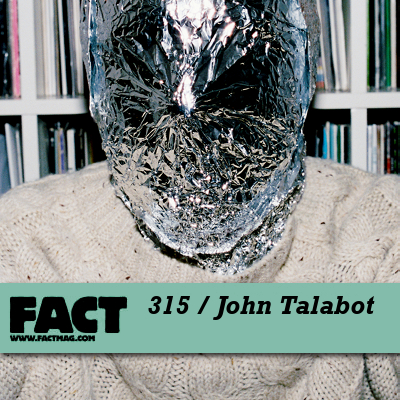
The extraordinarily talented, Barcelona-based producer, who has recently taken to hiding his visage with a piece of tinfoil – as you do – released his debut album this week. Entitled ƒIN, it’s deeply rooted in his beloved house music, but it’s not a dancefloor album. It’s something much more than that.
Over the next two pages, Talabot talks to FACT’s Mr Beatnick about his rejection of “fireworks”, his complicated relationship with hip-hop and the long lost romance of Soulseek.
 Okay first things first, the tracklisting of ƒIN really confused me. How many tracks are supposed to be on it?
“Ah, okay… There’s 11 tracks total, I decided I wanted it to be able to fit on one single vinyl LP, therefore the vinyl version has less tracks. I like that feeling from the 70s where you can play four tracks on one side, five tracks on the other – like the old-school days. So I left a couple of tracks off the vinyl pressing, but the LP comes with the CD too, so you still get them that way.”
And keeping with the surprises, it doesn’t feature a lot of, well, for want of better terminology, big house bangers like [Talabot’s 2009 breakthrough single] ‘Sunshine’.
“When I got the concept of the album in my head, I thought about what I wanted to do and what I actually listen to. I never listen to full albums of house music at home. Actually the only one I’ve listened to all the way through is Daft Punk’s Homework. So I said to myself, I’m not going to make a house album, because that’s not what I listen to.
“I said to myself, I’m not going to make a house album, because that’s not what I listen to.”
“I decided the concept would be more relaxed overall, no big ‘highlights’ like ‘Sunshine’ or things like that. I wanted people to travel through an album that was free of sudden firework displays. The album is chilled, no hard percussion tracks. I just didn’t want singles on there – tracks that could be more ‘important’ than other tracks – so that people would have to listen to the full set. And now different people prefer different tracks on it. A lot of albums these days have two singles and the rest doesn’t matter. I wanted to treat all the tracks with the same importance, since all have their function.
 With so many styles on display, it’s very hard to work out what influenced you at times.
“I don’t think there are really any specific influences for ƒIN. I put the things together that I like from the 70s, 80s and 90s and melted them together. I really love the soundtrack of Aguirre, the Wrath of God with the first track I wanted that sort of vibe. When he first arrives at South America… Have you seen the Herzog movie?
I haven’t, no…
“The music is by Popul Vuh, really atmospheric. So the first track, I wanted to have that sort of vibe, but it’s not directly influenced by them because it’s really more 80s, and that movie is filled with krautrock music. The last track on my album is more housey, I wanted a club sound that you could play out. The rest is all recycled ideas from older tracks. I decided I didn’t want an album that sounded like 2012. Like when you listen to old albums from certain years, and they don’t make sense in the context of what was around them. No sense in the future, no sense in the past. Not ‘timeless’, because that sounds pretentious, but timeless in that you can’t tell what year it was made.”
“When you hear real house, you can feel it. House is a feeling.”
Tell me about the guys who sing on your album – Pional is your label mate on Permanent Vacation, but who is Ekhi?
“Ekhi is the singer in Delorean, a Spanish band; last year they made their album and toured the States. We’re really close friends and we play football every weekend; over the years we’ve become a family. I wanted to try Ekhi’s vocals out, I liked how on my last record [‘Families’, on Young Turks] the vocals fitted with the electronic tracks.”
Download: FACT mix 315 – John Talabot
Do you feel part of “the new house revival” everyone is going on about? What do you make of the “classic house” reissue boom, people remixing old Strictly Rhythm releases from the 90s and things of that nature?
“Well, one of the things I didn’t want my album to be was a tribute album – I like it when you can feel the influences but it’s not a tribute. I’ve been a fan of house all my life, I’m a huge fan of 80s Chicago house, much more than 90s house. I always prefer that simplicity in house music, that repetition. Those 80s tracks were made with a four track recorder, a drum machine, a bass and a melody. With this album I tried in places to recreate that process: ‘Oro/Y/Sangre’, for example, was made entirely with a drum machine and a synthesiser. I love that simplicity, house is the most accessible and ‘pop’, and also the must mutable of the electronic styles.
 “It makes sense that there would be, or is, a house revival going on, in the last 15 years we’ve all been listening to house music, on the radio, in many different forms. It never goes away, because it can always mutate into something else. Nowadays, if I had to define what house is I wouldn’t be able to, it’s just too big. But it’s strange because when you hear real house, you can feel it. House is a feeling.”

‘So Will Be Now…’ feat. Pional
When I first heard ƒIN I was struck by how “hip-hop” the production of it is at times, one could be forgiven for thinking this was the latest strain of Brainfeeder-style beats in places. Are you a hip-hop fan?
“I’ve actually never been a hip-hop fan because I’ve always had problems with the MCs, and singers. When I was a child, I never received that influence. I like old-school rap, but I’ve never been like a super-fan. But it’s true that in terms of production skills, when I discovered electronic music, I started listening to hip-hop productions, by people like Dilla and Prefuse 73. I like the way they make puzzles through the samples, how they build really concrete ideas with small fragments of music. I love making puzzles in my tracks, eight or nine different songs playing all at once – they could be from around the world but in your new track they all fuse together.
“For some of my early records I tried to combine those hip-hop skills into house-y tracks. ‘Sunshine’, ‘Afrika’ and ‘Naomi’ were about sampling, and re-sampling, and re-sampling, in the hip hop tradition. The Daft Punk album we were just talking about is a good example of that: hip-hop samples, bits of disco and funk, but with harder 909 drums, instead of 808. Hence ‘Revolution 909’.”
“I love making puzzles in my tracks.”
I note that you don’t show your face much. What’s the tinfoil all about?
“It’s totally conscious, I’ve decided to have photos that don’t show my face. But I’m not trying to hide myself from the people. I wanted to do something artistic with my image, I don’t feel the necessity to show my face. Especially in Spain, I didn’t want any prejudices about who I was or what I was, or how I was dressing. I wanted people to just enjoy the music instead of worrying about the guy behind it. People start asking you more about you than about the music. I don’t understand why the face is more important than the music, it doesn’t matter whether I’m young or old, a lady or a guy, an extraterrestrial. That information clouds the interpretation of the sound. It’s like, please judge me on the music for the moment and later on you’ll get to know who I am.
“I hate those photos of DJs where they’re staring up at the sky in their sunglasses. So I started working with my photographer, and we started experimenting. I think the photo of tinfoil on my face is more interesting to look at than my real face! Also I don’t want to go to a record store and see my face on the cover of something, it wouldn’t feel right. Maybe for mainstream music it makes sense, but not for our music.”
“I don’t want to go to a record store and see my face on the cover of something.”
I thought it was perhaps because – and I don’t know this for a fact – you had some sort of music career before this one? I feel like John Talabot is a character, maybe at a distance from who you really are.
“I’ve been making music since I was 18, but I feel like it all ended when John Talabot was born. I gave up making music for two years, I didn’t have a studio at that time, and when I picked it up again my friend said, ‘Wow, this is really you, this comes from inside, this is what you are.’ I think he was right, this is me and I feel proud of it. I’m self-taught, I had no connections in Barcelona with others making music with machines, no scene around me. It all feeds into this album. I felt that with my early stuff, I never achieved what I was aiming for, to get that human feel out of the computer – it was too clean, too digital. I had no YouTube tutorials to help me get to where I wanted; it was a case of trial and error.”

Tell me more about the process of “melting” the past and the present together on ƒIN. You must spend a lot of time digging through old records for things to chop up…
“I have a big folder on my computer called ‘inspiration’ and I leave things in there. Not just music, but photos too. You know, digging with the internet has changed things a lot. I like to dig in the stores and dig the internet, dig everywhere. Digging is about feeling curious, and it’s a necessity for art, you find something and you like something, so you end up using something. People need inputs to create what they want. The curiosity to look into who has come before you – that curiosity makes you evolve. You try to emulate something else, and via mistakes you discover something new, maybe something that is your own style.”
“Digging is about feeling curious, and it’s a necessity for art.”
So you feel that the internet, YouTube culture and so forth, has made things easier, better even?
“I remember when I was younger, going to clubs, I had to go to the DJ booth, ask for the name of a song and write it down, otherwise I would never find it. Now you go to the club and switch on your Shazam app – so the world has changed a lot in 10 years! When I was 16, you went to the club because that was the only place you could hear this music. The internet used to be the last place you would try to find something you couldn’t find in the store, now it’s the first place you look. There were so many tunes I wanted to hear when I was younger, that I had no way to hear before buying them. I used to buy loads of tunes on eBay, often I had no idea how they sounded, YouTube is now a goldmine for that. But there was that mystery about it all and you felt proud when you discovered a producer or a label.
“When I was younger, I had to go to the DJ booth, ask for the name of a song and write it down, otherwise I would never find it. Now you go to the club and switch on your Shazam app.”
“I used to know this guy I met on Soulseek, he sent me so many strange Chicago tracks. His username was lil808. He sent me a list of the best Dance Mania releases, with catalogue numbers, and I followed that list like it was my religion, if I saw a record with that number I’d buy it on sight, he was never wrong. I built my taste in house music via friends, forums like Global Darkness or Clone Records, it was an underground world you know. Nowadays everyone is reissuing the strange tracks I’ve known for 10 years. It’s nice now when young people approach me at the booth to find out the name of a track, ‘cos there’s lots of information out there but people don’t always have someone showing them the way. The WBMX house mixes were a big influence on me, people like Mickey Oliver from the Hot Mix 5, I was so lucky that people sent me those files. Let me be romantic – we have lost a bit of magic over the years.”
Who do you like listening to at home? Whose records are you looking forward to this year?
“I love The xx, I can’t wait for the new album, I think it’s great that Jamie is working with mainstream acts like Drake and Rihanna now. Their music is deep and made with so much care, I’m surprised that it crossed over to commercial rap in the way it did. I want Floating Points to do an album real soon. Also Pionar, who contributed to my album, I want to put his music out. The guy from The Knife who makes techno, Oni Ayhun, I really rate him too. I don’t listen to much new music really, I love the past too much.”
Mr Beatnick
John Talabot facebook













![Ryoji Ikeda installation data-cosm [n°1] extended at 180 Studios until 1 February, 2026](https://www.factmag.com/wp-content/uploads/2025/12/data-cosm-ALubbock_180-14Oct-3554-250x155.webp)
![180 Studios presents new Ryoji Ikeda installation, data-cosm [n°1]](https://www.factmag.com/wp-content/uploads/2025/10/ryoji-ikeda-data-cosm-1-250x155.webp)