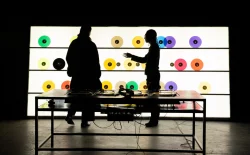
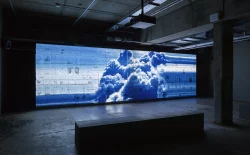
Raster-Noton has been at the bleeding edge of electronic music and sound art for two decades.
The German imprint remains one of Europe’s most revered and reliable hubs for experimental electronic music, IDM and audio-visual art, a stringently programmed platform for overlapping sonic, artistic and scientific exploration and collaboration. And if that sounds a bit lofty, well, that’s the idea.
The label is the brainchild of Olaf Bender, Frank Bretschneider and Carsten Nicolai, better known to Rasterfarians as Byetone, Komet and Alva Noto. The three of them grew up in Chemnitz, an East German town known as Karl-Marx-Stadt until the dissolution of the GDR in 1990, where they began releasing music in 1996 on their respective labels – Bender and Bretschneider’s Rastermusic and Nicolai’s noton.archiv.
For the first few years the labels existed separately but collaboratively, with a shared focus on computational sound design, digital aesthetics and music-as-process. By 1997, the trio had already hit the studio together (on Produkt’s proto-minimal acid sludger ‘Shift’), and the following year their in-house production project Signal appeared.
In 1999, a small army of like-minded voyagers – including Finnish artists Mika Vainio and Ilpo Väisänen (aka Pan Sonic), Russian producer CoH, Kompakt founder Wolfgang Voigt and UK sound artist Scanner – lent their expertise to an epic 12-CD compilation-cum-sculpture called 20′ to 2000, and with it Raster-Noton was born. The release won the label a prestigious Prix Ars Electronica award for digital music and was even selected for the collections of New York’s MoMA and Paris’ Pompidou Centre. Not a bad start.
Since that formative moment, Raster-Noton hasn’t looked back. Constantly seeking to break new ground in both sound and presentation, the label has released several landmark series – from the early ‘Static’ and ‘Post’ excursions to the excellent Archiv compilations and Nicolai’s seminal, ongoing Xerrox project – and experimented with all kinds of formats, from CDs and DVDs to memory sticks to food packaging. They’ve collaborated with galleries on sound installations, put on groundbreaking audio-visual shows at Berghain,Sónar, and Mutek, and continue to host their annual ‘electric campfire’ gatherings.
Few other labels have dug as deeply into digital music’s potential while at the same time working with the rich histories and extensive catalogues of what came before, from Detroit techno to musique concrète to Gustav Mahler. Far from coldly plundering the past in pursuit of a purified future, Raster-Noton’s best work is sensitive, and often sensuously connected, to both.
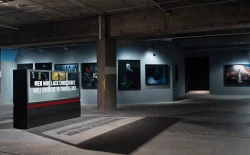
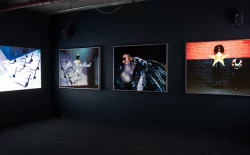
The label is celebrating its 20th anniversary this year with a series of events around Europe, including a recent exhibition at Berghain and showcases at Sou Festival, Sónar, Dekmantel, Ruhrtriennale and electric campfire in Rome.
To mark the milestone, we’ve sifted through the catalogue to pick Raster-Noton’s 20 essential releases.
Produkt
Float
(1996)
Produkt is an early project from Raster-Noton founders Frank Bretschneider and Olaf Bender (along with Tilo Seidel), and while their first album, Float, isn’t quite as good as their second, Stretch (which is really good), it’s worth the entry price alone for opener ‘Interflug’. A militantly hypnotic, 18-minute acid motorik workout, it laid the foundation for much of the processed funk and rhythmic asceticism to follow (particularly from colleague-to-be Carsten Nicolai, aka Alva Noto, then the chief of noton.archiv).
The ‘drop’ – which you have to wait the best part of 15 minutes for – is sublime, retroactively energising an already grooving assemblage of elements and consolidating a vibe that suits Donato Dozzy-esque DJ play as much as it does white cubes, black coffee and scrawled-in notebooks. Raster’s own description pretty much nails it: “An elegant looking electric car driving down the avenue, dressed with tiny spoilers, a disco glitter sticker on the back of the rear-view mirror, not faster than 80 km/h and always straight ahead.” Game on.
Kim Cascone
Blue Cube [ ]
(1998)
Released on Carsten Nicolai’s noton.archiv, Kim Cascone’s first album under his own name is the menacing dock leaf to Produkt’s revved up nettle. Showing traits of the advanced processing and ‘micro-design’ Raster would become renowned for, but coming from a distinctly dank, droning, dark ambient locale, Blue Cube [ ] is an armbands-off dive into the digital unconscious. The album is the murky fallout from a year spent in creative communion with MIT-developed programming language Csound, “an environment made from little more than cold silicon and code,” according to Cascone himself.
Cold’s the word: this is Helm in digital deep freeze, Conrad Schnitzler on ice. Sound is more of the order of wind, vapour and crystal than anything soft and sonorous; dustings of freeze-dried sparkle blown about by warping spurts, thrusts and gusts, and chiming, pitch-bent tones. Cascone, who’s worked with the likes of Merzbow, Taylor Deupree and David Lynch (as assistant music editor on Twin Peaks and Wild at Heart), has amassed a formidable body of work since the 1980s. This is one of his, and noton’s, best.
Senking
Trial
(2000)
A mainstay of the Raster stable, Cologne’s Jens Massel, aka Senking, has produced some of the label’s starkest and most cavernous material, ranging from the skeletal rhythmic abstractions of label-debut Trial and follow-up Forge, to the jazz-inflected post-dub drift of Pong, through to today’s flexing, reanimated steppers workouts (the best of which, Tweek, sounds punishing on wax).
On Trial, Massel presents elemental arrangements of bass, beat and texture – all bone, no flesh – that creep and circulate ominously. Clearly no stranger to weapons-grade bass music – with his recent material tending toward gruff, wind-blasted ruffage – his work lends itself equally to bin-heavy club rigs and careful headphone analysis.
Mokira
Cliphop
(2000)
Hot on the heels of Trial (the very next release, in fact) came another singular reconfiguration of bass music from Swedish artist Andreas Tilliander – also known as TM404, Komp and other aliases – on his first long-player as Mokira. The clue is in the title: this is hip-hop trimmed, snipped, clipped and glitched, left to cool overnight in a Berlin-built fridge and served neat.
‘Byte’ motors along like Basic Channel on an LA-bound desert cruise, shades on, air-con blazing; ‘Full’ is snd, Ae and Prefuse 73 microwaved; and ‘Slut’ could be Massive Attack’s ‘Angel’ given an early ‘00s Donnacha Costello makeover. A huge influence on Mille Plateaux’s subsequent sound (not least Alva Noto’s own Transform and the seminal Clicks & Cuts and Clickhop compilations) and the work of more recent click/glitch-hoppers (‘Palm’ is Dabrye without the breaks), Cliphop remains a standout moment in the formation of the genre: languid, spurty and, now as then, inimitable.
Robert Lippok
Open Close Open
(2001)
Best known as one third of Domino-signed space rockers To Rococo Rot, Robert Lippok’s first full solo outing, 2001’s Open Close Open EP, is a masterclass in collage, looping and tactile processing. Subtly pointing in the direction Nicolai would later take with his Xerrox series and collaborative work with Sakamoto (and indeed to Kangding Ray’s early output), opener ‘Open’, ‘Close’ and closer, er, ‘Open’ engage in the kind of sonic border crossing both he and his label would become loved for, as Mahler’s strings meet what sound like bit-crushed sparrow cries and all kinds of other digital loops, throbs and fragments.
More of this (including the birds) can be heard on Lippok’s latest, excellent Redsuperstructure LP, beautifully packaged in typical R-N fashion, but it’s the magical Open Close Open that makes this list, 15 years young and sounding as full, fresh and effervescent as ever.
Alva Noto & Opiate
Opto Files
(2001)
Carsten Nicolai is no stranger to creative collaboration. Most recently he’s been spotted with Olaf Bender as the swashbuckling electro-techno two-piece Diamond Version, but he’s also worked with Blixa Bargeld (of Einstürzende Neubauten/Bad Seeds fame), Mika Vainio, Scanner and revered composer Ryuichi Sakamoto. Nicolai’s short, sweet fling with Danish producer Thomas Knak, aka Opiate, made up the final entry of the label’s killer ‘Static’ series (two of which have already featured in this list), and is a fittingly mournful dénouement.
Falling somewhere between Mille Plateaux-era Frank Bretschneider and Aphex circa Selected Ambient Works Volume II, Noto’s crisp, clipped percussive inscriptions are haunted by Knak’s foggy chords and sombre drones, with layers of static, glitch and hiss gently congealing and crumbling in your ear, like PVC glue flaking into nothingness. Fans of early Xela, and the more spectral end of IDM will (and no doubt do) dig the hell out of this.
Cyclo.
.
(2001)
Another Noto collab, and one we haven’t yet mentioned: Cyclo. is Nicolai and Japanese sound artist Ryoji Ikeda, and a weighty affair for sure. Both had an impressive string of taut, sonically concentrated solo LPs behind them by this stage – the former with Noton and Mille Plateaux, the latter on Touch – but this took their surgical microsound(s) to a whole new – at times quite ear-troubling – level.
Focusing on the visualisation of sound, Cyclo. was intended to switch up the usual dynamic where images act as a “functional accompaniment” to sound, and instead render the audio subservient to the “desire and appetite of the image”. Such lofty aims are typical of Raster, with records like this one as much an exploration of digital hybridity and perceptual possibility as commercial ‘entertainment’ (although Cyclo. is that too). Really, the project needs to be seen and heard in its proper live audio-visual context – one in which the collaboration will remain, with the next performance planned for this year’s Sónar festival in Barcelona.
William Basinski
The River
(2002)
Something of an early retrospective for the label, 2003’s Archiv 1 was initially compiled for Wire subscribers and reissued soon after. The album remains a great way in to Raster-Noton’s complex sound world, packed with tranced-out digidrones and glitchy machine funk. But for all the bleached tones and chiselled architectures, it’s William Basinski’s thick, gravelly tape detour ‘Shortwavemusic’ that hits hardest, drifting in from a parallel (un)reality and generally psyching the whole thing out.
The body of work it came from, comprising 2002’s The River (originally recorded in 1983) and Basinski’s 1998 debut Shortwavemusic, is where to go for more. Those albums prefigured his classic works to come (including 2002’s essential The Disintegration Loops) and confirmed Raster’s status as an imprint dedicated to the outer (and not necessarily digital) fringes of experimental music. The River makes use of “strings from intros and interludes in muzak songs” plucked from the airwaves “to create something from nothing”. For fans, turning on the radio has never quite been the same since.
Komet
Gold
(2003)
Some of Bretschneider’s best work for Raster falls under his Komet moniker, not least 2003’s sample-heavy, technoid Gold, which starts out like ‘92 hardcore (minus the breaks) before levelling off and settling into a distinctly minimal, continental groove (minus the kick drum). More colourful than much of what surrounds it, this is the sound of Plastikman, tobias. and Uwe Schmidt dropping 12″s at a Kraftwerk afterparty, each track merging seamlessly with the next, ushered along by crispy vocal snippets and Noto-esque crackles.
A healthy 50 minutes long and unwavering in its thrumming linearity, Gold is both hypnotising and, dare we say, chillaxing – ambient techno redone for web 2.0 surfers and post-millennium knob-tweakers. Bretschneider continued in this vein on the more ‘typical’, digitally articulated Rhythm in 2007, but Gold’s the one to keep going back to.
Ryoji Ikeda
Dataplex
(2005)
Ryoji Ikeda’s first solo outing for Noton, following the Cyclo. test run, came after a string of conceptually rich and sonically arresting LPs on Touch (home to Biosphere, Fennesz, Phill Niblock and Philip Jeck, no less) – check out Matrix, in particular, for a patience-testing, cone-stretching listen. As with his Nicolai collaboration, the results of his next Raster-Noton appearance are explosive – if by explosive we mean mathematically precise glitch-tech whose intense frequencies are designed to invade and challenge the human ear. As with its research-driven, A/V-oriented agenda, Dataplex is best understood as part of a broader project, one Ikeda calls ‘datamatics’, described as “an art project that explores the potential to perceive the invisible multi-substance of data that permeates our world”.
Anyone who’s seen Ikeda’s audiovisual shows Superposition, Supersymmetry or Supercodex, or caught his work on Times Square’s digital billboards or beaming over the London skyline, will know that there’s more to his art than meets the ear, aligning him with fellow questers Robert Henke and, of course, Carsten Nicolai. The three of them performed together at the Tate Modern back in 2006, in fact. God knows what Ikeda would do if he had the Turbine Hall all to himself.
Signal
Robotron
(2007)
Things really started to hot up in the latter half of the noughties, with the three label owners weighing in with successive killers, including this fearsome, if difficult, three-way collaboration. Robotron – in-house supergroup Signal’s second full-length- could be the most concentrated dose of Rasterbusiness out there, as austere and alienating as it is muscular and, at times, exhilarating.
Sludgy droner ‘Ermafa’ sets the tone (think Mika Vainio, Ilpo Väisänen and your dog baking to death in a locked Transit van), while ‘Naplafa’, ‘Wismut’ and ‘Rawema’ are malevolent techno reductions which fizzle and crackle your audio setup into an early retirement. Yet somehow, even here at the bleep-ridden, technophilic bleeding edge, we’re still dealing with mind, body and soul. Given time and a proper pair of speakers, Robotron will tickle you on all three counts.
Alva Noto
Xerrox Vols. 1–3
(2007–15)
Plucking a single LP, never mind track, from Nicolai’s supreme, three-parts-and-counting Xerrox series – the crowning achievement of his career to date and probably the jewel in Raster-Noton’s crown – feels futile, even heretical. Such is the consistency and cinematic heft of this all-time-great contribution to the ambient/post-classical canon, whose constituent parts only register fully in the context of their respective wholes.
Ostensibly simple in execution – fried, fraggy digital feedback meets processed orchestral drone – the effect is both sonically arresting (‘sound design’, here, really does justify its name) and emotionally complex, the combination of stoic tones and psyched-out textures resonating spectacularly.
Much has been made of the so-called Raster-Noton ‘aesthetic’, a kind of surgical reduction and reconfiguration of existing electronic and experimental musics and audio-visual practices. But to frame Xerrox in those terms would be to miss what makes it so special: it’s deeply moving. Play it on a £10,000 home studio, a £100 pair of earphones or a £10 iPod dock, it doesn’t matter – each and every time, it’ll hit you like the existential space symphony it is.
Alva Noto & Ryuichi Sakamoto feat. Ensemble Modern
utp_
(2008)
Nicolai’s partnership with Japanese composer-polymath Ryuichi Sakamoto has been consistently fruitful (they were recently up for a Golden Globe and BAFTA for The Revenant film score), the former’s insectoid clicks, snips and glitches complementing the latter’s glacial piano washes to high-class effect.
2008’s utp_, initially released as a neat-looking CD/DVD gatefold featuring a filmed live performance, introduced elements of live orchestral instrumentation, subtly expanding their hyper-minimalist modus operandi (see the peerless Vrioon, Insen and Revep for that) into something darker, thicker and more volatile than what came before. While the likes of ‘Grains’ and ‘Broken Line 1’ remain at a similar register – a kind of airless, elevated post-muzak – the bruising two-part droner ‘Plateaux’ and the Biosphere/HIA-referencing ‘Silence’ bring a concentrated dose of dread to the party. Gently expanding and contracting as it snakes its way through a series of tense, intricately detailed scenes, _utp is modern music at its slippery, serpentine best.
Mark Fell
Multistability
(2010)
snd’s wonderful Atavism could easily have made this list, but it’s Mark Fell’s equally stripped, even more anarchically epileptic solo effort, released the following year, that muscles its way in. A kind of surgically controlled seizure of pranging chords, cranked-ignition kicks, and claps, stabs and glitches, anyone familiar with his more recent house-inflected Sensate Focus transmissions or 2013’s excellent n-Dimensional Analysis 12” will feel immediately at home here.
Multistability is an elasticated jumble of jittering phrases and toppling vignettes, alternately hypnotising and hernia-inducing – ‘3’ is an overcooked strobe light run through Ableton resonators, ‘2-AA’ is Vladislav Delay minus the delay, and what can we say about ‘10-A’, the album’s highlight – kamikaze footwork? On a rig, like so much of Raster’s best material, it speaks for itself in its own singular tongue.
Kangding Ray
Or
(2011)
A loyal and widely-admired big hitter of the label, Frenchman David Letellier’s work has blossomed into something powerful, pensive and tentatively political over the its five-LP trajectory. Early albums Stabil and Automne Fold, while relatively click/glitch in aesthetic, weaved delicate tapestries of sound (complemented at points by Arab Strap-esque murmurings) into something more muscular and affecting than tired signifiers like that evoke. More recent efforts Solens Arc and Cory Arcane, built for big rigs and loose limbs, skip to a distinctly hypnotic, hydraulic, techno-fied beat, in keeping with the artist’s development as a (now fierce) live act.
Or stands out as the stone-cold classic, up there with the best of Noton’s output. Melding the bassy abstractions of Nicolai and Bender with less purified dub, techno, ‘step and pop/rock vocabularies (and, again, vocals), it takes the Pan-Sonic-meets-Pangaea concrète jungle of the earlier Pruitt Igoe EP on an psychedelic trip into the late-capitalist peaks, questing through widescreen landscapes as it steadily builds, climaxes, resets and repeats.
A former architect, Letellier’s works create rich, speculative, at times utopian spaces, only to tear them down and begin all over again; there is something genuinely Sisyphean about his music. But it’s historical, too: each smashed structure lays the foundation for the next, and over time, something’s growing. Bender & co. are lucky to have him.
Byetone
Symeta
(2011)
No Raster Best Of would be complete without a solo record from co-founder Olaf Bender, aka Byetone. Symeta, his most recent LP, is among the label’s most accessible, but don’t be fooled – it’s also some of the best-assembled sonic firepower in the entire catalogue, stringently fabricated but unafraid to, basically, rock. Pulling UK techno, Finnish power noise and various strains of kraut, wave, EBM and (post-)punk into the mix, hosed down with Detroit breaks and baked dry in a converted fax machine, this is Raster on a night out and, by this stage, out of it.
The opening salvo of ‘Topas’ into ‘T-E-L-E-G-R-A-M-M’ (think Regis, The KVB and Neu! wired on bleach-clean class As) sets the tone, whipping up an angular psychedelic storm, while bucking tech-rockers ‘Helix’ and ‘Golden Elegy’ blast and hoover their way into your face as much as your heart. Bender’s penchant for grin-inciting drops is once again in evidence: ‘Black Peace’ will blast your face off. Universal Music, his third full-length for the label he’s commandeered expertly since day one, drops later this year. Watch out for it.
Vladislav Delay
Kuopio
(2012)
Sasu Ripatti is a giant of experimental electronic music, a man who’s worked with Chain Reaction, Mille Plateaux, Leaf, Semantica and, most recently, Raster-Noton, and who’s put out some of the freshest, least categorisable material on all of them (for the categorisable stuff, see his Luomo side-project).
Take ‘Marsila’, from 2012’s beautiful Kuopio: seven minutes and 40 seconds of Chicago-infused disco house that also sounds like a game of air hockey being conducted inside a delay unit. Like Mark Fell, Ripatti works with sound as a tangible, tensile object, pasting and molding it into spongy layers of chord, bass and beat; his rhythmic landscapes bounce and twist with life, threatening to snap clean in half, but never quite doing so. ‘Dub techno’ this might be (if only genetically), but not as you know it.
Emptyset
Collapsed EP & Recur
(2012/2013)
Emptyset brought together dubstep OG James Ginzburg (aka P Dutty, 30Hz and Ginz) and Paul Purgas, who together crafted some of the most frazzled experimental techno of the late ‘00s. Their arrival on Raster-Noton felt somewhat inevitable, and their malevolent, concentrated work for the label is enviable. But it’s another tough call: their first LP for the label, or the incendiary EP that foregrounded it? Both are among the rawest, noisiest and nastiest of Raster’s (and indeed Emptyset’s) offerings, giving the listener little more to work with than distorted throbs of bass, feral squalls of hiss, caving reverb trails, and dank, rusty sheets of processed feedback.
Ultimately, 2012’s Collapsed and 2013’s Recur are best absorbed in concert, the one setting the stage, the other calmly shredding it. Reduced tech-step for medieval torture chambers, these records are not concerned with wooing with the clicks-and-cuts IDM crew, or anyone looking for an easy listen. But in their fizzling, Sähkö-esque brutality, there’s both movement and humour. Recur’s ‘Fragment’, ‘Order’ and ‘Limit’ thrash and mosh with abandon, while Collapsed opener ‘Armature’ is Mika Vainio and Ancient Methods on a gun-toting, possibly doomed, excursion to the Bow flyover.
Atom™
HD
(2013)
Like Kangding Ray, the many-aliased acid maverick Uwe Schmidt, aka Atom™, is a Raster heavyweight not afraid to go off-piste. (He’s also been known as Fonosandwich, Lisa Carbon, MC Unknown, Phresh Phantasy, Replicant Rumba Rockers, Señor Coconut, Weird Shit and, perhaps best of all, Dropshadow Disease). His vast output (for labels such as Rather Interesting, FAX, Sähkö and, more recently, Editions Mego, Mule, Ostgut Ton and his new No. imprint) spans brutal, new-arsehole-tearing ‘90s techno, choppy Latin hip-hop, acid, house, electro and ambient, and much more; even sticking with his Raster releases, Schmidt’s work manages to baffle and wrongfoot in its wilful heterogeneity.
HD, his most recent full-length for the label, is a late curveball of sorts. Its hyper-crystalline production levels and Kraftwerkian riddims aside, it’s really not the kind of dish you’d expect Raster, home of “fine artists, club musicians, noise pioneers, academically trained composers [and] classic instrumentalists”, to be serving up, as the party-boy robot lyrics (“mp3 killed the MTV”) and Who covers might indicate.
But listening through, it really does belong on the label: opener ‘Pop HD’ sounds like Vladislav Delay and The Knife sipping cocktails near a Funktion-One, while closing banger ‘Ich Bin Meine Maschine’ could be Alva Noto dropping tracky house at Panorama Bar, just about. Brazen, singular and expertly built, HD is utterly at home on this seasoned giant of the electronic underground, proving that there’s life in the old beast yet.
Dasha Rush
Sleepstep – Sonar Poems For My Sleepless Friends
(2015)
Echoes of Chris & Cosey, Coil and insectoid ‘90s ambient/IDM (Locust, Monolake, Ae) haunt this latest, most captivating chapter in Raster’s history, suggesting a return to former sonic terrains but from a changed (and, encouragingly, less male) vantage point.
The familiar pops, clicks, crackles and throbs are all there, as is the attention to detail and robust crafts[wo]manship. But the touch is lighter, more spectral – more musical, even – than much of what’s stereotypically associated with the label. Most captivatingly, Rush’s voice, a somnolent yet persistent accompaniment, carries a gripping, phantom-like charge, guiding the listener through a series of suspended moments and altered states. The creeping, clickstepping ‘Scratching Your Surface (Revisited)’ marches on the spot, the Loscil-esque ‘Lumiere Avant Midi’ flickers in the the background, while the acid-soaked ‘100 Hearts’ and the Mathew Jonson-evoking ‘Micro Universe’ both trip hard.
Raster-Noton may just have turned 20 – a lengthy slog in these accelerated times – but if they keep that wagon well-fuelled and cruising in fifth, who knows where it might end up.









![Ryoji Ikeda installation data-cosm [n°1] extended at 180 Studios until 1 February, 2026](https://www.factmag.com/wp-content/uploads/2025/12/data-cosm-ALubbock_180-14Oct-3554-250x155.webp)
![180 Studios presents new Ryoji Ikeda installation, data-cosm [n°1]](https://www.factmag.com/wp-content/uploads/2025/10/ryoji-ikeda-data-cosm-1-250x155.webp)