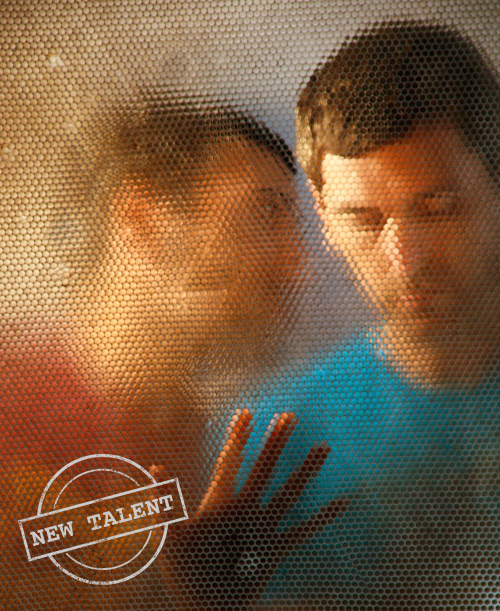
Anonymity is a big deal in dance music: sometimes artists don’t want to deal with expectations, preconceived notions, or simply would rather keep their personal lives separate from their musical lives.
But a group like Downliners Sekt seem to thrive on it: consisting of unknown and inconsistent numbers, refusing to disclose geographical info, their names, or much of anything at all, they carry with them a certain cultish diffidence evoked by their very chosen name, germanic ally-stylized spelling and all. The group make appropriately dark and sometimes claustrophobic music, a mercurial history traceable through their releases: the abrasive broken beats of debut album Statement of Purpose sprouted serrated fuzz for the post-rock influenced Saltire Wave, both albums full of sometimes unfriendly – and always distorted – beats and grooves. But when the group shed its excess and stripped itself down to a duo, so the guitars melted away and their energy channeled into slamming hunks of twisted metal that don’t so much hint at industrial music as melt down and remould it to fit a slightly dubstep-informed template.
That being said, Downliners Sekt don’t make dubstep: their music just shares the same lurching, bass-heavy approach. Evidently not too concerned with functionality, their tracks occupy strange and unexpected tempos from anywhere between 120-160 beats per minute: while they can certainly pair with like-minded music (particularly, yes, dubstep), they’ll make you work hard to make it fit. Bubbling with post-apocalyptic tension and a type of theatrical, all-encompassing dread that borders on the grandiose and cinematic, the music on the EPs comprising their current thematic trilogy seems to create its own self-reflexive world of obscure film references and occult flirtation. Where a group like Demdike Stare self-mythologizes around antiquated legends and tales, Downliners Sekt is intent on exploring the seedy underbelly of the industrial age, the pockets of black arts that emerge in an society with no place for them anymore. These remnants of the supernatural manifest in the mutant mechanics of tracks like ‘White Dawn’ or ‘U Gumbu’, where the malfunctioning machines sometimes harbour a menacing derision, an antipathy towards humanity.
Of course, the antipathy is only musical: and despite their shadowy appearance, the Sekt are quite the populists, sharing their entire discography for free download on their website. 2010 was a big year for them, signing with niche label Disboot for the physical release of an in-progress trilogy of EPs exploring the aforementioned and newly-minted industrial sound. Hello Lonely, Hold The Nation was four tracks of blackened mechano-funk, while We Make Hits, Not The Public explored the ubiquitous hardcore continuum obsession with chopping up R&B vocals, strangling and choking otherworldly sirens in their crushing pincers. Tapped for mixes by radio kingpins like Mary Anne Hobbs and Rob Booth of Electronic Explorations, their mix for the latter is a particularly wonderful way to understand their sound, forty minutes of post-industrial sound collage and abstract beats that acts as a thrilling longform preview to the kind of larger statement they could make in the future. Their new sound has seen rapturous critical reception, their audience growing leaps and bounds with the ongoing trilogy campaign, and it’s easy to tell why: there’s something so admirably current but uncompromising about their mix of styles, something wonderful about their flirtation with dubstep but refusal to give in completely. Their fusion of the emotional with the metallic often leaves them wide open for inescapable Burial comparisons, but such comparisons are reductive and surface-level: no one does Downliners Sekt except Downliners Sekt.
“Music, for us, is the most powerful language”
Where does the name come from?
“Well, originally it was a 1956 song called ‘Down The Line’ by Roy Orbison [also covered by Jerry Lee Lewis], then eventually used and modified by an obscure British band as Downliners Sect. We sampled the name from them because we thought it sounded great. Also, it has a special meaning that connects all of us to Portbou. Portbou is a train station that gets you in a really weird mood especially if you happen to stop there after raving “under the spinning lights” of Barcelona clubs all weekend. This place has a very Twin Peaks oppressive atmosphere. It’s the changing point between Spanish and French railway networks, and once you get there everything slows down for the customs check between borders. Because since 1845 the Iberian railway gauge has been 233 millimeters wider that the European gauge, the train has to undergo a break-of-gauge before crossing the border. It feels like time stands still in the town and Portbou, almost imperceptibly, shrinks by 233 millimeters. The sect of ravers trapped in oblivion, “down the line” in Portbou. Since then, when we feel a bit down, we kindly use the expression: “en descente de Portbou” — which means “going down the line from Portbou.”
What made you start wanting to make music in the first place?
“There’s some mixed sensations that only music can give you, this particular mood that rips you from the inside and is so hard to explain. Since the very first time that you have these overwhelming feelings as a listener, there’s a natural curiosity growing strong within that forces you to have some sort of control over it: to have the ability to mess around with these feelings, to move people the same way you’ve been moved, to get into their minds. Music, for us, is the most powerful language. It has the capacity to translate a wide range of feelings, to create imaginary worlds. Once you start thinking that you understand how it works, you might want to rest on that safe place you happened to produce. It’s up to you to go further and keep exploring. In our case, when it becomes too safe, we get so impatient that we start all over again from a new different angle. In some way it’s like re-experiencing what you felt at the very beginning.”
How did you meet, and why make music together?
“We are from small boring provincial towns with no real cultural life; not the best place to be for teens growing up in the ’90s, especially coming from a working class background where music wasn’t considered a serious career option. All we had were some isolated independent record stores where a bunch of lads used to meet up after school to discover new music. Soon after we put our first bands together, eventually escaping from the cycle of boredom and lack of understanding from our families that was keeping us down. After a while we decided to take our chances and relocate to bigger cities. Trying to extend our project in such cultural and cosmopolitan places proved to be incredibly challenging. Discovering great new sounds was priceless. It changed the way we perceived, consumed, and furthermore, the way we produced music. We began to introduce electronic elements in our songs, pushing the sonic experience as far as we could. It gave us new angles to work with in terms of depth and length of the tracks: it opened wide up new sonic directions of endless possibilities.”
How would you classify the music you make as Downliners Sekt? Do you think it fits in any scene particularly?
“All this nonsense about styles, genres and tags that the media uses to define and categorize any cultural act doesn’t really affect us. We are not following any trend, but we’re not purposely trying to be outsiders either. We happen to be this way, that’s our story.
“Musical “scenes” usually start with a handful of people, a few friends in a room with clear ideas of what they don’t want. Kind of like “let’s try not to sound like everybody else!” Then, all of a sudden, everyone wants to be at that party, but no one really knows how to dance. As soon as the people start dancing and the party gets crowded, it becomes something marketable and easier to package and sell.
“There’s nothing wrong with being inspired by something, but a lot of people just tend to follow the cool new sound of the moment. This is how the “scene” mutates into something bigger but more superficial, fading away from its roots. Loads of musicians and producers appear and catch that trendy new vibe and produce tracks in the exact same vein. Hopefully someone will eventually not fall into this copy/paste/preset mindset, and then the whole cycle might start again with fresh and new ideas.
“We do understand that most people stick with one genre or style, but truly, we’re not attached to any sound or formula in particular. We definitely have more of an attitude that goes way beyond the music itself. We feel that there are so many different colours out there, and rhythms to back them up, that we’re endlessly trying to get those sonic fragments to fit together and create a genuine and powerful tune in the process. We see our artistic development as a long term progression: for us, it’s essential to advance without repeating ourselves.”

“Maybe next time we’ll make the movie ourselves”
You mentioned not wanting to conform to any style, but I think your music’s connection to dubstep, both rhythmically and texturally, cannot be denied. I’m not saying this is on purpose, but there’s something there. What do you feel is your music’s relationship with dubstep, and do you guys listen to any dubstep?
“From a technical angle, when we worked on our first EP and album between 2001 and 2004 we got the chance to be around our friend Kemal. Back then, he happened to be one of the most influential drum and bass artists around, and sharing a studio with him gave us the opportunity to be instructed in dance floor production techniques. Around that period, our soundtrack was lots of abstract hip-hop and German dub. The combination of those two elements helped shape what was going to be our first few releases. In 2006, we heard this new term floating around: “dubstep.” Looking for a clear reference of what that was about, Google sent us to a Wikipedia article where we found an audio link called “4 bar example of a half-step drum pattern” that happened to be the exact same riddim of our tune ‘Benz’, which was produced before the end of 2002. The tracks from the artists mentioned on that article were very similar to our older material. If you’re curious enough, check out our first album Statement of Purpose and you’ll realize what we are trying to say.
“It happens that sometimes during the same time period, different artistic experiments can come to similar conclusions without ever being related or connected. This is the connection to dubstep you are looking for. We’ve always been making heavy beats with lots of sub-bass, way before this kind of music was officially baptized. This is a chronological misunderstanding that we feel the need to clarify. A musical tag like dubstep would be a bit reductive for what we’re trying to achieve here. We have the feeling that the term ‘dubstep’ has been overused and has pigeonholed a lot of artists together who aren’t exactly doing the same thing. Our relationship with dubstep is the same one we have with other genres because we have an open mind about music in general.”
How did you get into electronic music to begin with, and how did it develop into the spare, dark stuff it is now?
“During the last two decades the deployment of digital technology has given birth to a new generation of musicians and producers that have had instant access to an incredible source of material, as well as new and affordable music production software. These new tools came up at the right time to us, because making music as a live band was becoming increasingly expensive and complicated. Electronics became a necessity to keep doing what we liked doing. We’re not intentionally producing dark music. For different reasons, we’ve always been kind of ‘out of tune’ with the world we’ve been thrown into. We’re always in transition, in between cities, in between relationships. We work on every album with the thought that it could be the last one and our music perhaps translates this edgy feeling of fatigue. Our sound is better appreciated when the listener is locked up into this same transitional space. It carries a lot of emotions and sometimes it might be not that easy to digest, so maybe ‘deep’ describes it better than ‘dark.’”
There’s a real sense of drama and tension in your tracks; has film/cinema been an influence on your style at all?
“Because instrumental music doesn’t have lyrics to guide one through the tracks, every detail of production plays a much stronger role in the arrangement. Sometimes working without a vocal will push you to approach sounds in a different manner, and work with them like they were colours playing a specific part into the framework that you imagine. In real life, there is a special combination of places, time, and emotions that will put you in a more altered state of mind than movies might do. Then, you feel the urgency and the need to capture it, as if you were taking a picture with your soul. Cinema to us is more like an entertainment, one of our favorites between sessions.”
On that note, you were initially tapped to compose music for Darren Aronofsky’s Black Swan film – how did that pan out?
“A few months back we were approached by Darren Aronofsky’s music editors to work on a original piece of music for his new movie, but eventually, the track didn’t make it to the film. To us it was a very challenging opportunity and we learned a lot from the experience. This kind of proposition could have some obvious positive aspects at first glance, but there’s also a lot of side effects to consider. You will have to work under very specific terms, not in complete control of your artistic direction and never sure of the final outcome. We’re okay with the track not being chosen, we understand that it’s all part of the game, but it felt really bad when we learned the news through a newspaper article. Maybe next time we’ll make the movie ourselves.
Where does the title We Make Hits come from?
“It comes from a scene of the classic Jamaican movie The Harder They Come when, on the verge of a hit record, the character played by Jimmy Cliff discovers that the only way he can get a hit record is by signing away the rights. He tries to release his music bypassing the established industry and eventually fails. The big fish tells him “the next time you decide to cut a record just remember: everything has to pass trough me. I make the hits, not the public. I tell the DJs what to play.”
“It seems ironic now given the huge changes the music industry has experienced in last decade. It looks like the situation has evolved and now the artist can be in control of almost every aspect of the production of an album. To us, this title means that now, finally, we can bring the whole package to the table without having to sell out in any capacity.”
How is this EP a further evolution of your sound, and where are you going with it? Is it just me or are there more R&Bish vocals this time around?
“After Hello Lonely, Hold The Nation, we were asked by Mary Anne Hobbs to do a mix for her BBC Radio 1 show. That was the starting point which lead us to the second EP of the trilogy. For that mix we produced brand new material that we developed later. Also, for the first time we started sampling our own sound, eventually making new songs in the process. This profusion of r’n’b vocals has its roots on ‘Negative Green’. This tune was a happy accident, a one-shot track that came out of nowhere but gave us a lead to follow when producing We Make Hits.”
In many ways the vocals sampled, at least as one imagines them in their original context, are far removed from the sort of overwhelming dread of your music. How do you go about finding voices to sample?
A long time ago, we found ourselves in a club where we witnessed a very disturbing phenomenon; it was obvious that every fucker on the dancefloor that night was high on Ketamine. The main reason was that the usual dealer of the house was tricked into giving away K thinking it was just ecstasy. The result was a post-apocalyptic landscape. There was an overwhelming contrast between the energy and speed coming from the hardcore techno played by the DJ and the total looseness and lack of motion of the audience, heading towards oblivion without really understanding what was happening to them. This ‘slower-but-faster’ fucked up rave gave us a vision of an audience we’d love to work with. This dark side of partying has always intrigued us. This particular moment, in between days, when you regain consciousness and you feel less proud of yourself. We Make Hits, Not The Public really leads you into that space. The sampled vocals play an important role because they have a textural characteristic that might send you back under the spinning lights with raving divas on the mic. We do like female singers but because they are sometimes hard to access we always end up messing around on youtube with Leona Lewis acapellas and stuff like that.”
Why did you choose to release your music for free – even after you started releasing on Disboot? Do you think working with a bigger label like you said you wish to in the future will change this policy of free downloads?
“At the beginning, we started releasing our music on a French label, b:cuts. First came a 12” EP in June 2004 while we were finishing our debut album, which was supposed to be available through them around October of that same year. All of a sudden the label shuts down and we’re alone, with no deal, no money, lots of debt, no way of financing a self-release, and worldwide record industry mayhem around us. We spent a few months in shock with a finished album with some tracks on it that were sold to a publishing society, and had to fight to have those rights back. It was Hell for a while, and out of anger and frustration we opted for the free mp3 giveaway. It worked, it really worked, we had enough exposure to keep going, play a little bit, and survive.
“Why are we still doing it now even being under the Disboot structure? Frankly, because, like it or not, digital music is free. Everybody downloads stuff from P2Ps, torrents, Mediafire, Rapidshare… they use Spotify, Soundcloud, Myspace, Youtube to have access to all kinds of music. To us it’s like, if you want to have our tracks without spending money, you’ll get them anyway. So instead of looking for bad rips on Rapidshare, take those files here, in good quality with the artwork and everything. It’ s like being in the Netherlands of music – why go to the black market when you can go to a coffee shop?
“It’s the way it is, today’s situation is collateral damage from the whole world being connected via the internet. Maybe in a few years it will change and people will understand that it costs us a lot of energy and money to keep going. We’re actually really tired of talking about that; we kind of stopped talking politics, we’re not here to do some new industrial revolution, we don’t really care about the evolution of the whole thing, we just want to make music and touch people – that’s the important thing to us.
“We know that the labels we’d like to be on work differently. There’s no problem in shutting down that policy of free downloads for forthcoming releases if they can offer a good and ethical deal. Not really talking about money here, it’s more like: get us a decent booking agency, give us the opportunity to tour a little bit, have someone working the promotion for us. If you want to sell our tracks for one dollar on iTunes or release CDs for $20 that’s your business, we don’t care, we’ll claim our share like everybody else does. But you guys know that lots of people will still get that music without paying, just using Google. And that’s not our fault.”
Andrew Ryce
downliners-sekt.com









![Ryoji Ikeda installation data-cosm [n°1] extended at 180 Studios until 1 February, 2026](https://www.factmag.com/wp-content/uploads/2025/12/data-cosm-ALubbock_180-14Oct-3554-250x155.webp)
![180 Studios presents new Ryoji Ikeda installation, data-cosm [n°1]](https://www.factmag.com/wp-content/uploads/2025/10/ryoji-ikeda-data-cosm-1-250x155.webp)