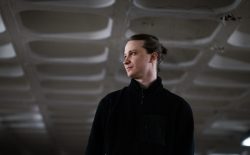
Under the guise of Oneohtrix Point Never, Boston’s Daniel Lopatin has made some of the most celebrated electronic music of recent years.
His strongly narrative, synthesizer-based compositions extrapolate on the psychedelic, time-stretching promise of German kosmische music and new age ambient, doing so with a viscerality more readily associated with the post-2000 noise scene (which is where much of Lopatin’s fanbase resides). What really distinguishes OPN from his analogue fetishist contemporaries is the thoughtfulness and flair with which he processes and bounces off more esoteric, extra-musical influences: TV, literature, visual art and “ecologies” both real and imagined. His works are densely allusory, but crucially never succumb to the condition of homage.
The first Oneohtrix Point Never release was the 2007 cassette Betrayed In The Octagon; tracks from this and subsequent limited edition offerings – including Transmat Memories (2008) and the masterful Russian Mind (2009) were anthologised on last year’s Rifts, a widely available and justly acclaimed 2xCD compilation released by New York’s No Fun Productions. Memory Vague, a DVD-R issued on Root Strata (also in ’09), found Lopatin teaming his music with collaged and manipulated footage sourced entirely from YouTube; it remains arguably the best showcase for the totality of Oneohtrix Point Never’s vision, and while hard copies are now virtually impossible to get hold of, internet seekers shouldn’t have too much trouble finding a rip of acceptable quality.
Oneohtrix Point Never’s latest release is Returnal, and it comes courtesy of Peter Rehberg’s Editions Mego, the Vienna-based label that has provided an outlet for such luminaries as Russell Haswell, Fennesz, Jim O’Rourke and. Though his career is still young, Lopatin is deserving of his place in such esteemed company: it’s hard to think any other recently established electronic artist capable of delivering so generously on both the sonic and conceptual levels. Not that the “concept” of Returnal readily reveals itself: it’s rather a cryptic record, variously recalling Eduard Artemiev’s expansive soundtrack work for Tarkovsky, the teeming”fourth world” music of Jon Hassell and the uncanny vocalisations of Coil.
FACT’s Kiran Sande caught up with Lopatin via e-mail to learn more about Oneohtrix Point Never, Returnal and humankind’s desire to exist in “sacred time”.

How and when did you first catch the synth bug?
“When I was a kid, I was fascinated with my sister’s blue 10 speed and my dad’s Roland Juno 60. Both mysterious machines to the pre-semiotic mind.”
When did the desire to make music of your own begin brewing?
“As far back as I can remember. My mom was also my piano teacher and I was always writing fake etudes and jingles and trying out paradiddles and patterning on the piano. In middle school my best friends started a band and I was asked to play bass, but I didn’t have one, so I had to skip their grunge period and wait for the jam-band period in early high school when I could play keyboards for them. I played a Yamaha electric piano and an Ensoniq SQ2, which I used for fake Hammond organ sounds, and the Juno 60 for space sounds. Then I got super into sampling and electronic music and I got some rudimentary gear for that, and a Tascam, and the first thing I sampled was a couple of riffs from [fusion band Return To Never’s 1974 LP] Where Have I Known You Before.
“I try to use synthesizers to model topographies, or ideas, or ecologies, or situations, or bodies…Synthesizers equals paint.”
To what extent is your music born out of process? Do you come up with ideas and then attempt to render them on your synths, or do you jam with the synths and see where they take you?
“Non-musical ideas inspire me. I try to colour or sculpt subtextual stuff into something musically palpable. I appreciate the work of Wendy Carlos and Tomita and Kitaro, in that they used synthesizers to model acoustic sound. What I do is less music-centric; I try to use synthesizers to model topographies, or ideas, or ecologies, or situations, or bodies. Like using melismatic or curved tones in the right way, you can tell a very particular story about Eros for example, or body architectures. Curved sounds are pretty erotic. Inversely, if you use extremely dense, coarse saw-tooth waves and overlap them a lot it might be a way to convey background radiation or TV static. Just an example. Once you start exploring the relationships between various zones like that it can be really fun. Synthesizers equals paint.”

You’ve worked on film music, right? Can you tell us about this and your approach to it, how it differs from your usual work?
“I finished recording for a film last winter; I don’t yet know what’s going on in terms of its distribution. It’s not that different other than the sort of interpersonal challenges that happen whenever you work on art with other people, but that’s also a huge benefit. In films, narrative will often guide the sonic experience, which is not so different to the way I work already, so it’s sweet. I would like to try scoring again sometime.”
Is it fair to say that soundtracks have been a big influence on you? Are there any particular composers or scores that have particularly inspired you? I guess Artemiev, Carpenter and Tangerine Dream must have figured in there a little bit...
“Mostly just Artemiev’s score to [Tarkovsky’s 1979 movie] Stalker, that had a big influence on me. I don’t know that much about Tangerine Dream. Klaus Schulze’s Body Love is really good. I am really into Antoine Duhamel, Sergio Leone, and also the work of Danny Wolfers [AKA Legowelt, Smackos] and his Strange Life label. Although he doesn’t score actual films, I think his approach is filmic and had a big impact on me at some point in the past. I’m now discovering a lot of ubiquitous broadcasting music via Dewolfe and Radiophonic Workshop.”
“A lot of the record was inspired by non-musical things: dreams I was having that summer, some literature, some thoughts I was trying to restore or reset about past relationships…”
What was the conceptual starting-point for Returnal? Was there a mood or a narrative mode that you had in mind from the outset? It comes across as perhaps your most personal, most non-referential work to date.
“A lot of the record was inspired by non-musical things: dreams I was having that summer, some literature, some thoughts I was trying to restore or reset about past relationships, and the ecology and environment of the suburbs where I was living while recording it. Beyond that it’s not totally worth getting very specific about it, as I think the record functions nicely without the behind-the-scenes details.”
Returnal is notable for the prominence of layered vocal textures. Is this your own voice? What prompted the decision to use these kind of textures now, and what effect are you striving for?
“Yeah, that’s me. I used vocals on Betrayed in the Octagon too, on ‘Woe Is The Trangression I’ and ‘II’. There are certain things I can sing effectively which wouldn’t sound right if I played them on a keyboard.”

The “new age” feel to your music is frequently flagged up by commentators. Do you feel there are “new age” elements to what you do? Is there any new age music from the past that you’ve found inspiration in?
“‘Format & Journey North’ off of Zones Without People was distinctive in that I was playing with new age tropes. A lot of the material on Ruined Lives as well. Yes I’m definitely interested in new age in terms of its cultural obsolescence and the way that western spirituality is so naive and linear…like, put this music on, and put some crystals down, eat some brown rice, and find god. What interests me is the subtextual noise underneath all of that failure.”
There seems to be a huge appetite right now for kosmische and new age-derived synthesizer music. Why do you think this might be?
“I think that maybe people are tired of linear time, and psychedelic music is as good a strategy as any for living in sacred time.”
“I think that maybe people are tired of linear time, and psychedelic music is as good a strategy as any for living in sacred time.”
Do you consider your music to be psychedelic? What does “psychedelia” mean to you?
“Yeah, I do. Psychedelic experiences deny linear time and hint at sacred time.”
Obviously there are exceptions, particularly on Returnal, but the overwhelming majority of your music rejects explicit rhythm, is beatless. What is your attitude to rhythm in your own compositions, and how do you feel rhythm enables or hinders the pursuit of “sacred time”?
“I find that anything good enables sacred time. I’m still working on my relationship to rhythm… I guess that I just never really liked the traditional drum kit approach. But rhythm is everywhere, even if it’s not overt – it’s there, with or without the metronome.”

How and where does the idea of the human and the individual figure in your music? Are you interested only in evoking ‘zones without people’?
“Not in any pointed way. I don’t want to make ubiquitous music, although I’m often inspired by it. At the same time, romanticizing the unique characteristics of a composer or an artist can be problematic as well. We all, in some way, are at once adding to the collective stew of human production while searching for a unique voice.”
“I don’t want to make ubiquitous music.”
Why did you decide to anthologise your music on Rifts when you did? How did you decide what to use and what to leave out?
“It was [No Fun Productions label-head] Carlos Giffoni’s idea. The LPs were really limited so we felt that it would be great to have a cheaper, larger run version of the music that was mastered to spec – that way people wouldn’t have to cobble together mp3 rips of tapes and LPs on the internet. I had a hard time picking the selections for disc two (after Russian Mind) because if I had my way, I would have loved to put a bunch more on there, but that’s the way it worked out.”

I read somewhere that you were quite taken with the music from the NES game Metroid. Can you tell me more about that?
“It’s a sweet game that has a really dark atmosphere and it was also one of the first NES games that was non-linear in the sense that you could just run around and freely explore and go back to previous screens if you wanted to. Also there was no interaction with other humans, you just went around blasting alien life and were totally alone in a future dungeon maze. The music is really beautiful. I can only compare it to Dopplereffekt or Drexciya or something like that, but it was before all that, and so mystifying.”
How much does place – where you live, where you record – impact on your music? Where was Returnal recorded?
“Returnal was recorded at my parent’s home in the suburbs of Boston. It was a very quiet summer. I spent a lot of that summer in air-conditioned rooms. Everything impacts everything.”
“I was primarily interested in Soviet-era TV programming as well as Japenese consumer electronics commercials…”
Any new artists that you’re particularly digging at the moment?
“Let’s see… I’m into a lot of whats happening on Olde English Spelling Bee. Also I like Blondes quite a bit. White Car. And Laurel Halo.”
Can you explain the concept behind Memory Vague, and how you went about executing it?
“I was tired of waiting for video artists to make me videos – it takes too long – so I started ripping YouTubes and editing them in Windows Movie Maker. I was primarily interested in Soviet-era TV programming as well as Japenese consumer electronics commercials, and I started organizing the footage by its body language and emotive aspects. Some of the videos on Memory Vague are really nice and still hold up, particularly ‘Computer Vision’, ‘Nobody Here’, ‘Nest 5900’, ‘Radiation’, and maybe some others. Some of them were object lessons. I’m making much better videos nowadays. I just finished working on a video for White Car actually, which I think is my most complete video yet. Hopefully that’ll be on the internet soon.”
Who’s responsible for Returnal‘s cover art? It looks great…
“Stephen O’Malley, thanks! He’s fantastic. What’s amazing about working with Soma is that you learn a lot along the way. He’s very direct and clear in terms of intention, which is how it should be.”
Kiran Sande
More from Residency



![Ryoji Ikeda installation data-cosm [n°1] extended at 180 Studios until 1 February, 2026](https://www.factmag.com/wp-content/uploads/2025/12/data-cosm-ALubbock_180-14Oct-3554-250x155.webp)
![180 Studios presents new Ryoji Ikeda installation, data-cosm [n°1]](https://www.factmag.com/wp-content/uploads/2025/10/ryoji-ikeda-data-cosm-1-250x155.webp)