“All I wanna do with this record is say to people, look, I know I’m not the only one who feels like this. But you don’t have to be afraid. You don’t have to expect that you’re going to get an immediate return from saying these things and that the world is gonna change. Just say it, just voice your discontent. That’s all it is.”
Jam City is back and – you guessed it – he’s got something to say. Three years after Classical Curves emerged from the post-post-dubstep landscape to flag up a fresh direction in UK club music through his alien, distinctly unhuman vision of the dance floor, the producer born Jack Latham has made a drastic about-turn. Disillusioned by DJ culture and frustrated with other artists’ silence on – well, on just about everything, he resolved to start again from a different angle, and build his own soapbox if he must.
The barbed, lustrous soundworld of his debut album had become “redundant” as he struggled to engage with the changes he was seeing in the world and in himself. “It couldn’t quite get there emotionally,” says Latham. “I think the beauty of the anonymity of electronic music – ‘oh, you don’t need to know where I’m from’ – has maybe got a bit out of control, where we don’t have to say anything, you don’t need to know anything about us at all.”
His own experiences in the music industry only added fuel to the fire. “I think sometimes being around the ‘DJ world’ can be fucking terrible,” he laughs. “There’s a kind of oppressive masculine energy in it that just wears you out, and that’s just if you’re a guy. It’s fucking exhausting, and it makes you think there’s a kind of energy that’s missing here. It reorientates you – like, what do I love in music? I love music that touches me emotionally, but that’s still hard-hitting and rhythmic and all these things that club music can be. In a certain corner of the shows I was playing, even though they were pretty diverse, I was feeling that I needed to make a certain sensitivity my priority.”
The result is Dream A Garden, a record of painterly fragments and peeling edges, wheezing synths and – the real surprise – Latham’s own voice, half-buried in the mix. It’s one of the most dramatic and fully-realised metamorphoses you could imagine from a musician who’s only on his second album. There’s an obvious beauty to the record, but it’s of an ad hoc, transient kind; the beauty of weeds breaking through cement or a faded family photograph, like the Japanese concept of ‘wabi-sabi’ where the passing of time confers on objects a particular appeal. From the disjointed, echo-laden pop of first single ‘Unhappy’ to the soft-focus soul of closing track ‘Proud’, the whole album feels like a rejection of the precision-tooled, steel-and-glass urbanism of Classical Curves, and a re-insertion of the living, breathing, fucking, shitting, failing human into its antiseptic landscape; a “shout back”, as Latham describes it, against a world of pessimism and greed.
At his suggestion, we meet at Highgate Cemetery on a bright winter morning to meander around the graves of the famous and forgotten. The former art student is shrouded in a baggy trench coat spotted with safety-pinned, hand-painted slogans (‘LOVE IS RESISTANCE’, ‘PROTEST & SURVIVE’), which he insists he wears in civvy life too, not just at photo shoots. After paying our respects to the cemetery’s roll call of deceased pranksters (Malcolm McLaren, Jeremy Beadle), we circle round to the top of the hill and the huge, unblinking bust of Karl Marx. I half expect a lecture on the labour theory of value, or at least a quick burst of the ‘Internationale’, but as one can’t trust music journalists to be lefties anymore I’m not surprised Latham leaves it to the big bronze face in front of us to signal the theme of today’s conversation. The spectre of communism is a topic Latham hasn’t been scared to put on the table in the build-up to Dream A Garden, appearing in the video for ‘Unhappy’ wearing a jacket emblazoned with ‘CLASS WAR’ while slogans flashed up declaring ‘ANOTHER WORLD IS POSSIBLE’.
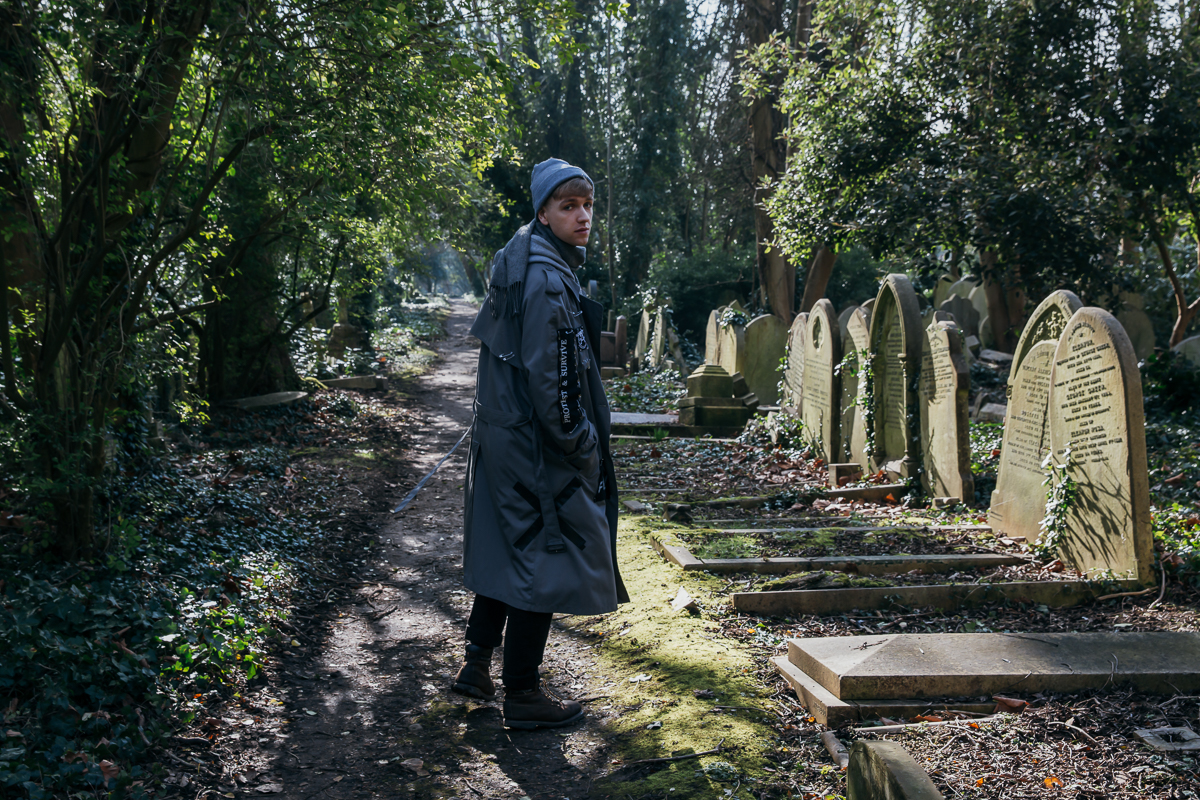
“Sometimes being around the ‘DJ world’ can be fucking terrible.”
If Classical Curves offered an ambiguous, almost fatalistic assessment of the bloodless rituals of consumerism, Dream A Garden marches out with banners raised, determined not to be co-opted by the dreaded realists. “The first album deals with the surface of the very oppressively capitalist, consumerist, high-tech culture we live in,” he tells me once we’ve found a pub with heating, “and I think there’s a danger sometimes that it can feel a little bit too complicit with that kind of world that [I’m] representing. It became really important to me, and necessary for me, to draw a line in the sand and be like, no, this isn’t really okay.”
Where his first album “skimmed along the surface and held a mirror up” to society, Dream A Garden “shouts something back”, he explains – but it’s not an escape. “We’re all complicit in it,” acknowledges Latham. “To play shows and tour for this record, that’s still part of a capitalist system. There’s nothing I can do in my life – well, there’s very little I can do in my life that isn’t contributing to that in some way. It’s the same with all of us. But I think it’s about trying to carve a space out, trying to dream something that isn’t colonised yet by all of that.
And as the gap between the haves and the have-nots grows to a chasm, even the music industry – long one of the twin ladders to money and prestige for talented working class kids, along with football – is becoming impenetrable.
“There’s a kind of disparity between the people that are involved in music who’ve grown up with money, and people who haven’t necessarily grown up with massively privileged backgrounds,” says Latham, who was brought up in the suburbs of south London. “I do feel that disparity is growing a little bit, in my limited experience, and I feel like we can all relate to the fact that there’s massive unfairness in the world. Things are really bad right now. They’re really bad, and it makes you feel a responsibility to say, hold on a second, this isn’t right – we need to remember who the enemy is. It’s the people with money, and it’s the people with power, and we need to start calling them out on it.”
Realising he would have to find those words for himself, Latham began to write poems to go along with the new tracks, eventually adding his own voice. “The lyrics go a long way to explaining what my stance is,” he points out. “That’s harder with instrumental stuff, obviously, so that was another reason why it gravitated towards having vocals. Although the lyrics are quite abstract – they’re poems effectively, so it’s not polemical in that sense.
“It was really not a conscious thing, but it was exactly the direction it needed to go, and I think the signs were there on the first record that this might be what happens next. There’s a lot of guitar on Classical Curves, but it’s just processed differently. When Alex [Sushon, aka Night Slugs boss Bok Bok] first heard it he was like, ‘ah obviously!’”
The retooled Jam City outed himself last October with ‘Unhappy’, a bold choice for the first taste of the album and one which polarised fans and critics alike, who variously panned it as “high-end neo trip hop”, drawing unfavourable comparisons with Jai Paul and Blood Orange, or praised its unexpectedly gooey textures and heart-on-sleeve emotional punch. Was he worried about exposing himself in this way, by projecting his voice into the world?
“Not really. I mean, if you make music and you sing songs, or even if you don’t sing, you’ve got to put yourself 100% into it emotionally. I wrote them and I sang them, so I can’t really go back. You may as well just go the whole way. So this is what these songs are about, they’re about struggling to love and be sensitive in a world that I don’t think really values those things, and trying not to be greedy in a world that values greed.”
Yet the words on Dream A Garden are often lost in the mix, obscured by his intricate palimpsest of textures and timbres. Instead he’s chosen to publish the lyrics in a separate booklet to accompany the album. Why hide the words if they’re so important?
“There’s a sonic choice,” says Latham. “I like things sounding buried, and the tracks are just overdubs on overdubs on overdubs, so there’s a lot of layers and textures in there. I like that the voice isn’t part of a hierarchy, the voice doesn’t sit on top and shout ‘you should feel like this’ or ‘you should do this’. I like that it’s ambiguous. But if you want to go further then the lyrics are right there in front of you. It’s quite nice to have that separation.”
Latham is hardly the first musician I’ve met who would describe his work as political, but the fact I considered putting scare quotes around the word ‘political’ just then perhaps points to just how difficult it is now, especially in electronic, typically non-vocal music, to go ahead and nail your colours to the mast. When rock dinosaurs complain that younger generations of musicians have nothing to say, or despair at our supposed apathy, it’s because they (shouting from their comfortably paid-off homes, of course) just cannot understand how distant the idea of change can seem from our perspective. It would be very difficult to make a political protest record today with the same earnest fervour as you hear on records from the ‘70s and ‘80s, I suggest to Latham.
“Yeah. And I don’t think it’s that people are asleep, as if we need to be woken up – everyone knows that we’re fucked.”
It’s what some people call capitalist realism, the feeling that it’s impossible to say or do anything that seems effective – but then you don’t need to have opinions, or speak up for the things you care about.
“Exactly, and it’s like, silence equals violence – if we’re not talking about this, then what’s going on? Who’s saying anything? When I was growing up I loved Nirvana, as I’m sure a lot of people did, and I was into punk and stuff like that – well, I still am. I grew up as someone who didn’t feel they could fit in anywhere, as I’m sure a lot of people have done as well, but I had a certain lifeline with the music I listened to that expressed solidarity with people who felt alienated by the culture that we live in.”
Was that through punk specifically, or other music too?
“Yeah, like Prince as well, everything contributed to it. And I guess if I was growing up now, if I was maybe eight or nine years younger, I wonder where I’d find that? I mean, maybe I’d find it in the same place, because I was too young when Nirvana were initially around, but these things get passed down.”
But we can’t just leave it to Nirvana to educate every generation of teenagers, fine idea though that may be.
“Exactly, we need new people and I just think, fuck it – if no one else is gonna talk about this and try to offer an alternative and say look, the culture we live in is incredibly violent and alienating and disrespectful to women and generates fear of others, then that isn’t right.” His voice broadens into a stronger Estuary accent as he becomes more impassioned. “And if you feel alienated by that, if you feel alienated by the world you live in and you don’t fit in, then you’re not the only one feeling like that, and there is another way – you’re allowed to imagine something different.”
Yet when people do try to make those statements, I suggest, often the more sincere they are, the more they’re disparaged by people who perhaps fear that kind of honesty and what it would demand from them – even by people who you’d think would share those views. It’s a strange fear of sincerity.
“Yeah, you’re right. The world, as a kind of coping mechanism to the shit we’re in, can turn very cynical, which I completely understand as a response – like, how else do you deal with this? But you don’t have to be cynical, you know. I think that’s important.”

“Things are really bad right now. It makes you feel a responsibility to say, hold on a second, this isn’t right.”
Watching Latham lurking among the gravestones during the photo shoot reminds me of the gothic mood that seems to pervade Dream A Garden; not in the musical sense a la Siouxsie or Bauhaus, but in the literary or even architectural sense: gloomy, sensual, oblique, decaying.
“The gothic to me is outside of what’s normal, it lives in the shadows,” he offers when I quiz him on it later. “I feel the world that we live in is very bright and overexposed, and I think as a way to cope with that I necessarily want to… there’s a certain mysteriousness. Dreams become more tangible in the darkness, in things that we associate with gothic. There’s a long history of anticapitalist critiques framed as gothic.”
The spectre of communism?
“Yeah, all that stuff.”
I’m pretty sure there are some vampires in Marx’s Capital too, I suggest. (Later I look it up and find that capital itself is described as “vampire-like” dead labour that “sucks living labour”.) The gothic mood of the record may be subtle, but there’s a sense of asymmetry to it that’s striking, especially in comparison to the “classical” order of the previous album. Slow-burners like ’Good Lads, Bad Lads’ and ‘Black Friday’ don’t have a clear centre; instead they swirl and eddy like a gathering storm, bleeding into each other.
“A lot of it was written as songs before being produced, but then the production gets very messy,” explains Latham. “I don’t really have a process, it’s hard to describe – just a lot of overdubbing and a lot of layers, and things begin to sound swollen and heavy and slow. It’s a really slow record.”
Classical Curves took its cues from the functional logic of the club, drawing particularly on the jackhammer rhythms of Jersey club and the spartan architecture of grime. On several occasions back then he told interviewers that he was aiming to become still more minimalist in his approach. What happened to that?
“Yeah, I got a bit bored of that! Been there, there’s not a lot there,” he laughs. “If you strip away all of it there is a song written underneath it all, but the layers and layers are almost building up this inertia to the world. That’s how it developed, in the studio. I’m not that technical, I don’t have a lot of equipment.”
The real stroke of genius hidden beneath the foggy layers of Dream A Garden is that there’s nothing truly haphazard about its construction. The album is “not a total break from the world of Classical Curves, but rather an inversion,” as he pointed out in a manifesto-like statement to accompany its announcement. In fact, it’s made from the very same software (Ableton) and limited equipment as its predecessor.
“It’s just the same samples I was using before but processed differently. It’s from exactly the same toolbox,” he explains. “I’ve been using the same little £50 audio interface for the last five years. It’s working with what I know rather than thinking, yeah, let’s get a £2000 synth in. I can’t really do any of that.”

“It’s about not being pessimistic anymore.”
He’ll launch the album with with two events in London in March, a night at Corsica Studios where Jam City and the Night Slugs crew will be joined by Berlin’s similarly freethinking Janus collective (a suitable antidote to the “oppressive masculine energy” of DJ culture), and a tiny solo show following his live debut at last year’s Unsound Festival in Poland. He’ll be alone on stage, accompanied by his guitar, laptop, and the vertebrae-quivering might of the sound system.
“The record is reformatted slightly for sound systems, so anything that feels a little bit murky on the record, or a little bit submerged, sounds quite hard hitting on the system,” he says. “But they’re the same songs, the same tempos. In my DJ sets I play a lot of 100bpm stuff, like rap and reggaeton and dancehall, and the record is roughly 100bpm too, so there’s a relationship between the two which you’re going to see more of.”
Before we end our conversation, I want to know if Dream A Garden is ultimately intended as an optimistic record. We’ve been talking about hopelessness and about being complicit in a system we feel we can’t fight, and on first impression the album seems to bear that out, with its track titles sighing ‘Crisis’, ‘Damage’, ‘Unhappy’. But underneath that there’s a sense of revelling in the idea of another world; a utopian longing that’s the total inverse of Classical Curves’ mechanised rationalism.
“I’m not saying what I’m doing on this record is powerful enough, or that the shout back is loud enough, but it’s a start,” he offers. “I think it’s a start to just reorientate your practice and what you want to sing about and what you want to talk about to something that’s a lot warmer, a lot more loving, a lot more sensitive.
“That is the break from [Classical Curves]. It’s about not being pessimistic anymore, trying to have some optimism, trying to dream something. It’s just a dream, because I don’t know what could happen after this, but it’s demanding the impossible – like, what if? And I think that’s really important sometimes, even if we don’t have the answers, to be like, yeah, but what if? Just dreaming something, imagining something that hasn’t been thought of before.”





![Ryoji Ikeda installation data-cosm [n°1] extended at 180 Studios until 1 February, 2026](https://www.factmag.com/wp-content/uploads/2025/12/data-cosm-ALubbock_180-14Oct-3554-250x155.webp)
![180 Studios presents new Ryoji Ikeda installation, data-cosm [n°1]](https://www.factmag.com/wp-content/uploads/2025/10/ryoji-ikeda-data-cosm-1-250x155.webp)