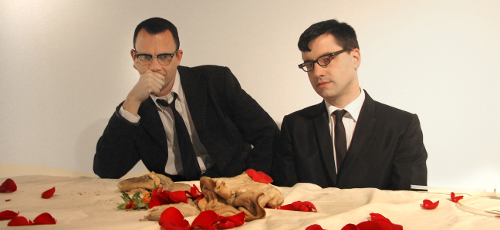
Matmos return next month with a new album, Supreme Balloon.
Renowned for their playful take on musique concrete and conceptual sampling, for this record the Baltimore-based duo ditched samples altogether and instead opted to use synths and synths alone. We called up Drew Daniel and M.C. Schmidt to find out what’s going on…
Is it fair to say that while you’ve moved away from the conceptual sampling of your previous records, Supreme Balloon is actually your most purely conceptual work yet?
Martin: We can’t get away from this thing, can we? [laughs]
Drew: Well no, it’s a good question, I think you’re right. I mean, even when we say we’re not using a concept and that we’re going to restrict ourselves to just once source, that is a concept, you know…
Why did you choose to make an all-synthesizer record?
Drew: I guess what we like is the way that you can seem very limited but in fact have a very wide open field; I mean, I think there’s an infinite number of all-synthesizer albums that we could have made…This one turned into an opportunity to revisit the sort of unfinished business of synthesizer novelty movements of the past, you know, the way that the Moog was a marketing tool, and to kind of wallow in a certain nostalgic pleasure-centre that we have from years of listening to Dick Hyman and Perrey & Kingsley and Wendy Carlos. I think it wasn’t…easy to make this record; but in ways I hadn’t predicted. When you don’t have a set of concepts to guide, it’s tricky, you know? It shouldn’t feel difficult, but it kind of was difficult…
Was making this record particularly difficult?
Martin: We certainly threw away more songs for this album than we ever have.
Drew: Yeah, with The Rose Has Teeth you knew that the song needed to fit a narrative structure, which was the life of whoever that song was about. And in this case it was just harder to know, ‘When am I done?’, ‘What am I going for?’, you know, ‘What feels right?’, especially because you can overdo the clutter so much with electronic means…
Part of it too was also that The Rose Has Teeth was so diverse from one song to the next, necessarily – because all the lives of those persons were so different. It resulted in an album that really had no through-line, and this time we wanted a record that really pulled you across, that flowed…
Were you keen to turn away from the crowdedness of The Rose Has Teeth and make a simpler record?
Martin: Definitely. My original idea was to make it very quickly; I wanted to put it out less than a year on the heels of The Rose Has Teeth – boy, that failed, but not because of the record so much but because –
Drew: – we moved to Baltimore.
It seems a more sensuous or expressive record than what I’ve come to expect from you…
I think the crux of stuff that we do, like The Rose Has Teeth, is so laden with association that I think people get bogged down with…thought. It’s not that I have the best distance to look at our stuff, but…
Thank you for saying it’s sensuous, but I would say that The Rose has Teeth was just as much that way, and that people got caught on the conceptual stuff, whereas synthesizers are so free of association…
I wouldn’t say that synthesizers are entirely free of association, though. It’s hard not to think of the synthesizer records of the 70s and 80s, a genuine but sometimes rather gauche pursuit of ‘futuristic’ sound. Are you not paying tribute to people like Klaus Schulze and Wendy Carlos just a little bit?
Drew: Yeah, definitely. I mean, we had in mind a set of records that had had a big impact on our aesthetics. I mean, when I first started going out with Martin he kept playing me these Klaus Schulze records and I was into techno and I kind of thought these Klaus Schulze records were embarrassing and tacky,
The sleeves certainly are…
Drew: I mean, now I can distinguish between good Klaus Schulze and bad Klaus Schulze, but I think returning to those eras and trying to do it that still feels valid and isn’t purely pastiche. You know, I don’t want to be like The Black Crowes are to The Rolling Stones…
Martin: Eurrrgh, God…
How’s your work-life balance these days?
Martin: Drew’s massively increased his “real” work…
Drew: Yeah, it’ s a little out of balance right now, I have to say. I’m trying to figure out a new way to do two things at once, and the more seriously you take both, the more aware you become of the sacrifices that you’re making. You know, we can’t spend as much time on tour as might be cool for us as improvisers, and I also have to be very careful about how much sleep I get because I’m also expected to be publishing and teaching at a high level in my position as a professor in the English department at Johns Hopkins. So it’s harder than ever to do both well, or to try to do both well, yeah…
Did you record Supreme Balloon before you moved to Baltimore and took up your post there?
Martin: Before we moved.
Drew: And then we mixed it and finalized it the first semester that I was teaching, and I got a sort of course relief from Hopkins ‘cos I explained that, hey, I have all this musical stuff that I need to finish. I mean, my students seem pretty curious about what I do; there was actually a hilarious article in the student newspaper , with the headline: “PROFESSOR DREW DANIEL REVEALS SECRET LIFE”. [laughs]
Do you feel that your “real” jobs merely offer relief from making music as Matmos or do you feel that they perhaps feed into or enrich it?
Martin: I’m not sure with this record that there’s too much association. Certainly in the past, Drew’s, well, actually, both our work – both his work on the Renaissance and my stuff in a sort of conceptual art department at an art school – I mean yeah, they definitely fold around each other. I’m not so sure with Supreme Balloon.
Drew: I think they’ve contributed to the longevity of Matmos as a band. I think if we were just a touring band and that’s it, we might have kind of burned out by now? You can afford to wait. You don’t have to tour every year. You don’t have to hustle if you don’t feel like it; if you want to take longer on a record, then you can. I mean, I think even people who are professional musicians couldn’t do that, the temptation to say yes to everything is always there. With us, we let like five years go by between shows in Chicago.
Martin: [laughs] NOT VERY PROFESSIONAL.
Drew: For a US band, that’s insane, you know?
Martin: I also suspect that some of our longevity comes from that fact that we, er, well, not to put too fine a point on it, I think most people end up – when they get a little older – having babies.
Drew: Yeah…
Martin, are you still working for the art school?
Martin: No, I’m a housewife now. I spend more time cooking than I spend making music…
Drew: Well, you make all the video art for Matmos too…
Martin: Yeah, I make a lot of video work. And I have one student here in Baltimore; he’s this kid who comes over, and boy, does he get a lot of education…[laughs]
Drew: Martin’s getting raunchy…[laughs]
What’s Baltimore like?
Drew: Free noise, free improv, instrument-building underground. A lot of warehouses and squats where kids do noise shows. So it’s been kind of a challenge for us; a reminder that maybe we’re actually pretty…poppy. Before we never felt like much of a pop band…
Martin: It’s definitely been a lesson; when we played our first show here I was like, yeah, we’re being NORMAL. Compared to the larger world, or whatever, the pop world, we’re reeeeal strange, but boy we’re not real strange here…
Drew: We like melodies and we like rhythms and basslines and we like things that are catchy, you know? I like to have really fucked up textures and really fucked up sources, and shape them into something that’s in dialogue with pop music. That’s important to me, and maybe not so important to people in Baltimore. It’s more inward-looking here.
To go back to the record…There were no microphones used for the recording; does that change the way you’re presenting and hearing music?
Drew: Yeah. Because sound is normally in a space, and when we record objects we don’t just get the object but we also get the space around it., the room around it; how close is the mic? How much texture is there? And everything in a stereo mix has to be put into a space. But when there’s no microphones, it’s all artificial and all synthetic, so you’re completely free to shape it however you want. And you can also kind of trick the reader by doing things to recreate –
Martin: Did you hear him say ‘the reader’?
Drew: [laughs] – to trick the listener into hearing unreal spaces. We used a little bit of this software where you can construct virtual objects and make them strike each other in different spaces; it’s made by this company Applied Acoustics, it’s called the Tassman, and it was was kind of a fun game to make things that sounded like a metal box, or sounded like a thump of wood, you know, but not real….
People talk about the tactile appeal of using synthesizers. Is that something which you felt?
Drew: Yeah, sure, with the Coupigny and ARP in particular…
Martin: Here’s the thing – I’m not the sampling guy in this band, and certainly part of wanting to do this record for me was, yes, to enjoy playing synthesizers. And it’s hard not to project into the future with that, like, “If we make this record, then I will get the chance to really show off my synth skills live, I look forward to touring on these things.” I was definitely thinking that… [laughs]
Drew: Synthesizer solos…[laughs] When we first got to play the Coupigny in Paris…It’s this amazing synthesizer with no way to shape the attack of the waveform, or the decay –
Martin: – it’s got no keyboard.
Drew: It has no keyboard, and it has no way to do the conventional shaping…Really, it’s like one of those hoses that’s used to control a riot, you know…You turn it on and it just goes wild, you know, and you can sort of direct the flow, but not completely…I love that feeling, you know?
You’re going to play some shows in support of this record. Are these going to be synth-based affairs?
Martin: We’re hoping. It’s hard for me…I’ve always believed in putting on a SHOW at our shows, and the sampling schtick has always fed very conveniently into that, so I don’t know…I use as my mental model for this the tape music shows of 50s, 60s and 70s where, you know, it’s enough just to sit comfortably and listen to recorded sound, or synthesized sound. It’s hard when we’ve been booking the tour: I’ve been saying to our poor, unfortunate agent, “is there a place where we can do it in the round? Or there could be pillows on the floor and we could play for six hours, that would be great!” And of course there aren’t any venues like that….
Drew: Well, we are going to play for six hours in London…we’re going to do a special improv set. I mean, that’s sorta what’s cool about playing a piece like the song ‘Supreme Balloon’ live – it’s demanding in a way that can make a lot of sense in a live setting, you know? The slow, endless build of something, the cumulative feeling that something gets more and more powerful the more you delay and stretch it out. And I think live is a quite way to experience this.
Martin: Yeah, there’s the ever-shortening attention span of our culture and, ha, we’re trying to be all like, “No, no, no, for this you need a really LONG attention span!” [laughs]
Drew: That’s what’s fun about the classic era of 70s electronic jams. It wasn’t about iTunes playing 30 seconds of a song and that’s your window of opportunity to judge the artwork…
Martin: You don’t get the idea of ‘Supreme Balloon’ by listening to the first 30 seconds…
Drew: No, not at all. It’s deliberate, to make something that’s crediting people with some intelligence and some patience.
Would you say there’s something particularly macho or boys-club about synthesizers?
Martin: I’ve always been fond of synthesizers because they’re not shaped like a cock.
Drew: Yeah, I mean, when I think of Pauline Oliveros or Delia Derbyshire or Laurie Spiegel, you know, it seems to me like the connection to the piano is maybe more relevant than a guitar model…Yeah, you’re right, there is a geeking out, build-your-own-synths thing that is mostly a male thing, or has been historically, but even that’s changing – somebody like Jessica Rylan, she builds all her own gear. So I feel like that culture is changing, you know…
And then you’ve got Wendy Carlos…that goes beyond normal gender binary…
You think the synths stimulated the change from ‘he’ to ‘she’?
Drew: It’s poetic, you know? It’s the about history – history…rhymes.
Your label, Vague Terrain, has been pretty quiet of late. How come?
Drew: The thing with Vague Terrain is that it’s…
Martin: …a vanity label. It was just a way, when we put out our first record, to keep people happy. When you put out your own record, distributors want to hear that there’s a label, so you kind of have to make up a name and an identity for it…
Drew: We’re not good enough businesspeople to take a risk with other people’s art. We would fuck it up.
Martin: Yeah, it’s just not the kind of work that either of us excel at doing. I would like to be the curator of a label, and not have to deal with the business.
Has being in Matmos changed the way you listen to other people’s music?
Drew: Yeah, I mean, there’s a greedy part of me that’s like “OK, what’s a good idea, what’s a move that formally I can learn from?”, or you know, “What’s a beautiful weird chord?” Like, I’m reading that The Rest Is Noise book by Alex Ross and he mentions the notes in chords in certain pieces and I’ve been checking them out in Ableton, you know, programming it in and just listening to it and figuring out why it affects me in the way that it does. But I feel that in the moment of actually making Matmos material, it has to just arise of its own…It has to have some kind of independent reason to exist. That sound like I’m mystifying it I know, but…
I don’t think being Matmos takes away any of the awe or wonder I feel at great music, and my admiration or envy for people when they’re really able to follow through on a great idea. Maybe we’re more aware of the labour involved in the process.
Martin: I certainly respect people more for bravery. We were listening to Stockhausen’s Sirius today, and I was like, “WOW. He is so brave and we are so cowardly.”
Kiran Sande






![Ryoji Ikeda installation data-cosm [n°1] extended at 180 Studios until 1 February, 2026](https://factmag-images.s3.amazonaws.com/wp-content/uploads/2025/12/data-cosm-ALubbock_180-14Oct-3554-250x155.webp)
![180 Studios presents new Ryoji Ikeda installation, data-cosm [n°1]](https://factmag-images.s3.amazonaws.com/wp-content/uploads/2025/10/ryoji-ikeda-data-cosm-1-250x155.webp)