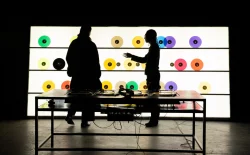
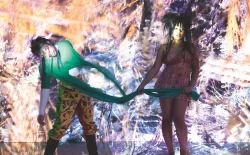
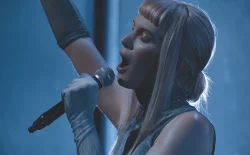
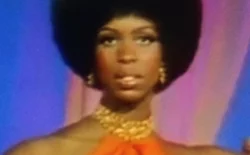
Zerkalo is the brainchild of Victoria Lukas (pictured), conceived in collaboration with Heinrich Mueller.
As many of you will know, Mueller is the assumed name of Gerald Donald, who along with the late James Stinson was responsible for singular Detroit electro outfit Drexciya, and its myriad pseudonymous ventures. Since Stinson’s death in 2001, Mueller, who is now Europe-based, has concentrated chiefly on the long-running Dopplereffekt (currently a duo with Michaela To-Nhan Bertel) and the more recently minted solo venture Arpanet, but last year reports began to surface of a number of new female-lead group projects bearing his signature: among them Zwischenwelt, Black Replica and Zerkalo.
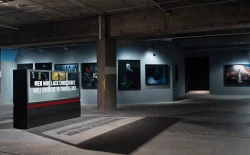
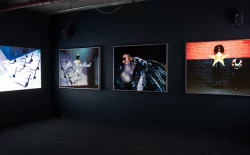
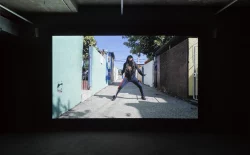
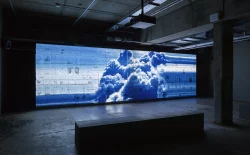
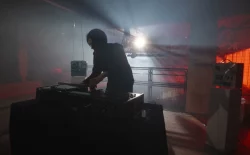
With a string of arresting live performances and three 12″s released through Clone Records – ‘Stoi Storoni Zerkala’ Pts. I and II on dedicated post-Drexciya imprint Aqualung, last month’s ‘Experiment Zero’ on Frustrated Funk – Zerkalo has been the most active and engaging of these groups. Drawing on Lukas’s and Mueller’s shared interests in science and Russian literature, and Lukas’s particular obsession with the work of Andrei Tarkovsky, Zerkalo’s music is rooted in electro – the austere synth and rhythm patterns of Mueller are unmistakeable – but gestures towards older and more self-consciously poetic traditions. Zerkalo’s visual identity is strongly pronounced, and particular in the live arena the work of filmmakers Julia Pello, Darlene Lin, Marie Athenais and Dorothée Smith combines with Lukas’s eldritch vocals and Mueller’s dry analogue textures to mesmerising, often disquieting effect.
FACT was lucky enough to speak to Victoria Lukas over e-mail recently about Zerkalo, her relationship with Heinrich Mueller, and her search for electronic music with “more warmth, more heart, more passion”.
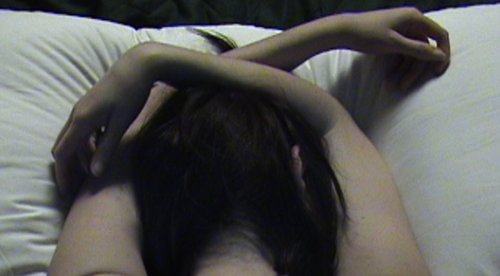
Who or what is Zerkalo? Tell me about the origins of the project…
“Zerkalo was originally the collaboration between two musicians: Heinrich Mueller and I, Victoria Lukas. The name of the group comes from the movie Mirror (Zerkalo in Russian), by Andrei Tarkovsky. The beauty of its meaning and the aesthetic of it has been a strong influence on our project.”
What has been inspiring and interesting you of late?
“I’ve been listening to some great artists, like Zwischenwelt and Black Replica, two projects which also involve Heinrich Mueller. I love Ultradyne’s new work, also Alek Stark, Nancy Fortune, Gomidas, Yan Wagner…
“Recently, I’ve also been obsessed with the Hungarian mathematician, Paul Erdos – his discoveries and his personality were both genius.”
“Heinrich Mueller has always influenced me, because he has an unique perception of music and sound.”
Tell us about the visual component of Zerkalo, and the work of Julia Pello and Darlene Lin. How did you come to collaborate with these artists, and what is the relationship between their visuals and your music?
“I worked with Julia Pello and Darlene Lin for a long time….It was really interesting and powerful but that cycle is over now and it’s time for a change. Actually, we are working with some new directors: Marie Athenais and Dorothée Smith. The visuals are an inherent part of the project, they give another dimension to our music and together they create a whole world.”

How did you first encounter the work of Heinrich Mueller? How would you describe his impact on your own artistic practice?
“The first time I encountered his work was in 1995 with Drexciya. Heinrich Mueller has always influenced me because he has an unique perception of music and sound. He’s always had the capacity to create something new and visionary.”
Early-mid 20th century Russian history and culture seems to inform your work very strongly…
“Yes, I’m very interested in Russian culture, literature and especially the work of the formalists. The essay by Victor Shklovsky Art as a device has had a huge impact on me. I love Russian poetry too. A few of my favorite Russian poets and writers: Anna Akhmatova, Marina Tsvetaeva, Velimir Khlebnikov, Yuri Tynianov, Boris Eichenbaum, Boulgakov, Dostoyevsky, Rozanov, Pushkin…”

As well as his influence on Zerkalo, I gather also that you’ve studied and written extensively on Tarkovsky. Can you tell me a bit more about your relationship to his work?
“I have a strong relationship to the work of Andrei Tarkovsky because we pursue the same direction artistically: ‘sculpting in time’, with faith.”
How important is performance to Zerkalo? Do you think of Zerkalo as performance art? What effect are you trying to create with your live shows?
“It’s always a performance to reinterpret the songs live. It requires a lot of strength to feel the original emotions again, which made me write the songs in the first place. The musical and visual aspect of it creates a sort of surreal theatre where everything is happening.”

“We don’t want to talk about robots, machines, aliens and all the common electro music subjects used since Kraftwerk. We want to talk about reality, the invisible world of poetry and science.”
There is a strong literary sensibility to Zerkalo; your work is dense with allusions to the likes of Nietzsche, Tsvetaeva, Woolf, Spinoza…
“Heinrich Mueller and I share the same interests in literature, philosophy and science, it’s normal that these studies influence our work. We don’t want to talk about robots, machines, aliens and all the common electro music subjects used since Kraftwerk. We want to talk about reality, the invisible world of poetry and science.”
Can you tell me about your Vita project?
“With Vita I express a very intimate and experimental music with absolutely no boundaries. It’s like walking through my mind…”

Would you describe your work as poetical? Do you feel there’s a dearth of poeticism/lyricism in most electronic music?
“Yes my work is poetical, definitely, and I would like to hear more lyricism in electronic music, more warmth, more heart, more passion.”
What next for Zerkalo?
“We are finishing a new maxi called ‘In Extendo’.”
Kiran Sande
More from News



![Ryoji Ikeda installation data-cosm [n°1] extended at 180 Studios until 1 February, 2026](https://www.factmag.com/wp-content/uploads/2025/12/data-cosm-ALubbock_180-14Oct-3554-250x155.webp)
![180 Studios presents new Ryoji Ikeda installation, data-cosm [n°1]](https://www.factmag.com/wp-content/uploads/2025/10/ryoji-ikeda-data-cosm-1-250x155.webp)