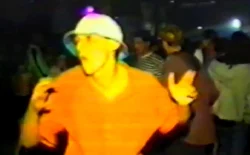
MMM make rave music that’s exuberant, delirious, crazed. But what’s so remarkable about their tracks is how damned tense they are. Theirs is the sound of contained chaos, potential energy, internal combustion – even at their most explosive you feel like you’re only experiencing the half of it.
The duo of Erik Wiegand and Michael ‘Fiedel’ Fiedler have been collaborating as MMM since 1996. Their first self-released 12″, MMM 1, established their unique aesthetic from the off: a collision of techno, disco, hardcore, house and electro that paid loving but irreverent tribute to great music of the past – reference without deference, if you will. In 1997 came ‘Donna’: mastered by Monolake’s Robert Henke, this lysergic electro-techno monster became an underground smash, and thirteen years later its off-beat arrangement, screaming acid lines and air-locked drums have lost none of their mind-mincing, club-razing power. Just thinking about it makes my palms itch.
With a sense of restraint and quality-control that many techno producers would do well to imitate, Fiedel and Erik proceeded to take an extended break from the MMM project. Erik made a name for himself for his solo work as Errorsmith, building custom synths and making jagged, loop-based works equally valid in the contexts of rave and sound-art, and collaborating with like-minded Frank Timm (AKA Soundhack / Sound Stream) on more disco-influenced work as Smith N Hack. Fiedel – who cites early electro-anchored hip-hop (particularly Mantronix, Ice-T, 2 Live Crew, Egyptian Lover), acid house, and Berlin’s Hard Wax store as his three key formative influences – threw himself back into DJing. An esteemed name on the Berlin scene since the mid-90s, these days he holds down a residency at Berghain.
It would be a whopping 11 years before the next MMM release – 2008’s 10th Anniversary EP, a split with Soundhack. The jaunty melody of lead track ‘Touch & Go’ evidenced Fiedel’s enduring love of hi-NRG, while the brilliant synth-wave-gone-mad of ‘Casiotone (From The Vaults)’ might just be the most demure and addictive jam in the MMM canon. It seemed to safe to assume that the next tranmission from Erik and Fiedel would drop some time around 2020, but then the duo surprised us at the beginning of this year by releasing the massive MMM4. Leading with the utterly bombastic ‘Nous Sommes MMM’, the 12″ has acted a timely reminder of MMM’s place at the top-table of Berlin dancefloor technicians – it’s an unashamed banger, but one rendered with such conviction, acuity and disregard for (or, perhaps more accurately, amplification of) conventional narrative logic that it can be seen as a kind of surrealist rave art-piece. You can hear it in Fiedel’s new and exclusive FACT mix, which also features a track from the forthcoming MMM5. Oh yes, these lads are hitting their stride now.
FACT was able to get hold of Erik and Fiedel for a rare joint interview, conducted via e-mail. Fittingly enough, they chose to answer questions as a single entity, occasionally chipping in with an individual opinion. As well as telling us what ‘MMM’ actually stands for, they explain their motivations and methodologies, and the importance of that “raw, imperfect quality” in their music.
How did the two of you first meet, and how did MMM begin? Did the idea of MMM exist before the music…?
MMM: “We met in the year 1995 through a mutual friend, the late DJ Niplz AKA Rufus. Erik was already making music, experimenting with self-made and modified sound devices. Fiedel was DJing and from there came the great idea to work on music together and release it on vinyl. We had the feeling that our music wouldn’t fit on an existing label and we were adventurous enough to do it on our own. We were fortunate that Hard Wax supported us from the beginning.
“Music-wise we didn’t have a plan, we just tried to find our own twist on styles that we liked: electro, techno, house, disco…”
Can you tell us where the name MMM came from? What about the logo and design?
MMM: “MMM stands for ‘Messe der Meister von Morgen’, an ‘exhibition or trade fair of the masters of tomorrow’. This was the name of a youth science competition in the GDR intended to animate pupils and young workers to do research and make inventions to forward the economy and strenghten society. We liked the absurd name as well as their artwork – the kind of stamps, logos and certificates that you would get for your inventions (like Fiedel did!). So we picked up their name and design.”
Erik, how does your work in MMM differ or relate to your work as Errorsmith and in Smith n Hack?
Erik: “For Errorsmith, my solo project, building synthesizers is an integral part of music-making. I develop and customize them while working on tracks. In collaborations this side of me is more in the background, as it would bore my colleagues to death if I spent our precious studio time programming synthesizer details…So [in Smith N Hack and MMM] we mostly use commonly available tools for production. But I also contribute some sounds that I developed on my own – like this classic ‘mentasm’ or ‘hoover’ sound that I recreated and which you can hear in ‘Nous Sommes MMM’.
“The differences between the projects simply come from the different combinations of individuals as they have their own tastes and preferences. So it feels very natural to make more disco-influenced music as Smith N Hack, and to have a strong affinity with rave as MMM.
“The similarities between the projects are that we work slowly! We take time to really finish a track in the hope that at the end it will good enough to stand the test of time. I think another similarity is that our tracks have an openness to them: I mean, although you can put our tracks in genre boxes, at the same time they defy that, because they have many different references.”
The MMM sound aesthetic is a very particular one – your tracks are instantly recognisable. When you’re making music as MMM, do you enter the studio with a special mindset or methodology that you stick to?
MMM: “It’s not that we have the big picture in front of us in the beginning. We start with a small idea, then we develop this idea until the end. In each step the track reveals some path options that we can take or not take. It’s like the track itself guides us through the process.”
“To give you an example: The ‘Nous Sommes MMM’ track was born with us reprogramming this nice brass hit sequence in Cerrone’s ‘Je Suis Musique’, and using the aforementioned mentasm synth as a sound source. But we altered the sequence so much that it only has remote resemblance with the original.
“When structuring a track we often have a jam approach: we are turning knobs to modulate some synthesizers, transposing the pitch of a sequence on the fly, switching between variations of a pattern, and so on. We record these parameter changes to get a first arrangement. Then we develop the track by editing, adding more sounds, finding a nice intro and outro, et cetera.”
MMM seems to take the tropes of rave, and to exaggerate or intensify them to the point of abstraction. Do you think of MMM conceptually, or is it more intuitive than that?
MMM: “No, there is no concept. The sound of MMM is the result of our working method. We like to restrict ourselves to only a few ideas or elements in a track and find ways to get the most out of these. Exaggerating and intensifying are good words to describe it. Plus we like to achieve a kind of raw, imperfect quality.
“Isn’t club music always loop-oriented? The art is to keep a loop interesting!”
What equipment do you build your tracks on? Or is that a secret?
MMM: “Nowadays we produce only on the computer. We use Ableton Live as sequencer. NI Reaktor and Massive are some of our favorite plug-ins.”
The art of looping seems to be such a huge part of what you do, not only as MMM and Errorsmith, but also Smith N Hack and Frank Timm’s work as Sound Stream and Sound Hack. Where does this interest in loops stem from…?
MMM: “Isn’t club music always loop-oriented? Loops go well with dancing. The art is to keep a loop interesting!”
Fiedel, your recent DJ sets and mixes show you have a real interest in so-called UK funky and post-dubstep rave and garage stuff. What attracts you to these sounds?
Fiedel: “Basically, I just like to play tracks that move me and hope to share this with the audience. Those tracks have that certain force to move me. It’s their special kind of funkiness, restlessness, the unpredictability, the breaks, the basslines, the energy they create. Plus I like the fact that they combine different styles or even stand between the styles, so I can mix it with techno or house. In my DJ sets I really like variations in sounds and styles – depending on the party I play.”
“Our new material points in a similar direction with a fast and funky groove and lot of low-end – as you can hear in track 5 of my FACT Mix. We were asked if this track was UK funky when we played it for the first time last year, but back then we hardly knew that such a style even existed. These beats refer also to dancehall, soca, and kuduro for instance. Its a great time when genre boundaries disintegrate!”
‘Donna’ was obviously a massive tune for you guys, and is now a certified classic. Tell me about its origins…
MMM: “This track is inspired by Donna Summer’s ‘Our Love’, a classic Giorgio Moroder production. It has this great acid synth line at the end. We tried to come up with something similar but a with a rougher sound. We used analogue sequencers to get this kind of meandering melody, and jammed this track together. One of us was tweaking this screaming Korg MS 20 filter while the other was muting and unmuting tracks. Then we cut up the audio recording of that jam, slicing the best parts together.”
What about the live incarnation of MMM? How does MMM studio feed into MMM live, and vice versa?
MMM: “Just as we jam in the studio, we jam in our live set. We use the same set-up. Rather than preparing whole audio tracks and just pay those back, we prepare a tool that we can jam. We have some beat and melody variations that we can step through manually, modulate synthesizer and effects, and we can play along with additional sound. If we didn’t do any of this you would only a hear a static loop or beat.
“We are constantly developing our live set. Adding new tracks to it in their earliest stages so that we can try them out. In a live set it is often OK – and sometimes better – if the tracks are not so elaborated but still a bit rough.
“We always record our shows. Sometimes for studio versions we take a good live version as orientation and reproduce it in order to preserve this particular moment we had during the live set. This influence of club atmosphere and the reaction of the crowd is missing in a studio situation.”
MMM releases aren’t very frequent – only three 12″s in the last thirteen years! Is this deliberate? Are you sitting on a lot of unreleased material?
MMM: “It’s four releases if you add the Anniversary EP with Soundhack! Agreed, we’re not the fastest but we are working on it! We already have a bunch of new tracks in our live set awaiting release…”
What’s next for MMM?
MMM: “MMM5!”




![Ryoji Ikeda installation data-cosm [n°1] extended at 180 Studios until 1 February, 2026](https://factmag-images.s3.amazonaws.com/wp-content/uploads/2025/12/data-cosm-ALubbock_180-14Oct-3554-250x155.webp)
![180 Studios presents new Ryoji Ikeda installation, data-cosm [n°1]](https://factmag-images.s3.amazonaws.com/wp-content/uploads/2025/10/ryoji-ikeda-data-cosm-1-250x155.webp)